
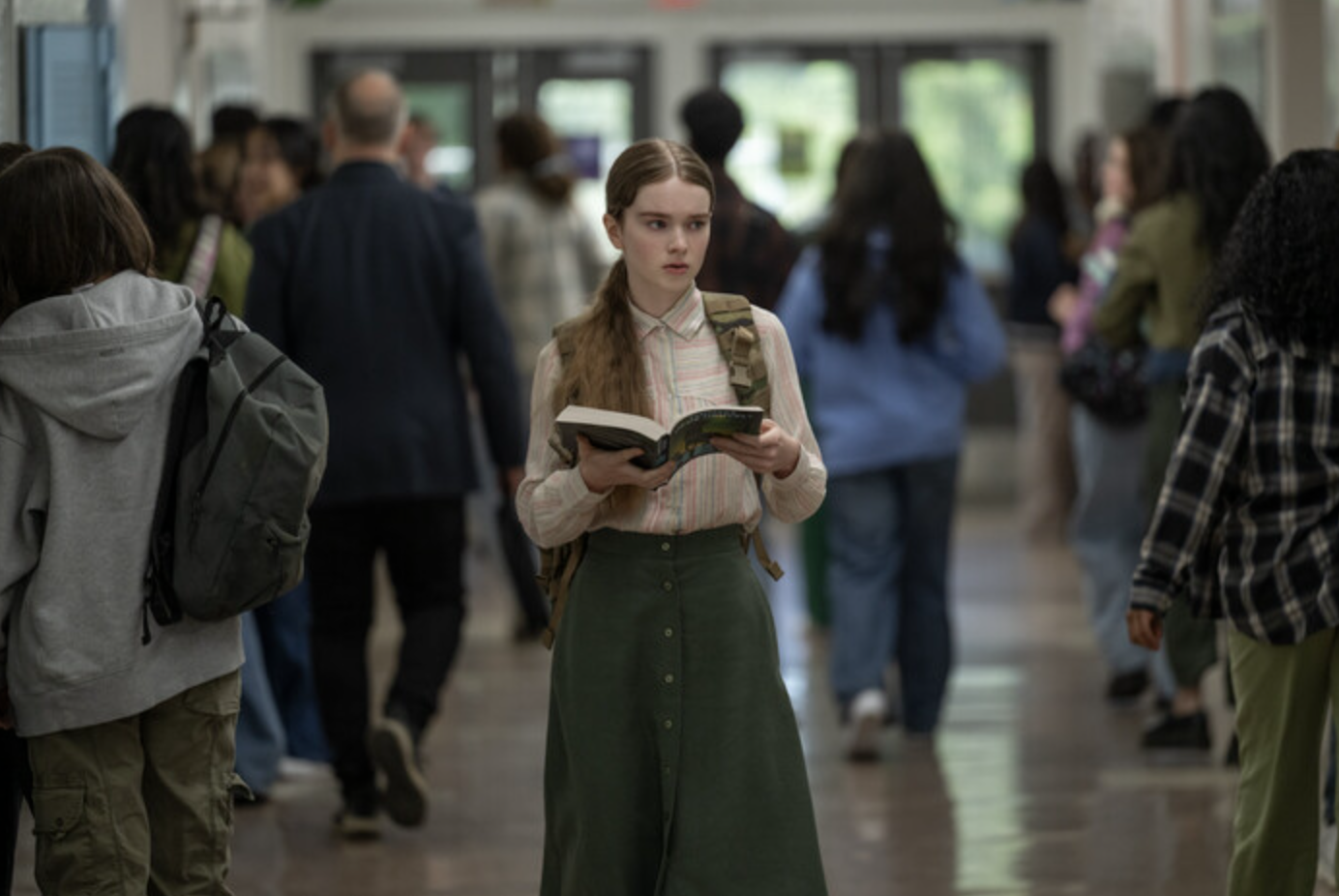
Big confession: I have not read or watched any other version of Carrie. I know the plot and ending through just cultural osmosis, but that is it. The show itself knows we all know the ending so much so that it starts with us seeing the school on fire with people trying to figure out what happened in the aftermath. So any major character or plot changes Mike Flanagan has made I am not aware of. What is clear is that updating the story to the present day is showing how camera phones, memes, and Instagram are now a huge part of not just school bullying, but can have larger consequences we cannot predict. Even with detailed character work and rising tension built beautifully, the deeper mythology of Flanagan’s new version of Carrie is undercut by the season’s end.
As a general overview, fifteen year old Carrie’s (Summer H. Howell) father dies in an on the job accident. She and mother Margaret White (Samantha Sloyan) are discovered by the state. Her dad and mom are religious as well as conspiracy theorists so have hid that Carrie even existed. Margaret now needs to show she can hold down a job so Carrie needs to go to public school instead of being homeschooled. The main people she interacts with at a school are seniors Sue Snell (Siena Agudong) and Chris Hargensen (Alison Thorton) in her homeroom class with Miss Desjardin (Amber Midthunder). Later she meets Emaline (Thalia Dudek), who acts as a friend to Carrie, but we sense has an agenda. Then on top of all that Carrie is slowly figuring out that she has telekinetic powers
Summer H. Howell does a masterful job of capturing the innocence and wonder of Carrie. While missing her father, she is excited to experience more of the world and is incredibly trusting and genuinely nice to everyone. But her naivete and lack of social knowledge leave her open to bullying. She is never a pushover or weak, but there are traumatic incidents that happen and we see her deal with it. In many cases her genuine niceness and wanting things to be less stressful cause her to try to be the mature one in the situation. Yet we do see the pressure building in her and when she does use her powers, it feels like an emotional teenager lashing out. Carrie’s bullying from students and her mother are well known and are still shown for the terrible trauma that it is. But we are given a lot more context for it.
Margaret White, while being very controlling and wanting to shelter Carrie from the world, does come from a place of her version of love. When Carrie breaks rules she does abusive things like put Carrie in a closet to pray for penance. But then there are moments she is truly there for her daughter. Carrie comes home late and Margaret has every right as any parent to be angry. But Carrie comes in crying, saying the kids are as mean as Margaret said they would be. Margaret does not gloat, condemn, or even feel victorious. Her first and only reaction is someone hurt my daughter and I am going to comfort her and promise her we will make this right. Mike Flanagan said he wrote the role with Samantha Sloyan in mind and I can see why. She captures the wealth of contradictions Margaret has, from her pettiness and disdain for the people she has to deal with to the pain of losing her husband, and the genuine fear she has for Carrie being traumatized. There is also her competency in how she advocates for Carrie while becoming blinded by her own righteousness.

This same detail is given to Carrie’s main bully, Chris. Chris is such a bitch but she also has a lot of fear in her life. Her parents are breaking up, and her mom is now living with another man who has his own teenage daughter in Chris’s class. Her dad is having some sort of work issue so money is tight and so she can’t get into Duke where her best friend Sue is going. Chris’s anger and fear are understandable. Even as she lashes out, both in person and later with an anonymous Instagram page, Chris seems to know her actions are self-destructive and will end badly for her, but she feels so powerless this has become her outlet. Alison gives her such vulnerability and humanity for a character we usually just hate naturally. Her ability to go between stuck up queen bee, to genuinely scared young woman, to really bad teenage acting where you know she is lying, was incredibly impressive.
This combination of characters creates a huge issue at the school and we get to see the toll it is taking. Miss Desjardin wants to help but has her own issues about being a teacher and navigating a new relationship with a fellow teacher who is being bullied by the anonymous Instagram account. Principal Henry Grayle (Matthew Lillard) dealing with Margaret, trying to explain the way things work in the school, and how even with suspecting who the online bully is, needing evidence. I want to give special praise to the performance and the way Peter Morton (Tim Bagle), the guidance counselor, is written. We see his empathy with Carrie, sharing quotes from books, and doing simple things like just listening to her, and then showing her the school library, giving Carrie a sense of hope and discovery after the bad few days she has had. Even when he is dealing with Chris and her arrogance, he still tries to politely explain why he cannot help her get into Duke, but what her options are in the meantime. He can vent with the other teachers as well (giving some good zingers), but he was able to show that there was someone who really was just trying to do a good job for his students.
In fact, we see all of them trying, and sometimes they are great and sometimes they screw up. It might seem like this is just extra detail but it really adds to the feeling of what not only this school is going through but what all schools are having to grapple with. It really added layers, and lends itself to other forms of tragedy.
With all the high emotion and building tension, I needed to pause mid-episode at times (I know, bad TV watching), and after one episode I needed a break. For those worried that things are stretched out for such a short story, Flanagan and his team keep this tension and character beats growing till the inevitable. But when we got there some issues started to emerge.
The show very much wants us to know that Carrie isn’t the only one with powers in the world. Each episode has stories of women with powers in history and the world not understanding them or dismissing them. Then there is Sue, mentioning at the end of episode one that there were others at the dance beyond Carrie. There is Emaline, who we know is interested in Carrie’s powers, and seems to know a lot about them and wants her to use them more. Originally this seemed to be some additional tension going into the finale. Instead what it ends up doing is adding things that didn’t need to be there and and, even worse, actively took away from some of the deeper moments. It felt more like setting up new lore for something later that was a lot less interesting than everything we saw before it.
It feels weird to be so full of praise for so much of what this show did with its acting and tension building, just to have the finale knock so much of the wind from me, but there it is. The set-up was fantastic, and there are some actors here I hope I get to see more from. The journey, I think, is still worth it, touching on some real issues of bullying and how a community deals with it. Ironically, it may have been better off not seeing what happened after the pigs’ blood was dumped on Carrie.
Carrie debuts on Prime Video on October 7.