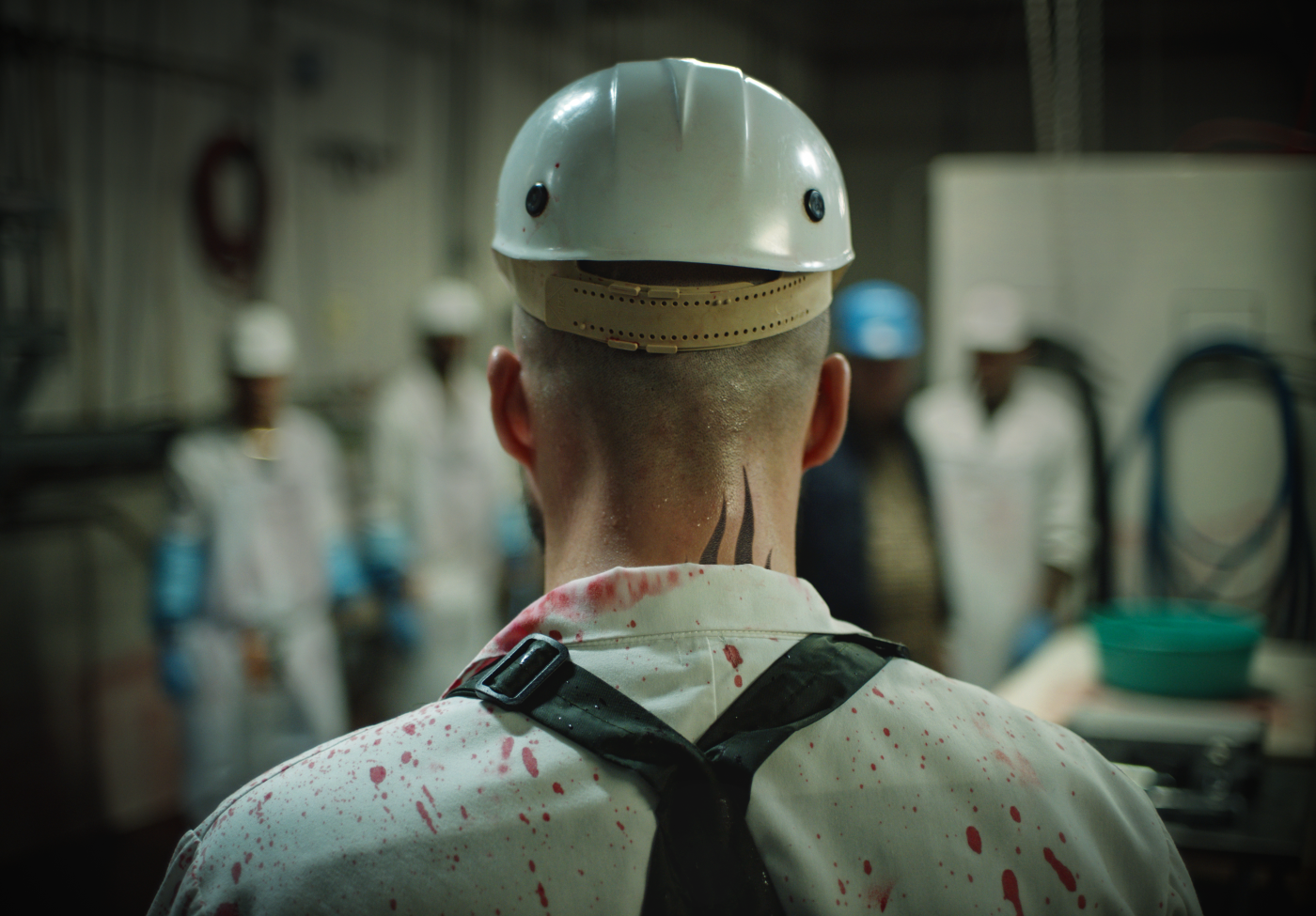
You are trapped in a slaughterhouse in Pier-Philippe Chevigny’s claustrophobic drama, Mercenaire. I couldn’t help but think that none of the men employed here would show you sympathy as they toil away, and maybe they could keep to themselves because they would be afraid of what you think about them. Chevigny’s film is steeped in death, the sounds ringing in your ears as we all try to get to the end of a shift. As one man tries to suppress his anger and frustration, you cannot help but be lulled into the compelling drama.
At the center of Chevigny’s film is David, played by Marc-André Grondin. He brings an unnerving stoicism to a man who is trying to forget that he just got out of prison from an unspecified violent offense. Keep your head down. Punch in, and punch out. Don’t let anyone get to you. Could it be possible that David is scared of himself?
“I think he knows himelf better than anyone else in there, because my idea was inspired by childhood friends of mine who had done crimes in the past and ended up doing prison time,” Chevigny says. “They weren’t bad guys, and what’s kind of what the point of the film is. Because you go to prison doesn’t make you fundamentally evil or even that you’re a bad person. I think David knows that. If he is in a bad situation, though, he will definitely defend himself.”
Chevigny speaks about how numerous systems fail those who don’t have the means to claw their way out of dangerous or troublesome situations. One act shouldn’t define the rest of your life.
“If you grew up poor with no opportunity in your life, there is a chance that you’ll end up doing some stupid stuff, and that was a main idea behind this,” he says. “I wanted to show how you can be defined by your environment, and it can be very hard to grow out of it. Unless you get the chance, with education or you move out of your city and meet new people, it’s very hard to grow out of that.”
David’s presence at the slaughterhouse isn’t by accident. When he got out of prison, he was placed here as part of a rehabilitation program, but you can feel how anxious he is. He doesn’t speak to the men he works with–in fact, he hardly speaks at all. We see him engage the most when he speaks to a counselor familiar with his situation, and he might be requesting a new post in an effort to gain more control of his life. When you don’t have a say in the actions or surroundings of your everyday, it’s natural to shut down. We follow David with the camera close behind him.
 “He knows that he doesn’t belong,” Chevigny says. “When you’re an outsider, you don’t belong in your social environment, and you’re not going to be the first one to crack jokes. You’re going to keep to yourself, or you just might be quiet. Also, to some extent, it’s sort of a static choice to not show the emotion or to refrain from going into melodrama. I don’t show you his face, because he’s a depressed guy while the human fan can be very, very expressive. I wanted to make sure that even though the film was very intense, we wouldn’t slide into that kind of melodrama. You would never see David cry or see how things are totally getting to him. It was an idea of backing off a little bit and not forcing us to feel for him. I wanted everyone to be present for him, but shooting him from behind is similar to when you follow someone for moral support. They can be right there beside you.”
As we look at the back of David’s head or his entire body, our eyes might be drawn to the tattoo peeking out from the top of his collar on the back of his neck. We are drawn to it as it hints to a time in his past, but seeing just the edge of it intrigues us. Theses two lines almost look like the tips of fingers reaching out to keep a hold on him.
“That was about things that are hidden,” he says. “He’s hiding something from his past where there’s not a specific, natural meaning. It’s not associated with anything specific or with a specific group. It’s just to show that he’s probably been part of gangs or with other people. SInce I was shooting it from the back of his head, I needed something very pragmatic but something to focus on. A lot of people who come out of prison will have tattoos, and they may have to hide it when they go on job interviews–that’s pretty common.”
Chevigny’s film cannot avoid the violence that takes place inside of it. You can almost smell the activities from one room to another, but the director never hones in on any of the actions themselves. Sometimes the workers splash water on the floors to rinse them, and we worry that the residue is stuck on the bottom of our shoes. We hear plenty, though, as an animal’s confusion gives way to fear and alarm. It’s inescapable, and it’s burrowing into David’s psyche.
“All of the visual choices were born out of ethical reflection of showing you as little of the slaughterhouse as I could,” he says. “So that meant this aspect ratio, one by one, really focused on the character. You forget about the backround–it’s mostly out of focus in the back. I never wanted to show the animals being killed, and if there was going to be blood, we wouldn’t focus on it. Since a lot of the action takes place off screen, the sound is the only way we can build this world and make it feel very alive. I wanted it to be as immersive as possible. The ratio traps the character inside the frame, but it also traps you. This is a film very much about a man who realizes that while he’s no longer in prison, he’s still trapped. You needed to feel trapped as well.”