Paul Thomas Anderson’s One Battle After Another is an accomplished film, not a great one, because it lacks true grit.
Periods of domestic turmoil like the 1970s invariably lead to angst in American cinema. Our current decade, with its prevailing unease, mirrors that era of history in at least one way: there are piles and piles of societal worry to exorcise on the big screen and many filmmakers are attempting to do so. One of them is Paul Thomas Anderson, who with his latest film, One Battle After Another, joins perhaps a dozen other 2025 movies that purport to have something to say about this cultural moment. But I am dubious that this movie and others like it will be understood by later generations as telling timeless tales existing outside of their own times. This good but unsatisfying film is more likely to be seen as living well within the suffocating confines of its time—reflecting parallel anxieties of intergenerational adequacy and intracultural acceptance, resulting in a tentative total product.
PTA wrote, produced, and directed One Battle After Another as a black comedy, action crime thriller. The story is based very loosely on the 1990 book Vineland by the great American novelist Thomas Pynchon, a master of complex themes and commentary. (PTA previously adapted another one of his works, Inherent Vice.)
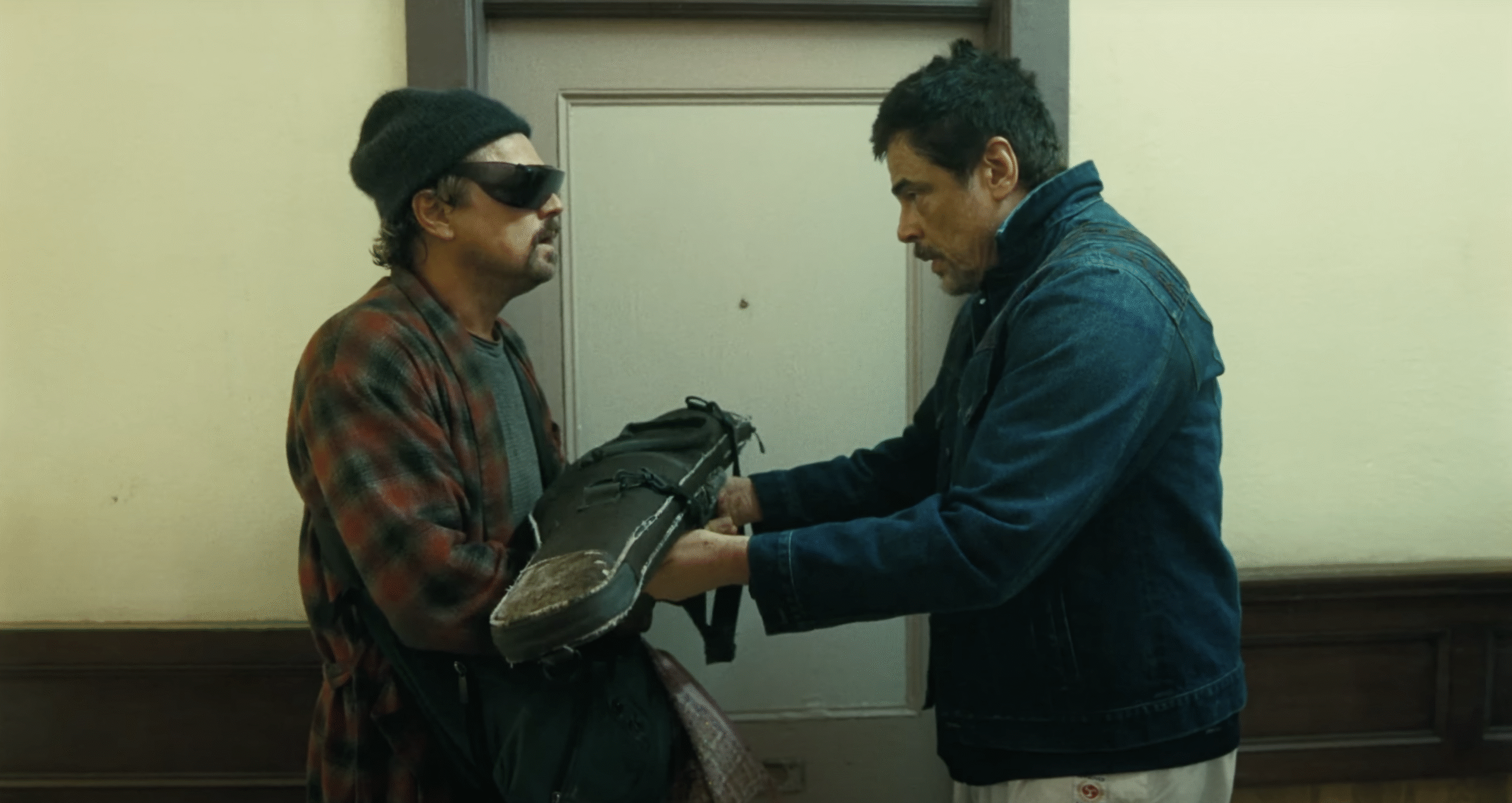
This version of the story revolves mostly around a former militant named Bob Ferguson, played by Leonardo DiCaprio, and his daughter Willa, Chase Infiniti in her film debut. The two are accosted by a longtime family enemy, the veiny, red-in-the-face Col. Steven J. Lockjaw—Sean Penn in a brutally committed, Oscar-worthy role. When the film opens, Bob is part of a revolutionary group called French 75, which is led by the mercurial demagogue Perfidia Beverly Hills, the brilliant Teyana Taylor, as well as Deandra (Regina Hall). In the first few scenes, Perfidia has a chance encounter with Lockjaw that intertwines their destiny and provides the film’s central conflict. Benicio del Toro appears later as an immigrant coyote who aids Bob and Willa when Lockjaw returns to clean up the past.
One Battle After Another announces itself loudly and assuredly from the first few frames, proceeding at a brisk, determined pace that is punctuated by Jonny Greenwood’s equally resolute score—thumping when it has to be, but eerie and gritty when it must. A particular tech trick that recurs is coordinating the sudden cutting of a scene, through the hands of editor Andy Jurgensen, with the equally abrupt ending of Greenwood’s score. This keeps viewers properly off balance and the action moving along in a no-nonsense matter. It is a brilliant juxtaposition with the campy, sardonic overtones of the film, which persist just like the stimulating editing thus. Cinematographer Robert Elswit’s sharp, dynamic visuals reinforce the film’s frenetic energy, lending even the quieter moments a sense of impending chaos, and merging with the brilliant editing to create a mesmerizing third-act car chase sequence.
There is no question that PTA is a technical master of this craft, and that One Battle After Another is immensely creative and inventive when it comes to finding new styles of storytelling. But a movie that has such lofty technical ambitions surely has equally grand aspirations for its story, too. And this is obviously true of PTA’s script. Yet it is also, unfortunately, where the film stumbles the most.
In the opening sequence, Perfidia and her band of merry revolutionaries are a well-oiled militia that robs banks, bombs courts, and foils racist, odious and oppressive members of the establishment. Of course, satirizing militant groups that adopt extreme positions is a common cinematic trick in times of domestic turmoil—just ask Paddy Chayefsky and the members of the Ecumenical Liberation Army, in Lumet’s 1976 masterpiece Network. The point is obvious: extreme groups are sort of a joke and can veer unsympathetic even if some of their ideals are appealing to the director and his core audience.
Their natural enemies, the despotic overlords that control society, are unmistakably a joke as well. In this film, they are represented by a trio of aging white men who are overtly racist and obsessed with racial purity. They form a preposterous group, meant to emulate dozens that have existed throughout history, that takes its name after Christmas carols, and that is posited to secretly control most levers of society.
But, so what? Network had a clear point—greedy, media-types would exploit the ridiculousness of both groups, as well as the incessant appetite of sullen audiences for smutty content, for their own profit, sinking us further into an abyss of our own making. One Battle After Another, at most, suggests that revolutionary struggles are hard, futile, and endless. It is, at its core, terrified of crossing one of the many live wires that are smothering all artistic life out of entertainment. It does not even dare to offer anything insightful or groundbreaking, let alone revolutionary. Instead, it asphyxiates under the weight of the very societal restrictions it purports to superficially decry.
Not every movie has to have something transcendental to say about the world, of course. It is just that this film so clearly sets out to board the topics of today with an air of confidence and even cockiness, that it naturally sets up and later betrays that expectation. The best thing that can be said about the story’s power is that it very cleverly tells you that our current conflicts are timely. The opening sequence involves a migrant camp, unjust detention, and over-militarized conflicts. All of us would naturally assume the setting is 2025, and PTA tricking you into thinking this is the one message the film can effectively deliver about political fretfulness—it has been around and will continue to.
That concept—that struggle is continuous and intergenerational—evokes the film’s story’s most touching, and most effective message, the one that reminds the viewer of the other repeated worry of the modern, aging American filmmaker. As PTA and those of his generation begin to enter the last stages of middle age and their children grow, they are clearly very anxious about intergenerational sufficiency. “Were we good parents to our children?” they ask repeatedly—as Noah Bambach did in this year’s Jay Kelly. “Did we protect them enough?” “Did we teach them the tools to carry on our struggle, since we have failed at it?” While this message is delivered far, far too late into One Battle After Another’s two-hour and forty-minute runtime, it arrives with a surprising and powerful force that further justifies the otherwise highly entertaining but mostly undaring movie that preceded it.
Beyond the story, Anderson’s direction and his talented cast and crew ensure that the film remains compulsively watchable, even when the script falters. The cast delivers standout performances across the board, with DiCaprio and Infiniti developing a believable, fraught rapport as father and daughter, and Penn’s Lockjaw providing a menacing yet darkly comic presence.
What ultimately holds One Battle After Another back from greatness is its own reluctance to fully engage with the messiness it depicts. While the film is visually bold and occasionally wickedly funny, its script often pulls punches when it comes to offering real narrative or ideological risk. There are moments when Anderson is on the verge of a profound statement about the endless cycles of conflict—both personal and societal—only to retreat safely into ambiguity rather than dare offer provocative resolution. This hesitance will be remembered not for its brilliance, but because of the tragic, stifling environment in which the film was created.
The silver lining of darkened moments in history are sometimes found in inspiring morsels of art that allow us to escape and also expiate our suffering, while connecting to other generations in that joint misery. If that moment is to arrive to accompany the darker moments of this part of the 21st Century, American Cinema has yet to deliver it.
Grade: B
One Battle After Anotherskipped all the film festivals but will be released in the United States on September 26, 2025, by Warner Bros. Pictures.