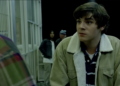
Introducing her absorbing feature debut, La Gradiva, at this year’s New York Film Festival, cinematographer-turned-writer/director Marine Atlan quoted the great German filmmaker Rainer Werner Fassbinder emotionally stating, “I put my blood and tears into this film.” The result is an exhilarating, poignant and heartbreaking work that miraculously captures that brief but endless moment between adolescence and adulthood.
La Gradiva uses a tired film trope, the class trip, to specifically zero in on three teens and one teacher and examine their hopes, dreams, dreads, foibles, desires, vexations and their capacity for empathy.
A gaggle of unruly but respectful French students are taking a bus trip to Naples and Pompeii to visit the surrounding museums and volcanic sites. Among them, and central to the film’s core is Toni (amazing newcomer Colas Quignard), an openly gay, working-class teen who isn’t sure what his future holds and is constantly being singled out and picked on by his Latin teacher, Mme. Mercier (Antonia Buresi), who even calls him “dumb,” at times.
Toni is proudly part Italian and loves to tell the story of how his grandparents fell in love instantly, despite their class difference, but before they could elope his grandfather died in the 1980 Naples earthquake, which also destroyed the family mansion. Grandma flees to France and never loved again. A sweet story, disproved later in the narrative, shattering the teen’s illusions about love and his own sense of identity.
Toni crushes on his bestie, the arrogant class Romeo, James (the somewhat androgynous Mitia Capellier-Audat), who is aware of Toni’s feelings and likes to toy with them.
The more academic student, Suzanne (Suzanne Gerin), doesn’t see herself as someone boys pine over. “Some women have to be unfuckable for others to be fuckable,” she vehemently tells a room full of pretty, yet shallow, girls.
Mme. Mercier exhaustively tries to impassion the group about the history of the sites they’re visiting and the sculptures and paintings they’re seeing. Some are interested; some are not.
The magnetic Quignard is a revelation as Toni, deeply troubled, but still hopeful, until he can no longer be.
The title is taken from a short story by Wilhelm Jensen, describing an archaeologist’s obsessing with a bas-relief representing a woman walking, imagining her as a Pompeiian and pursuing the fantasy to the buried ruins under the Vesuvius eruption.
The film is rich in location detail as well as character insight. These are intelligent but insecure kids—even James’s peacocking shows signs of being a surface show—who are trying to figure themselves out and Atlan does a tender and loving job of allowing them to be. She is rather tentative about the sexual scenes, but that is befitting the generation she’s depicting.
As screenwriter, Atlan has a keen way of exploring how what we say and do to people matter more than we can imagine and could have the most wonderful results or horribly tragic consequences.
I felt so invested in the film that when it was over I wanted to go back and dive into the narrative myself—Purple Rose of Cairo-style—and try and urge the main characters to be kinder to one another, to be mindful of the feelings of others…to show more empathy.
It’s a serious shame this film won’t be competing for the International Feature Academy Award.
In French and Italian (and Neapolitan) with English subtitles.
La Gradiva is screening at the New York Film Festival and is being release by 1-2 Special on December 18, 2026, at Film at Lincoln Center and IFC Center in NYC and on December 25, 2026, in Los Angeles, with a national expansion to follow. Tickets/More Info: NYFF.