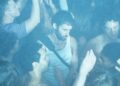
Oliver Laxe’s bold, brave, bleak cine-spectacle, Sirât, begins with a shot of giant speakers that soon begin blaring techno dance music as a large gaggle of ravers start to move to the hypnotic, pulsating beat—allowing themselves the joy of being transported from the precarious world they live in—if only for a few moments. The viewer becomes locked into the reverberating, sensory experience. Yes, it’s a rave, but it’s also an escape, a desire for catharsis as well as a need for self-expression, and a plea for peace.
The latter will soon prove impossible.
The setting is the Moroccan desert and as the narrative begins we are introduced to overweight, middle-aged Luis (Sergi López) who is searching for his missing daughter, Mar. Accompanying him is his young son, Esteban (Bruno Núñez Arjona), and their dog Pipa. They set out to question everyone they can, showing them photos of the teen girl. No one seems to recognize her, but one of a quintet of ravers mentions to Luis that she could be at the next big party which is taking place deeper in the desert.
Suddenly military men arrive on the scene, end the festivities, and insist that all Europeans evacuate the area with them. World War III has, apparently, broken out. But we aren’t given many details.
The hippie-like thrill seekers flee the scene in their large vehicles and Luis and Esteban decide to follow them, in hopes of locating Mar. What happens next is part Mad Max Fury Road, part Wages of Fear/Sorcerer as father and son join Stef (Stefania Gadda), Jade (Jade Oukid), Josh (Joshua Liam Henderson), Bigui (Richard Bellamy), and Tonin (Tonin Janvier) and journey deep into the desert, crossing a river and driving along a treacherous mountainside (which really fucked with my vertigo), where they will have to confront psychological, physical and emotional horrors.
Shortly past the one-hour mark, something so shocking and ghastly occurs that I am still not recovered from it a day later. But that’s not the only sucker-punch moment—they keep coming.
The word “Sirât,” is Islamic and refers to the straight path or bridge over hell that believers cross to enter paradise on the Day of Judgment. The bridge represents the fine line between good and evil, requiring people to commit to righteousness. However, Laxe’s propulsive, haunting, cinematic creation seems to be committed to a randomness. The righteous aren’t necessarily saved or spared in this particular apocalyptic world. And these lost souls are on a very perilous journey where, at any moment, they might just be taken out of the life equation.
it struck me that the film is also about the choices/decisions we make, even the smallest ones, could take us down a different path, sometimes a perilous one.
Screenwriters Laxe and Santiago Fillol have crafted a harsh, meditative, twisty and incendiary film the leans heavy on a singular vibe where stunning visuals (kudos to ace DP Mauro Herce) and aural sensations are key.
This merciless viewing experience beat the shit out of me. And perhaps I’m a cinematic masochist because I appreciated every moment of it. Some of us need to trudge through hell to get to our own nirvana. I thank the movie gods it can still happen.
Sirât, part of the Main Slate at the 63rd New York Film Festival, won the Jury Prize at this year’s Cannes Film Festival and is Spain’s official Oscar selection for Best International Feature.
A NEON release.
For NYFF tickets and/or more info visit HERE.