
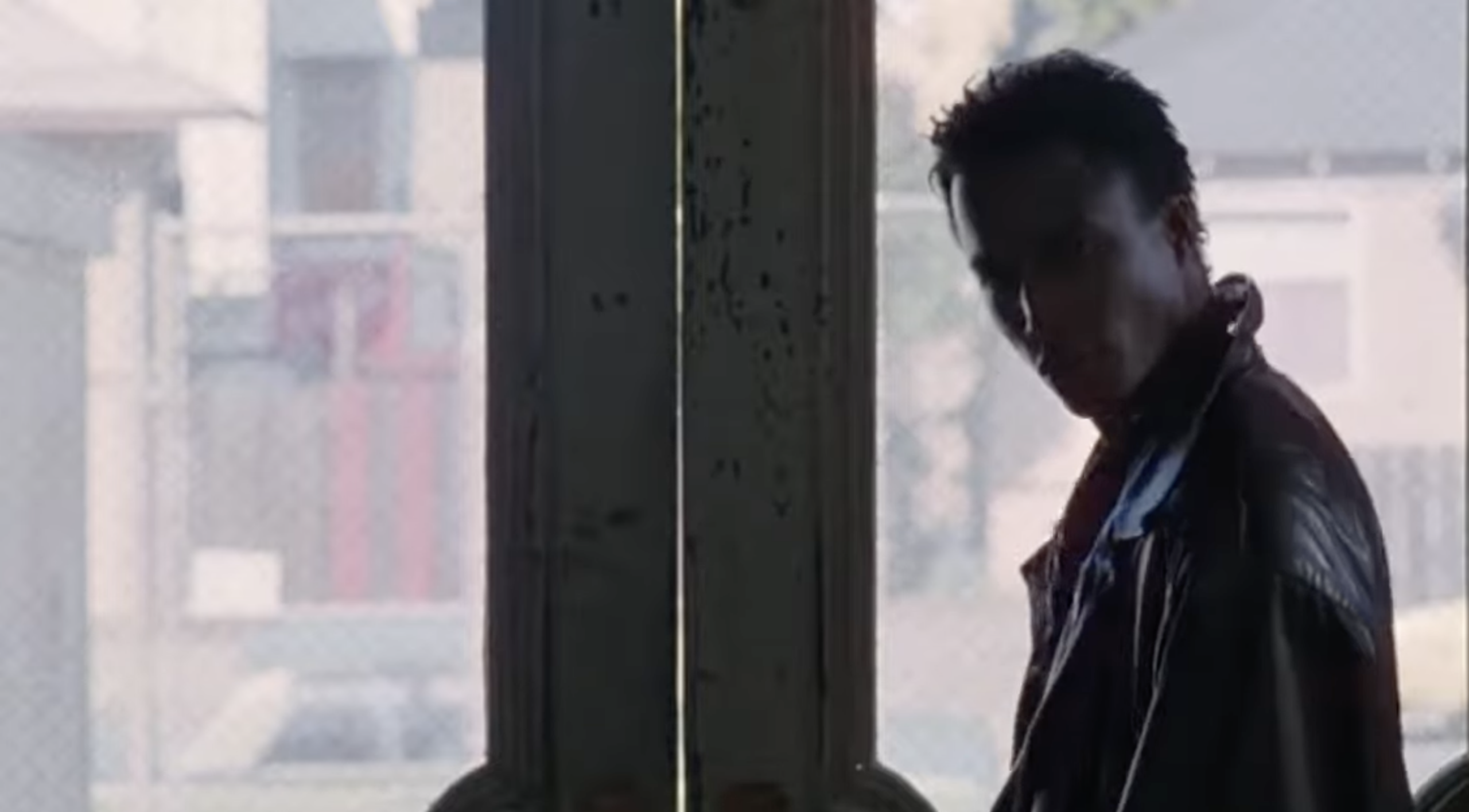
Michael Wright was an actor best known for a handful of outstanding performances in underseen fare over a relatively short period. You could call him a cult figure of a sort. He conveyed intensity with such ease that he was almost unnerving to watch on screen.
Wright got his first break in Philip Kaufman’s NYC street gang film, The Wanderers (1979), with Ken Wahl and Karen Allen. Like most of Wright’s best projects, The Wanderers was little seen, but well remembered by those who saw it. Although the film focused on young Italian men in the Bronx, Wright made a strong impression in his film debut.
Four years would pass before Wright scored a second role of note. This time, he played a pivotal role in the smash miniseries V (1983) as Elias Taylor, a resistance fighter against an alien race that attempts to take over the Earth. Wright would reprise the role in the sequel miniseries V: The Final Battle (1984) and in a short-lived series continuation of the story (also titled V) that ran for 13 episodes over 1984 and 1985.
In between his work on the three iterations of V, Wright landed what may have been his greatest role, that of Carlyle in Robert Altman’s criminally overlooked film adaptation of David Rabe’s play, Streamers. Taking place primarily inside a claustrophobic Army barracks where four young soldiers await their deployment to Vietnam, Wright gave the film’s standout performance (across from Matthew Modine) as a volatile and secretly terrified Black man whose instability results in two horrible acts of violence. Wright is astounding in Streamers. His Carlyle hides his fear behind misplaced bravado. Every second he is in front of the camera is a nerve-jangling experience. Streamers is an all-but-forgotten Vietnam film from a legendary director, and well worth seeking out. Wright won the only acting award of his career at the Venice Film Festival, as the festival took the unusual step of giving the Best Actor award to the film’s entire cast. While the award was shared, Wright was first among equals.
1987’s The Principal, starring Jim Belushi and Louis Gossett Jr., is nothing more than a white savior B-movie about an overburdened principal (Belushi) trying to hold together an urban high school, but I’ll be damned if Wright didn’t walk away with the picture in style. Wright was thirty years old at the time and couldn’t look less like a high school senior on film, but it scarcely matters because of his riveting performance. Playing a stereotypical gang leader/drug dealer, Wright transcends the pedestrian material, creating a fearsome antagonist in a film that doesn’t deserve him, but would be nearly unwatchable without him.
Four years later, Wright would be cast as a member of The Five Heartbeats, a fictional take on a Temptations-like band, directed by Robert Townsend. Wright played lead singer Eddie King Jr., a wildly talented vocalist brought down by ego and drug addiction. In Townsend’s deeply underrated gem, Wright gets to show a softer side and lands rare comic beats with precision. When Eddie’s story turns tragic, the pain runs deeper because Wright’s performance is so winning. The film’s finale is both mournful and uplifting, as we watch old friends warmly reunite in the shadow of what could have been.
As was common in Wright’s career, there would often be gaps between roles of note. Had The Five Heartbeats been a hit, Wright likely would have seen greater opportunities. A prime chance to shine did come in 1994 with Sugar Hill, a rugged Harlem Gangster drama starring Wesley Snipes. Wright plays Raynathan, the unstable brother of Wesley Snipes’ crime lord, Roemello Skuggs. Snipes was on the brink of stardom at the time, and Sugar Hill is his movie, but it takes all of his charisma not to be blown off the screen by Wright. There is a palpable desperation (a hallmark of Wright’s work) that simmers to a boil in Raynathan. He is erratic, dangerous, and yet somehow, your heart goes out to a man who just wants to be seen. Sugar Hill doesn’t break any new ground in gangster cinema, but it’s a story well told, and Wright is the lightning rod that charges the film.
Like nearly all of Wright’s projects, Sugar Hill was not a hit. Wright spent several years looking for roles worthy of his talents. In 2001, Wright was cast as Omar White in HBO’s heralded prison drama, Oz. Appearing in 22 episodes over seasons 4-6, Wright is profoundly affecting and disturbing as a drug-addicted inmate sent to the Oswald maximum-security penitentiary for murdering a key witness in his cousin’s trial. Wright’s character arc is as grim as Omar White is explosive. In the last major role of his life, Wright once again delivered his specialty: pain. The pain of the overlooked, the unappreciated, the disadvantaged, the ignored. Wright brought that pain like few others in the history of cinema.
Aside from a small role in 2007’s The Interpreter (starring Nicole Kidman and Sean Penn), Wright was never again seen in an A-list project. Like several of Wright’s characters, the actor suffered from substance abuse that curtailed his immense potential. He also contracted Marchiafava-Bignami disease, a rare degenerative neurological disorder that would induce fatal complications.
Cruelly, the condition came as Wright found a measure of peace. A peace that none of his characters on film ever found. Wright was an actor who, when given material up to his gifts, would scorch the screen like a raging wildfire. His intensity could be almost unbearable. And yet, underneath his raw, often extraordinary, performances was a vulnerability that made you care about the bad guy. Because maybe, just maybe, with a slight turn of luck, the best of him might be accessible.
The best of Michael Wright was seldom made accessible. But what there is to see isn’t just memorable; it’s unforgettable.
Michael Wright died on August 19, 2026. He was 70 years old.
![James Cusati-Moyer On the World Premiere of ‘Sacred Creatures’ at Edinburgh International Film Festival [VIDEO]](https://thecontending.com/wp-content/uploads/2026/08/SC_MicRay_10_Courtesy-Nicolas-Villegas-H-75x75.jpg)