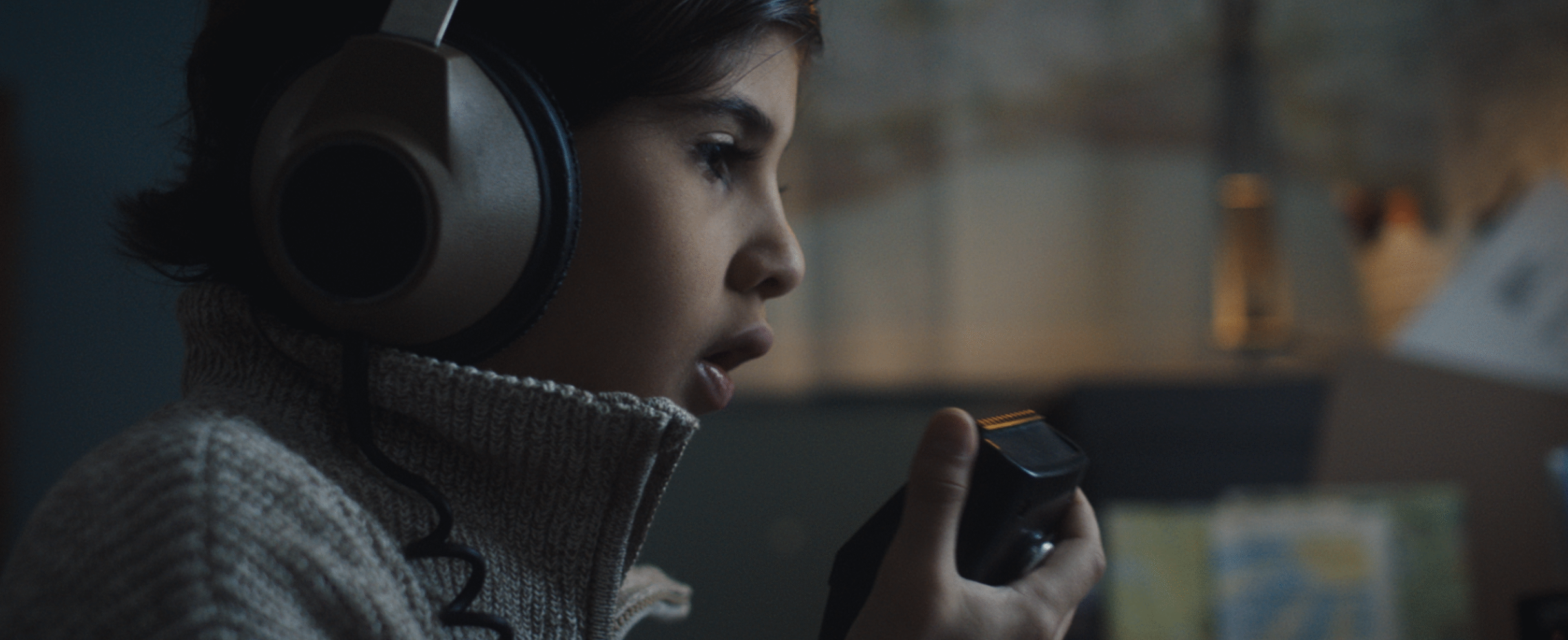
The sound of the ocean is felt throughout Largo, Max Burgoyne-Moore and Salvatore Scarpa’s affecting, open-hearted drama. The way the water laps at the shore rings in your ears even when you are indoors, and you can almost feel the rush of the wind flying off the surface and caressing your face. Largo is a film about how yearning for a true home defies time, and Scarpa and Burgoyne-Moore direct with sensitivity and guile.
We witness a seaside town through the eyes of Musa, a Syrian refugee living in foster care under the watchful eye of Grace, a local. Even at a young age, Musa faces discrimination from grown adults, and these filmmakers began their journey of this film as a way to open people’s eyes about casual racism that some experience every day. The more that they realized that this story would resonate in today’s politcal climate, the more they wanted to push.
“We grew up in a place similar to the town in the film,” Scarpa explains. “Max was in the Midlands in the UK, and I was in a fishing town in Italy before I moved to the same town as Max. We’ve both experienced this type of place. So many people are warm and really loving and welcoming. When the refugee crisis started to become more evident un the UK, these people who we thought were welcoming turned out to be quite the opposite.”
“Secretly racist,” Burgoyne-Moore says, plainly.
“Exactly,” Scarpa continues. “It’s not out and out hostility, but it’s the kind of casual racism where people will play it off as a joke. Or they will say that they chose to come here–it’s not our responsibility. It has this veneer of being reasonable, but it’s just the lie that they’ve been fed by the news and social media. We wanted to make a fim that would, to the people we knew in real life, sort of push back. It’s shocking when you find out that people in your family or close friend network turn out to be hostile or racist–even if you never thought of them that way. This is our way of trying to change the people around us, but go even further.
If you look at the statistics, they are overwhelming. We finished the film with that statistic of 11 million child refugees, because we cannot comprehend that big of a number. Every time I see it on screen, I think about how seeing those kinds of statistics. In the UK, refugees are referred to as people on boats, and it’s reduced to a daily counter or a monthly tally of who has arrived in the country. It’s numbing.”
Zack Elsokari, as Musa, has an incredibly expressive face. His eyes open wide and glisten with hope and fear throughout Largo, as his character waits and waits for his parents to return to retrieve him. Tamsin Greig has a careful like to walk as a person who is trying to decide how much she should reveal. Their bond, and how they test one another, is integral to heightening the drama.
“Tamsin [Greig] really is a national treasure, and we were kind of in disbelief when she wanted to do our film,” Scarpa says. “She is mostly known for comedic roles, so putting her in this for us was very exciting because we know what a great actress she is. At the end of the film, when she’s on the beach, it’s so powerful to see her go to that extremity for our story. She met Zack [Elsokari] the night before we started shooting, and she told him that she was going to be playing a person who is very angry with his character. But she told him that once the cameras stopped rolling, she’d be nice to him again–she wasn’t going to go full method.
Zack was so comfortable with these experienced actors, and he took everything in stride. To be able to find a kid who is so keen and wants to jump into every situation was so exciting for us. His mother was on set, and she’s also a brilliant actor. She asked if we could create a quiet place on set so she could talk to him about the importance of what he’s saying. He knew how delicate the subject matter was, and I think it’s so difficult to find kids like that.”
“He has that childlike naivety, and there were things that the character had, these optimistic delusions, about what would happen versus what the truth of what the situation was,” Burgoyne-Moore says. “We let him allow his character to get carried away with that. We didn’t have a lot of time to shoot, but he took notes so quickly. He’s such a superstar.”
Even though the area is surrounded by those who tease him, Musa finds unexpected comfort in the small interactions with Hakim, an adult that Musa sees himself in. Hakim’s boss refers to him as ‘Harry’ instead of his actual name–a detail that opens up an entirely new conversation with the audience about assimilation and doing what you need to do in order to fit in or survive.
“Ammar [Haj Ahmad] is a Syrian refugee who is doing such great things on stage in London,” Burgoyne-Moore says. “He has this true magnetism. Between takes, he would help Zack with his accent so it was more specifically Syrian Arabic. They worked together on things before we got to their scene, so when we got to it, there was already a different vibe–this different magic. We wanted to get across that Hakim represents that a refugee and an immigrant can survive in a place that’s hostile. You can allow yourself to have your identity be absorbed into the local community. They call him Harry and not Hakim, and so many people, our friends and colleagues who are an immigrant or a child of an immigrant, speak of this name change thing. A lot of people who read that in the script noted that it was weirdly true.”
“That goes back to that quiet racism,” Scarpa says. “A kid’s reaction would be that they wouldn’t want to do that–they don’t want to change something like that about themselves. He looks at Hakim in a way that tells him that he could have a future. This is what it could look like. It’s my favorite scene in the film, for sure. We took inspiration from a film we both love, Cinema Paradiso, where the kid sneak into the cinema and he encounters the scary man who kind of teaches him everything. I wanted to capture that.”
“Whether he knows the adult implications or not, Musa’s face almost lights up when he see’s there’s some similarity between them,” Burgoyne-Moore adds.
It feels like the camera has a magnet drawn to the water. We know it’s all around us or we literally see it in the background as characters talk. It calls out to both Musa and us.
“Once we had written the ending, we wanted the water to represent a sort of an on-the-nose metaphor,” Burgoyne-Moore says. “Deep down, Musa knows, but he is looking out and longing and wanting to escape. This is really about him coming to terms with that, and he had to, unfortunately, go to the extremes before he accepts it and faces the truth.”
“Largo, the musical term, means wide and open, and this ocean is this big space that Musa has to try and conquer,” Scarpa says. “The water should feel like a wall, and we always wanted to see the boat very tiny on this water. Some people assume that it’s CGI, and we make a point to tell them that it’s not.”
When Musa ventures out into the ocean, he is alone. It is something that he must do on his own terms. Even filming on the water for a big budget film has to be daunting, but for a short film? Watching Elsokari in the boat on the water only adds to the drama that Scarpa and Burgoyne-Moore have drawn on the entire film.
“We just had to get out there and do it,” Scarpa says.
“We were fortunately enough to get Roy Taylor as our stunt coordinator,” Burgoyne-Moore says. “He came right from the set of Barbie, if you can believe it. When we started approaching it, we didn’t know if we had to get a water tank or green screen with a bunch of crash mats? Roy told us that we had to do it for real–that’s the only way that we could make it look and feel real. Especially for Zack, who was very keen on doing all of his own stunts.”
“We were on the shore wondering how it was going to go, because it’s actually dangerous,” Scarpa says. “Luckily we were surrounded by an incredible stunt crew.”