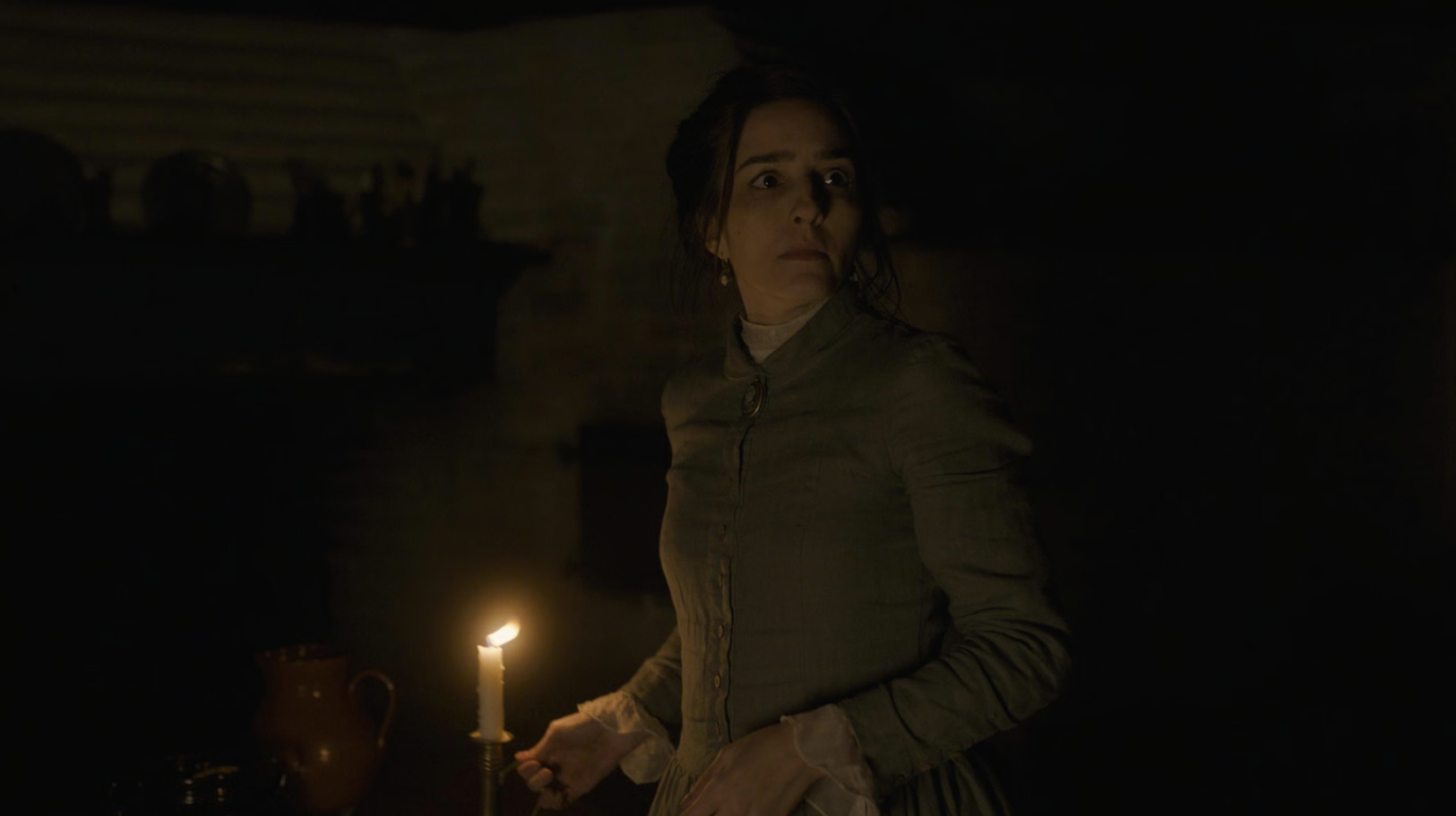
The quietness presses in on you throughout The Traveler, Matthew Scheffler’s intensely atmospheric, psychological exploration of one woman’s grief. It’s often stated that the best kind of horror is when we, the audience, cannot see what might be tormenting us just out of reach in the shadows. By infusing this story with palpable sorrow, Scheffler has created one of the most striking films, feature or short, of the year.
Scheffler was inspired by some beloved stories and films for the look of his film, and I couldn’t help but think of Henry James’ The Turn of the Screw (even with the absence of children). I joked that he was working in the beloved genre of “candelight horror,” the kind of story where your jagged breath threatens to blow out your only source of light.
“The concept is something I came up with when I was a teenager, so it lived with me for along time,” Scheffler says. “I was at Last Week Tonight with John Oliver for five years, and I wanted to reconnect with myself as a filmmaker. A couple of friends and I were looking to make our own thing, and I had this concept that I had developed into a feature. I thought it could exist on its own. In the writing of it, The Witch [by Robert Eggers] was a big inspiration as well as Alejandro Amendabar’s The Others. I loved seeing that in the theater, and that film has always lived in my heart a bit. It was very impactful for me.
When we were ready to shoot, our DP, Fletcher [Wolfe], and I agreed on a lot of the visual look by trying to lean on candlelight as much as possible. I feel like a lot of people may not trust themselves to do a film, even a short film, with the main lighting coming from candlelight. I feel like everyone would second guess it. We wanted it to feel as authentic as possible. The whole town of historic Richmond is all period buildings, so the windows could be boarded up on buildings. When the lights went out, you were really in pitch black.”
The Traveler centers on Hannah, a young widow in 1887 New York who begins to think that someone–or something–might be lurking in the shadows of her large farmhouse. Is her beloved husband, Robert, trying to get back to her with a message? As she inches closer to the truth, Hannah wonders if the force in her home might not have the best intentions.
You can get lost in Scheffler’s film due to how every department delivered. The story is an emotional one, but the film will surprise you with where it goes (the less you know before seeing it, the better). He admits that rolling up your sleeves and asking artists for advice can lead to some rewarding results.
“Maybe we shouldn’t have made our first film a period piece with over 60 VFX shots,” he says, laughing. “We were aware of our limitations with the budget, and one of the first things I did was talk with Chris King, and what was achievable–this was before he was attached. I wanted to get his advice on what would work or what we could change things to, if necessary. How do we not stretch ourselves too thin on things. We got creative. For instance, every bit of costuming came from an Etsy shop in Finland. We would message the costumer about colors and she would send us swatches, because we wanted to find things that wouldn’t take people out of the period.”
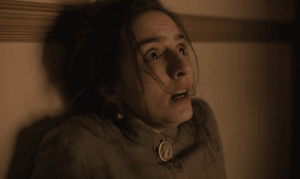 The film rests on the shoulders of Natalie Knepp, as Hannah. For the first half of the film, she barely says a word–almost as if she cannot find the right words or simply cannot allow any sound to escape her lips. Knepp’s face is exquisite with every wrought, emotional feeling mingling with Hannah’s frustration, determination, and heartbreak.
“It’s a tough role, because so much of the film relies on her,” Scheffler notes. “It’s essentially a one woman show. My wife, Meghan-Michele [German], has a close friend who is an agent, and he linked us with this incredible actress who became attached. Apart from Megan Michelle and I, she was attached for the longest time. We were about to shoot, and she got a job on a show that shot in Australia. We had to go dark and recast, and we were put in contact for another casting director, Daryl Eisenberg, who’s also really great, and we went through so many candidates. When we got to Natalie’s reel, she didn’t have anything genre like this, but she always stole the camera. She felt lived in and natural, and I felt like she could feel so human on camera even when she wasn’t speaking. I think that’s a hard thing to find.
There’s a lot of crew there with a camera in your face, and I feel like it would be difficult to feel calm or present in the moment. The fear side of it was the biggest unknown, for me. I knew she could handle the emotional beats and the subtlety of certain scenes, but horror is a hard thing to portray. She just nailed it.”
When Hannah comes face-to-face with the spirit trying to make contact, it takes your breath away. I remember seeing the film for the the first time at this year’s Indy Shorts, and the audience was at rapt attention, the air even felt chillier in the room. In terms of story, what Scheffler pulls of is remarkable, but the balance is key. If he leaned one way, he risks losing the audience, but he keeps a deft grip on Hannah’s plight.
“There’s not a lot of dialogue in the film, and I am a big believer in telling a story visually and attaching a point of view,” he says. “You should be able to tell what’s going on in the story with the sound off. I am big on taking the question that people might be wondering and trying to answer them in pieces–like climbing a ladder versus going up an elevator or going down a slide. Approaching the finale from a writing standpoint, I was always trying to set the story up from Hannah’s point of view, so, originally, the audience thinks that Robert, her husband, is trying to break through with a connection in order to have catharsis. But once we know it’s not him, we wonder what it is–it’s something hostile. Now it’s in the room. Now it’s bleeding. Now it’s a man. There’s a lot of information to process and that’s coming to both her and the audience at the same time. When she sees Robert’s work, it’s obviously important to her even though it’s confusing as to why it’s on this man’s device.
I wanted the audience to be processing the information at the same time and the same way that she is even though we can kind of understand it more as she is sifting through everything. This is now the first time that she has been able to see Robert since he has passed away. We’ve all lost people, and we have the luxury of being able to go onto some social media and see them. If there wasn’t a painting of someone at that time, their face or their presence only exists in your mind. I rewrote that sequence a lot, but, at the end of the day, it was all about how she was feeling leading up to her pressing that button at the very end.”
The Travleler will play in the Sunday Block 2 program at the Harris Theater at the Three Rivers Film Festival on Sunday, November 23, 2025. If you go, try to sit in the balcony–it was one of my favorite places to see movies in Pittsburgh.