When we learn that one person has violated another, why do we not act immediately? When someone seeks solace or counsel in our confidence, we should automatically believe them and take the necessary steps in order to rectify the situation. A horrific act of sexual violence is reported in Marnie Blok’s tremendous short film, Beyond Silence, but the reaction will take you by surprise. This film will leave you breathless.
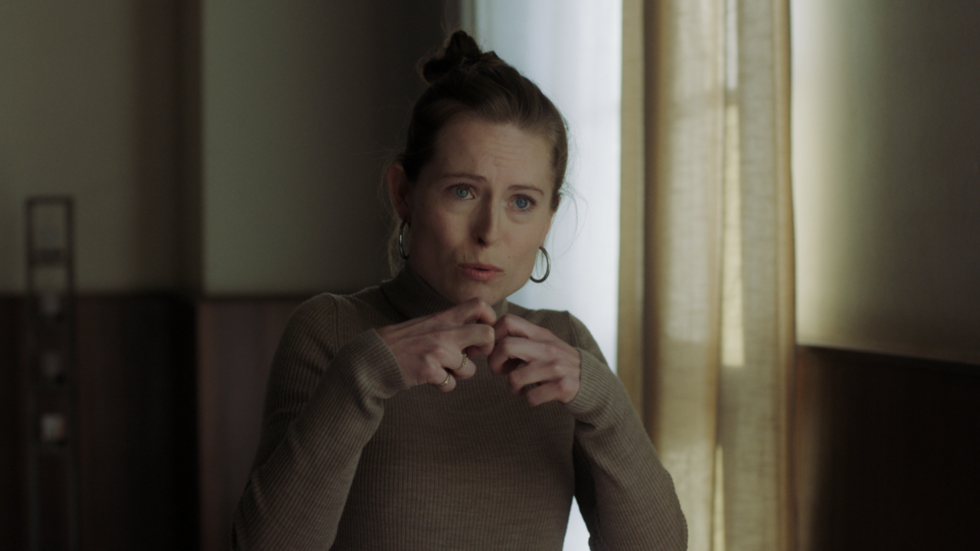
Accompanied by her sister, Eva, a young deaf woman, knocks on the door of the dean seeking guidance. A male professor she has been collaborating on a project with has assaulted her more than once, but she is shocked to discover when the dean, Sandrine, doesn’t take action immediately.
I told Blok that I thought about Eleanor Burgess’ The Niceties the first time I watched her film. That play deals with race and not assault, but it does have an intergenerational conflict between two women at its center. Does Sandrine assume that Eva is being dramatic about what transpired? Does she assume that younger people should learn from history and not bother their elders when their problems?
“There are many reasons why I wanted to write this short, but one of them being after Me Too came out in 2017, there were reactions from older women, my age and older, that expressed some fatigue about it,” Blok says. “They would say things along the lines of, ‘Are you going to moan about these stories?’ which basically suggested that it would make women victims again. They warned younger women of victimhood. I remember being so angry, because when you are raped, you are a victim. There’s nothing weak or wrong with that–I think it’s very strong that you are able to talk about it. As an actress, I put up with so much that I shouldn’t have put up with, but it was never vocalized at that moment yet. Even though it is vocalized now, there are so many people who remain silent. I think we should not pass on that message to a younger generation.”
In the central role of Eva, Henrianne Jansen leaves everything on the screen. Blok was determined to work with a deaf actress, because it was vital to the story.
“I wanted to shoot this with a deaf actress, so that’s where I had to start,” she says. “We don’t have many deaf actresses in Holland, and Henrianne, who plays Eva, tried to go to theater school years ago, but she wasn’t accepted. I thought I was going to have to put something on Instagram to get the word out as I considered doing more auditions, but I met Henrianne through a friend who was dating her. After talking to her with an interpreter for about an hour, I knew I was going to do it with her. I spent a lot of time with her since this is her first role, and I have known Sigrid [ten Napel] since she was in her teens. We talked a lot together about how to get to these emotions, and I needed to spend a lot of time exploring their relationship. These sisters are very dependent on each other. Henrianne is now in contact with Marlee Matlin, who has seen and loved the film.”
 Blok uses silence effectively throughout her film, but no two silences are the same. In order to make the audience understand what Eva doesn’t hear, Blok introduced them from the very beginning. She didn’t simply erase the sound from the drama unfolding on screen. Silence has an arc of its own.
“When I was writing it, I actually put the silences in there already,” Blok says. “When we were engineering the sound, it felt far too dead. If you fall into complete silence, it doesn’t work. For Henrianne, she can put something in her ears like when she’s walking near traffic, so she can hear a vague sound. I put stuff in my ears just to figure out what it would be [like], but I could hear my own blood rushing and my heartbeat going. Henrienne doesn’t hear that. We worked with the sound designer to work with different tones to achieve some variations.”
As Eva is explaining her situation, her sister, Anna, translates on her behalf. The camera is positioned behind Eva as we watch Sandrine’s reaction, but Blok keeps the outline of Eva in the frame. We are incorporated into her point of view immediately, and we are affected by Sandrine’s reaction. Is she working through her own uneasiness about hearing another young woman’s experience? How much does she have to hold everything together?
“I wanted [Sandrine] to go into the conversation very willingly at the beginning, but she’s caught off guard when she realizes that this is going to be a talk about sexual violence,” she says. “She is not the person at the university to talk to about this sort of thing, but I told Tamar [van den Dop] that I wanted her to only listen but to feel the fear inside. Sandrine is worried that this is going to ear open something inside her, and she doesn’t want to go there. I had a whole soundscape written in the first draft of the scenarios where we would hear things that only she would hear where we would realize that she had also gone through things. I took it out because it felt far too obvious, and I wanted it to stay a bit more ambiguous.”
Eva and Sandrine are separated by time, but we cannot help but wonder about the similarities between them. Early in the film, Sandrine is facing out a window and Eva walks behind her. For the briefest of moments, the colors of their shirts look identical before the sun reflects the actual tone on their clothes. It’s not something Blok intended, but it helps us understand how she is trying to compose the things we have in common versus what sets us apart.
“When Eva turns, I wanted her to see herself in the reflection of Sandrine’s eyes,” Blok says. “I had to shoot this in three days, and we only had seven hours each day. I wanted, for a moment, that you feel that these two women are the same. There is a moment where Eva is getting more and more frustrated and she says, ‘So you’re putting the responsibility on me,’ and Sandrine replies with, ‘Not only on you, but also on you. Because we want equal rights.’ Tamar and I talked about that line because she didn’t like it, but I told her that it is the most important line that her character says. She is saying something that she does not believe herself but she is trying to convince herself that she is doing the right thing. That line actually comes from the lawyer from the Weinstein case. I knew I needed to keep that line.”