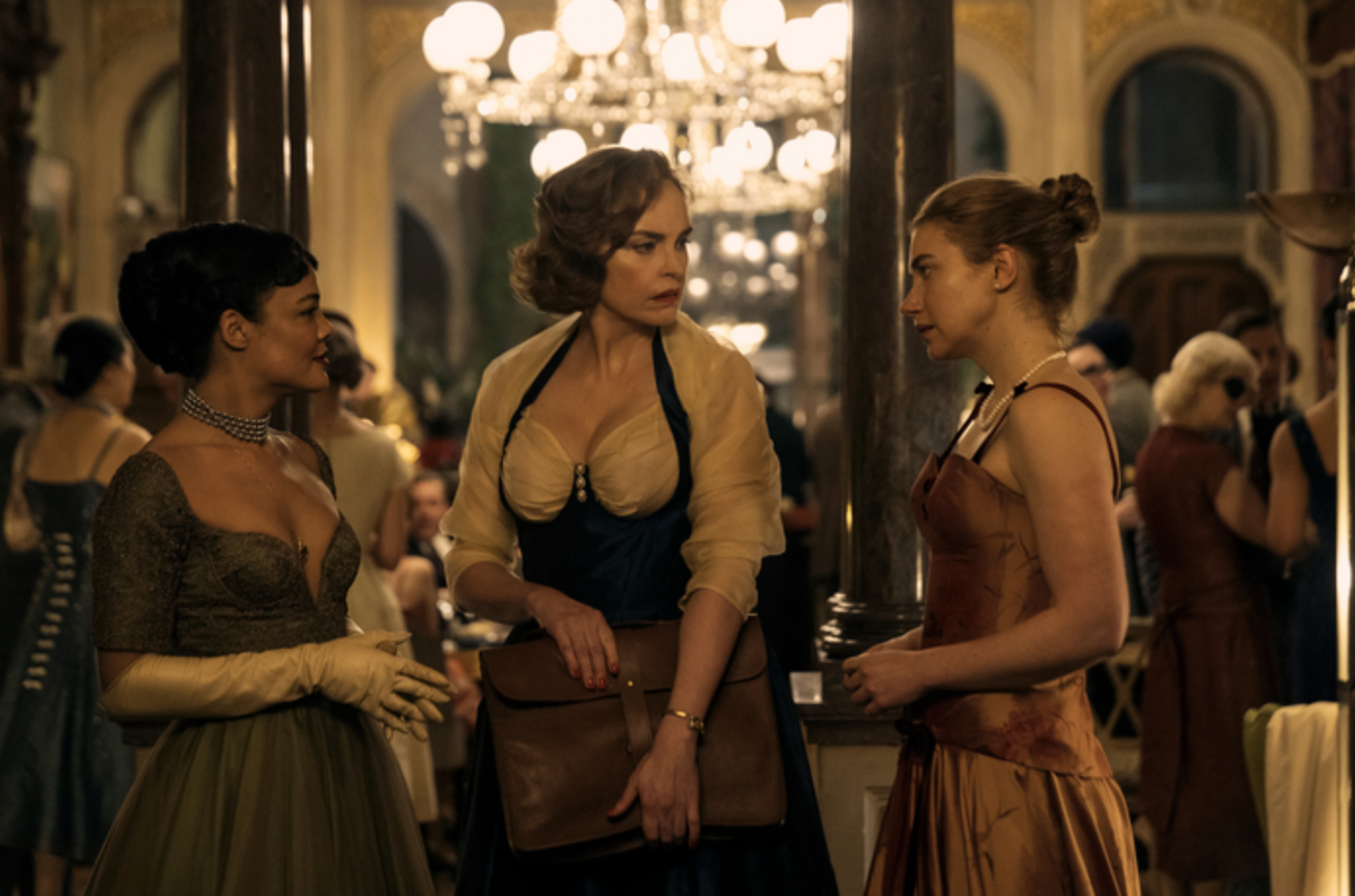
If you were invited to a lavish party in the English countryside, what woud you wear? If you were attending on someone’s arm, would you be looking at everyone else’s fashions? With so much treachery and sneaky motives at play, Nia DaCosta’s Hedda gives the audience plenty to chew on, but the costume design, by Lindsay Pugh, isn’t just gorgeous window dressing. For the three women at the center of DaCosta’s gorgeous film, Pugh uses fabric, color, shape and style to mold the arcs of these women to dangerous effect.
From the very first frame, DaCosta’s adaptation has a singular attitude and look, and that translates to the costume design as well. Rather than look at famous stage productions of previous performances of the original text, Pugh insists that she needed to bring new life into this story by relying on this new version of the text. Notice how each of the main women wear pearls in entirely different ways.
“I think you have to see the project of it for itself,” Pugh says. “I have seen various versions of this play, and you have to wipe that away, I think. Nia had something very specific to talk about with this version, so I, along with everyone involved, had to look at the story with fresh eyes and this new perspective. While I suppose it helps with the sort of deeper understanding of the history of the text, everything came from Nia’s 160 pages.”
One of the unique qualities of Hedda is how the film takes place over the course of one night. It makes you wonder how much pressure Pugh felt to create iconic looks as this night spirals deeper and deeper out of control. The dress that Tessa Thompson’s Hedda wears for the majority of the film feels like an event unto itself. When Hedda is trying to get the house ready, her hair is down, and her body is wrapped in luscious, bloody red. At the party, her waist is cinched tighter, and the silhouette feels more classic. Depending on what room she is in and what kind of light is being used, though, the dress appears to change color. The texture is akin to snakeskin, and the dramatic, plunging neckline becomes a focal point throughout the evening.
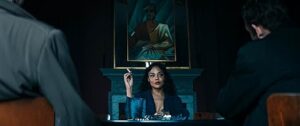
“In the original illustraiton of the dress, we drew it in black,” she says. “When we re-read the script, we realized how on point that was but Hedda is not that type of character. She is a million things inside of this shell. There is a bit of camoflauge going on, and that echoes how she behaves. Hedda will say one thing, but there is something else clearly underneath it. We did that with her main dress with the two different colors of green underlay [and] the silk with the brown on top. I wanted to keep you off balance, and Hedda dresses for her. Right now, she has money and she’s bored, so dressing a certain way is how she can express herself–I think she really enjoys it. That look is very of the period, but it is a new shape. We wanted to have that constriction at the waist, because it thematically shows her life. Hedda is the wild child who is now married, and she is going to do all the things that is expected of her so she is grabbed-in psychologically as well as physically.”
One guest who finds herself in the center of Hedda’s web is Imogen Poots’ Thea. Since she worked with Nina Hoss’ Eileen on their book together, they have become lovers, and she has known Hedda for most of her entire life. When Thea is asked to stay for the party, Hedda invites her to come upstairs and pick out a new dress to wear. Even though the conversation between Thea and Hedda is casual on the surface, Hedda is ripping the garments literally off of Thea’s body before throwing another one in her direction. As the evening unfolds, we are reminded that Thea is literally wrapped in another person’s wardrobe. It’s a delicious example of a dress being used as a weapon.
“That was quite hard, because it has to fit these two very opposite people’s style of dress, doen’t it,” Pugh says. “You have to believe that it came out of Hedda’s wardrobe, and you have to believe that it fits her and that it works on her without making it look comedic. It’s wrong for her, but it’s not silly wrong, and it doesn’t distract from anything that’s going on. When you see poor Thea being manipulated, demeaned, and belitted, the dress plays subliminarry into that. The fabric of that dress is stunning, and it’s hand-painted with bamboo. We can only imagine how amazing it would look on Hedda against her skin tone, but we never get to. With the little delicate bows, it’s all meant to demean this poor girl. Something about it just doesn’t quite work.”
The entrance of Hoss’ character is an event. She floats across the room towards Thompson, but I would argue that her black-and-white gown is equally hypnotic. Since she is a tad older than the other two women, there is an inherent sophistication built into the design. It’s elegant but also strong. In a moment of vulnerability, Eileen’s bodice becomes see-through.
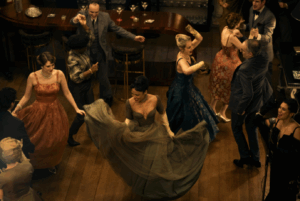
“Eileen is about to enter a collegiate atmosphere with a bunch of men, and she is resolutely and absolutely feminine but I wanted to very subliminally put her in a suit,” she says. “She is wearing a white shirt and a blue suit on, but it’s so feminine that you wouldn’t have thought that. It’s the same makeup as every man in the room that when she goes to try and impress them, unfortunately, she is exposed. It was the same coloration of that which is what I wanted to do while taking away every single bit of masculinity.
When she goes into that room where she is the only woman, she really holds her own–she’s so statuesque in that dress. There were some things that we had to take into account in the script. Obviously, with the reveal, we disguised the possibility that something was going to happen which is why the bolero was on. The way she holds that physicality–and how Nina uses her physicality throughout the whole film–is just tremendous.”
There are so many well-tailored suits in the room but so many women have fabulous accessories and jewelry. Maybe Pugh could swipe something from her own closet when one of the characters least suspects it?
“It would be the red dress,” she says. “And the blue coat. Which would I wear more? I don’t know if I could pull off the red dress, so maybe the blue coat–I would get more wear out of it.”
Hedda is streaming now on Prime Video.