Dark blue nurse smocks hang high together as they travel the course of a dry cleaner’s track in the opening moments of Petra Volpe’s Late Shift. There is something calming in their ordinariness–it’s orderly. Perhaps all of these shirts, all in a line, will be comforting to some viewers. After all, we look to nurses and doctors in their uniforms as a source of ease since they know more about the next stage of our lives than we do, and these shirts, even though they are empty, look like the uniforms of soldiers. Late Shift, the Swiss submission for this most recent Academy Awards, is engrossing and emotionally propulsive as we begin to feel overwhelmed even though we aren’t wearing one of those dedicated smocks.
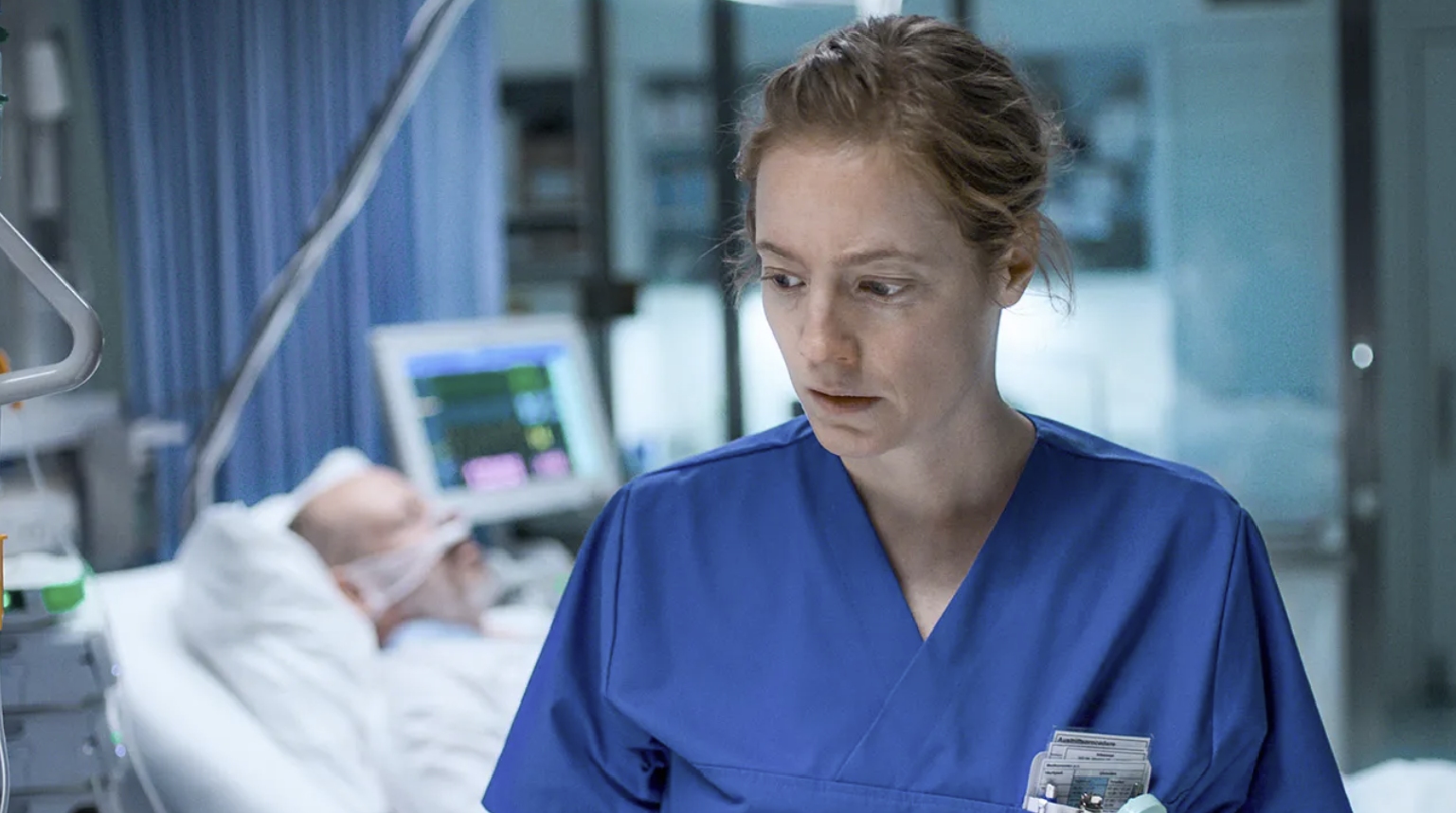
When Leonie Benesch’s Floria arrives for her nursing shift at the hospital, she has to keep gently telling patients or their families that they are understaffed. ‘There’s only two of us today,’ she says, as she notes that a key doctor is in surgery and it is not known when she will be out or available. Floria will take the west wing of the ward while her only other colleague, Bea, takes the east, and a nursing student, Amelie, floats between. When Floria begins the shift, in a pair of new shoes, no less, she steps in immediately to help with an elderly patient, and we sense that this night will not go over as easily as the shift changeover does.
Because the ward is understaffed, Floria is pulled in a million directions every time she leaves a room. Mr. Leu catches Floria to ask her if the doctor will be able to talk about his cancer diagnosis. A trio of sons try to flag her down so she can give them an update on their terminally sick mother, Mrs. Bilgin. Mr. Severin, an entitled patient with private insurance, explodes at Floria because he doesn’t like the tea offered at the hospital. When she isn’t rushing to get pain meds for several patients at a time, she is confiscating a pack of cigarettes from another woman who probably shouldn’t be sneaking out with her oxygen tank.
With her roles in The Teachers’ Lounge and September 5 and now Volpe’s film, Benesch has a keen knack for inhabiting ordinary characters thrust into moments where they have to choose what to do when authority presses in on them. With Late Shift, it feels different since Floria has to weave in and out of different rooms, assess a new situation, and make decisions that will make almost no one happy. She finds unique strength in resisting the temptation to break. Benesch holds so much tension behind her eyes and in her expression that she is quickly becoming of one our most fascinating performers. I would kill to see her and Renate Reinsve square off in…anything.
Volpe never lets the camera let up as we constantly follow Floria from room to room. In the earlier moments of the shift, before night sets in, I couldn’t help but hold onto the light at the ends of long, tunnel-like hallways. For the weary nurses, it feels like the end of a long day that seems like it will never come. I imagine that light might be frightening to the patients if they ever stepped out of their rooms. No one likes to be in a hospital or surrounded by such a clinical atmosphere–you can almost smell the hand sanitizer that Florida uses every time she enters a new space.
Volpe highlights the universal goodness in those in charge of our well-being. They, too, feel exhaustion, fear, and, sometimes, want to lash back out when they are at the end of their rope. But they can’t. They have to guide and comfort in our most vulnerable moments. Perhaps we simply need to learn to extend it back to them.
Late Shift is in theaters now.