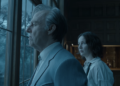
Every spy thriller needs a domineering villain, but the second season of Prime Video’s The Night Manager takes that idea and plays with your preconceived notion of how a baddie can feel. We don’t often consider how the antagonist’s feelings are playing out as they manipulate others and commit violent deeds. At the beginning of this new season, we think we know what kind of man Teddy dos Santos is, but Diego Calva creates an affecting arc that will make you question whether even a Colombian arms dealer deserves more understanding and empathy.
Before we meet Teddy, he is described as “Richard Roper’s true disciple,” and, if you are familiar with the first season, you will automatically have an idea of his ideology and perspective. He is aware of the family business and what his father has done to get to the top. Can Teddy look beyond his father’s actions to get his approval?
“The only way to forgive Teddy or play him or protect him is to humanize him,” Calva says. “The motive is the love of a father while thinking of the absence of the father or the trauma that the father has inflicted. I think trauma moves within every person, every human–the most vulnerable and the most horrible people. In this case, it was trying to grapple his trauma in order to respect it, because it is part of him.”
One of the things that I latched onto immediately in Calva’s performance is how intense Teddy’s gaze locks onto someone. He stares when he follows Jaco in the hotel, when he watches Matthew Ellis play tennis, but it’s most intense when he watches a $20 million transfer. By using just his eyes, he can make an audience feel uncomfortable, as if we are terrified that he will look in our direction, but that choice wasn’t something Calva planned much ahead of time.
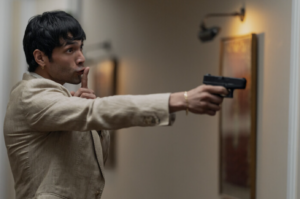
“I didn’t think about that much in advance, but Georgi [Banks-Davies] and I spoke a lot about Teddy’s layers,” he says. “There’s some kind of shield that he creates to move around this world, and you actually see him a couple of times without that guard or mask that he has created. That mask is charismatic, intense even. I thought of Teddy like a stray cat that moves very slowly, and I like to think about animals a lot when I perform. When I was playing Henry in On Swift Horses, I thought of myself as some form of street animal, so I think they created something very similar. Everything in a spy thriller needs to be about the unspoken things. When Teddy is looking at something or staring at someone, I thought a lot about what he isn’t saying out loud. Teddy is always planning his next move.”
Can someone who does unspeakable things consider themselves a devoutly religious person? The actor admits that the contradictions is what makes playing a character like Teddy so rewarding.
“He was raised in a monastery, and if you look at his room, you will see that it’s quite empty,” Calva says. “I think that Teddy believes in some kind of guilt, some kind of purgatory, because he knows that what he does to these children in the army that he’s creating is wrong. Has has those kind of morals, and it’s very strong and very severe even with the contradictions. He is losing his soul every day–step by step. I think that’s why he has to feel pain sometimes. He believes that he’s guilty. That’s why, I think, he says goodbye to Pine in the last episode when Pine tells him to have faith. Teddy says, ‘Goodbye, Matthew.’ He knows that this is the end, and he knows that he’s never going to make it alive and he will never kill his father.”
As the season draws to its close, Teddy gets closer to Tom Hiddleston’s Jonathan Price, and he tells Teddy that his father is ashamed of him. Richard will not take Teddy back to the United Kingdom and proudly show him off as his son, and Calva wears that pain tragically on his body and in his face. Richard won’t even call his son by his full name, opting for the shortened Teddy where Price will call him Eduardo. It’s a small detail that some audiences might miss, but it wasn’t lost on Calva.
“It’s hard to explain what happens between Pine and Teddy,” Calva says. “I would say, at the beginning, they are enemies, and Pine is lying to me literally the entire time and I am lying to him. In this game, though–this dance of lies–we actually start to see each other. When Pine finds out about my past, I think he calls Teddy Eduardo to give him a chance to go back home and be the guy that he couldn’t ever be. Teddy dos Santo is someone that he created for himself. That situation between Spanish and English is the same situation when Teddy realizes that he’s Colombian. He’s not British and he’s never been to London even though it’s a desire that he has. It’s a dream. But he’s Eduardo dos Santos and he will always be that.”
The Night Manager is streaming now on Prime Video.