When you look at the trajectory of Valerie Cherish’s career, the men are surprising constants. Her loyal husband, Mark, is an emotional rock (mostly) outside the entertainment industry. The late, great Mickey was her closest confidante as he primped and primed Valerie to go to set, and they shared a bond like no other pair on The Comeback. Dan Bucatinsky’s Billy Stanton represents that gay man to actress devotion pipeline, but Billy was lucky enough to not just work with one of his favorites. He could also call her his friend. In the third and final season, Billy and Valerie’s relationship hits an unexpected snag, and it might be the first time that I’ve ever seen the bond between a gay man and straight woman reach a concerning falling out.
Season three opens with Billy excitedly revealing to Valerie that she has an offer for a brand new sitcom where she is the star. Not a guest, not recurring–the star. The only caveat? It’s written by AI, which becomes the major thrust for this final go-around. I wondered if Billy had any feelings about this component and maybe he was just hiding his concern from Valerie or anyone at large–Bucatinsky doesn’t think that is the case.
“I think Billy heard the word offer and he heard the words ‘starring role,’ and he was like…’I don’t even know what AI is,'” Bucatinsky says, plainly. “I don’t think Billy gave it a second thought–I really don’t. He probably thought that it was just another tech thing that he didn’t know about, like CGI. All he saw in the email was “big offer.” There’s a tiny piece of that scene that the audience did not see, because it was trimmed. Billy was showing Valerie and Mark what the offer was, and he shows Valerie and says something like, ‘Do you see what they are offering you?’ Then she asks if it was for the whole thing and I tell her that it’s per episode, and she gets all excited. Valerie then asks if it’s okay to do an AI show, and [Billy] tells her, ‘It must be okay, because they’re doing it.’ That kind of logic, that lack of communication, and that lack of an impulse to do research is really indicative of where Billy’s priorities are.”
The tension between Billy and Valerie is difficult to watch, because we know how much they love each other. Even though they try to, they don’t ever get a chance to sit down and hash it out, and it always feels like the tension is being held in since they are constantly around other people. When you go back and watch earlier episodes of The Comeback, we imagine that Billy has always felt like he was never given his due even if that aspect of the series hadn’t been developed yet–it’s all baked in Bucatinsky’s performance.

“It was upsetting to read,” Bucatinsky admits. “Billy has been in her corner for twenty years working exclusively as her publicist. We don’t know who his other clients are, but he’s been very loyal to Valerie for a very long time. When we meet Billy in season one, he’s pent up, because he’s a guy who has been passed over. The first thing you learn about Billy Stanton is that he was at the big, big, big firm–like a PMK–and he got shoved aside for a promotion for somebody younger.
This is a guy who’s got some frustration building, and you can imagine like that scene in the trailer where he throws his phone and quits. He tells her, ‘You’re going to fire me anyway, Valerie. Why don’t you just say it.’ This self-pitying, petulant kind of baby is a little window into what you see ten years later when he excitedly tells Valerie that she’s going to be on an AI show. When she shows some reluctance, he almost starts crying. I think Billy is reaching his boiling point all season, and he’s looking for his way out. I don’t think he even realizes it yet.”
When news breaks that How’s That is written by AI, Valerie becomes the scapegoat and is dragged the hardest since she is the face of the show. As she has to literally take cover in her and Mark’s apartment, Billy and Ella Stiller’s Patience try to assess the damage on social media after, as Valerie says, the “S has hit the F.” Everything that Billy sees online, he shoves in Valerie’s face, a continuation of their producing partnership crumbling since he might wonder how it will affect him too.
“One of the most upsetting episodes, certainly for me as an actor, is in episode four when Billy is doing Fifty Over Fifty, and Valerie is in a real crisis. She needs a partner. In this business, you go to your producing partner and let them handle the problem, and Billy isn’t interested. He’s focused on himself, and she eventually tells him that he’s a bad producing partner. Then he tells her that Mark is bad on his show too–it’s so graspy. You start to wonder if maybe she’s been taking care of Billy a little bit too, but he’s not showing up for her. That was very upsetting.”
After we have seen how Billy’s arc in season three ends, we cannot help but wonder how deeply he was harboring his feelings of wanting to break out. When he is able to reveal who he truly is, there is a sense of peace that Bucatinsky as the season includes and in the last interaction we see between him and Valerie. It’s a feeling that a lot of queer and gay people will recognize even if it’s not explicitly spoken out loud. Bucatinsky admits that he recognizes other gay men like Billy, which led me to ask him if the younger version of Billy would be proud of where he currently stands. There is no standard path for coming out and coming-of-age.
“Billy’s in his fifties and he came out at a time when it wasn’t really well-received,” Bucatinsky says. “Even though, generationally, he was sort of a more processed gay than Mickey was, I think Billy had a hard time expressing his inner self in an authentic way. He would look at Mickey that would show us that he judged the old regime. The other thing I realized in this idea of Billy and the big picture is that if Billy’s idol and role model was Valerie Cherish, who does Billy become at the end of The Comeback? I think he’s Valerie from season one. Valerie’s made all of this progress that we’re all watching–I get goosebumps thinking about how much she has grown. By the end of the show, she has found her confidence and her own strength as a human being. Billy winds up exactly where she was when we first meet her. He’s hoping to get his own reality crew, and he’s happy to be visible in the second row of a fashion show. I think the growth for Billy is going to come after we’ve wrapped, after the end of the finale, and in the next ten years.
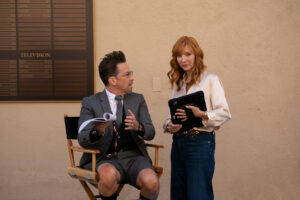
I’m not sure season one Billy was self-aware enough to know why he was so frustrated by everybody around him who wasn’t giving him what he wanted. Even for her, he would shove people out of the way, which was hilarious to watch, but I don’t think he knew himself that well yet. I’m not quite sure whether he would be processed enough, even in season one, to be really psyched that 20 years from now he’d be an EP on an original show. He will have power and he will have the money to buy these really cool outfits and be seen. In season one, he wants to become a competitor of PMK before he discovers later that he has more in him. He’s a star. I think it got to the point where he resented her success and her visibility, and he was ready to turn the camera on himself.”
Before I let Bucatinsky go, I revealed that I just watched All Over the Guy for the first time. The 2001 comedy, written and starring Buactinsky, celebrates its twenty-fifth anniversary this year, and, I have to say, the film absolutely holds up where some films of the era have entirely fallen away. Queer films that came out between 1998 and 2004 should be celebrated for existing at all, and Bucatinsky is excited to party at this year’s Frameline’s fiftieth edition.
“I am currently shooting a gay romantic murder mystery, and it’s the same vibe on set,” he says. “It feels so full circle for me to be here 25 years later in a very different position in my life and career and be working with a new filmmaker who is making his movie. He is the exact age that I was when I made All Over the Guy, and, back then, I was trying to make the movie that I wish had been out for me. All the gay content back then was about AIDS or coming our stories, and I wanted to make what I like to call a “Just Happens to Be” story. Its a rom-com about two friends who fix their friends up, and they just happened to be guys. It’s still not done–even over two decades later. We are doing a 25th anniversary screening at Frameline and Julie Davis, our director, and Richard Ruccolo, will be in attendance. I am hoping that it brings a little life into the film again, because I am still very proud of it.”
The Comeback is streaming now on HBO Max. All Over the Guy is currently streaming on Prime Video and Tubi.