“I should go,” says Alistair Nwachukwu’s JJ says when he feels uneasy in the opening moments of Lee Knight’s Oscar-nominated Live Action Short film, A Friend of Dorothy. That feeling of needing to flee is not uncommon for anyone who ever found comfort in the closet, and many will understand JJ’s hesitancy and fear to be discovered when he makes the acquaintance of Miriam Margolyes’ understanding and encouraging Dorothy. Knight’s script and direction are careful but never tentative. This directorial debut harkens back to something so familiar yet welcomingly charming and necessary. A Friend of Dorothy reminds us that we must turn to our elders not just for a source of guidance but as spirited allies and peers. This is a film about how art transcends any generational divide, and it feels more needed than ever.
I have been on record stating how robust Live Action Short has been this year. I could name another 25 films that could have landed on The Academy’s shortlist, but Knight’s film has stuck out all season for its compassion and unwavering dedication to its characters living authentically.
JJ meets Dorothy when he accidentally kicks his football into her backyard. She requests the help to open a can of prunes and notices this young man eyeing her bookshelf of storied plays and scripts. It’s the most unexpected meet-cute you’ve ever seen. These two people strike a deal: JJ will help her with things around the house if he will read bits of famous plays to her every day. With each passing day, a truer version of JJ emerges, as if he is shedding the familial and societal expectations off of his body as he consumes more and more plays. Sometimes an audience of one is all you need.
There is a relationship between performer and audience, and a novice actor or aspiring talent learns how that bond evolves and grows as they hone their craft. At the end of a play, when an actor takes their bow, an audience’s applause is meant as a thank you. When an actor curtsies or bends at the waist, they are replying with a humble ‘you’re welcome.’ Live theater is the most immediate form of performing that we have. The words spoken, yelled, or cried out by an actor rings through our ears and onto our skin. It changes us as we witness it. Knight’s career on the stage understands and translates the preciousness of that to the screen.
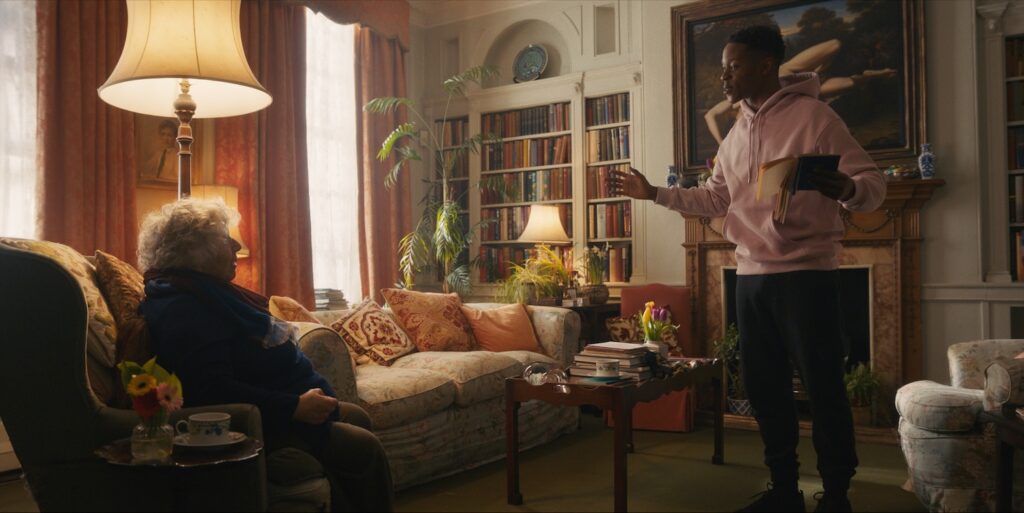
When was the last time that you sat and listened to an elder person’s experiences? Knight’s script gives Margolyes plenty to sink her teeth into, and she delivers a vulnerable monologue where she says, ‘My body may be failing, but my mind…you’ve made it live again. You see me. Perhaps you are the first person ever, truly, to see me.’ There is a pause in Margolyes’ delivery that makes me take a staggered breath every time I watch this film–as if she cannot believe that she would ever have to worry about getting older. And she surely never expected to be saved and seen by someone whose life was about to authentically start. Knight shows how art is essential to our survival. It can touch the lives of these two very different people separately but it becomes every stronger when a play is pulled off a shelf and someone speaks the truth of its words again.
Dorothy’s understanding and appreciation of one text might be shared or challenged by JJ’s interpretation, but isn’t that the point of great art? It’s alive, and it should be passed down like heirlooms or priceless valuables. We can educate one another in a far more exciting way if we analyze plays, art, poetry and performance with those most different than us. That’s the advantage that we have over the tech overlords who assume that they can program passion with an unsympathetic keystroke.
A Friend of Dorothy is vital to me for its vulnerability, its ease, and its unflinching dedication to the spoken, and performed, word. Let the film touch you too.
A Friend of Dorothy is available to stream via Attitude’s YouTube page below.