Long before Patrick Stewart became known on this side of the Atlantic for his two iconic roles as Picard on Star Trek: The Next Generation and as Charles Xavier in the X-Men films, he first established himself as a gifted stage actor. In 1966, he joined the vaunted Royal Shakespeare Company in his native England. In just four years, he appeared in acclaimed productions of The Merchant of Venice, Hamlet, Henry V, The Taming of the Shrew, and King Lear. In 1971, he made his Broadway debut in A Midsummer’s Night’s Dream.
While Stewart never left the stage for long, he began working on British television with The Fall of Eagles in 1973. One year later, he played Enobarbus in a filmed television version of Antony and Cleopatra, Starring Richard Johnson and Janet Suzman in the title roles. I probably never would have known about that movie if it weren’t for my Shakespeare scholar wife. She introduced me to the production a couple of years after we married.
When Stewart came on the screen, she could barely contain her affection for his performance. She told me to listen to how he speaks his lines. “He understands every word he’s saying.” That might seem obvious, but she explained that only when actors fully understand their lines will the audience fully understand them. As I paid closer attention, I started to understand what she meant. Stewart fully owned everything his character said. He was intellectually and emotionally bound to every line. I began to understand there are levels to Shakespearean actors, and Stewart was of the highest.
Stewart continued to excel on stage and screen for the remainder of the 70s. In 1979, he was double-nominated by the Olivier Awards. Once for Best Actor in a Revival of a Play (The Merchant of Venice), and again for Best Supporting Actor in Antony and Cleopatra. He won for the latter. On British television, he appeared in the legendary productions of I, Claudius and Tinker, Tailor, Soldier, Spy. 1981 would bring his first major film role as Leondegrance in John Boorman’s Excalibur. From 1981 to 1983, he appeared as the lead in the British series Maybury, as a psychiatric consultant to a hospital. He was 41 at the beginning of Maybury, his hair already white and thin. He was a respected veteran actor of stage and British television, but few might have guessed what lay in store for Stewart.
The rest of the 80s saw Stewart gain roles in high-profile productions such as David Lynch’s Dune (1984), Tobe Hooper’s Lifeforce (1985), the sleeper crime drama Doctor and the Devils (1985), and the Edwardian tragedy Lady Jane (1987). The decade would see Stewart’s longest break from the stage, from 1982 to 1991. In 1987, Stewart was also cast as Captain Jean-Luc Picard in Star Trek: The Next Generation. The syndicated series was a huge hit, airing from 1987 to 1994, running for 176 episodes. At 47, with half his life behind him, Stewart had become an unlikely on-screen star.
In 1991, Stewart was cast in a supporting comic role in Steve Martin’s L.A. Story. More significantly, he would return to the stage in a production of Charles Dickens’ A Christmas Carol. It would become one of the defining roles of his stage career. Stewart performed the entire play (which he adapted) solo, playing more than thirty roles, without props or costume changes. It was a staggering achievement. Stewart later starred in a more conventional television version in 1999, playing Ebenezer Scrooge.
After Star Trek: The Next Generation ended its TV run, Stewart brought Picard to the big screen in four Star Trek movies: Generations (1994), First Contact (1996), Insurrection (1998), and Nemesis (2002). While many fine actors have played a Starfleet Commander in Star Trek’s long history, I think it’s fair to say Stewart is the most fondly remembered. He brought Shakespearean gravitas to the role. The scripts and the special effects may have been cheesy at times, but that never mattered when Stewart was on screen. He elevated Star Trek to an even higher level of esteem.
Despite the demands of regularly playing Picard, Stewart still found time for the stage and other on-screen roles. He played Prospero on Broadway in The Tempest. George in a Minnesota production of Who’s Afraid of Virginia Woolf? He also reprised his solo performance in A Christmas Carol on Broadway.
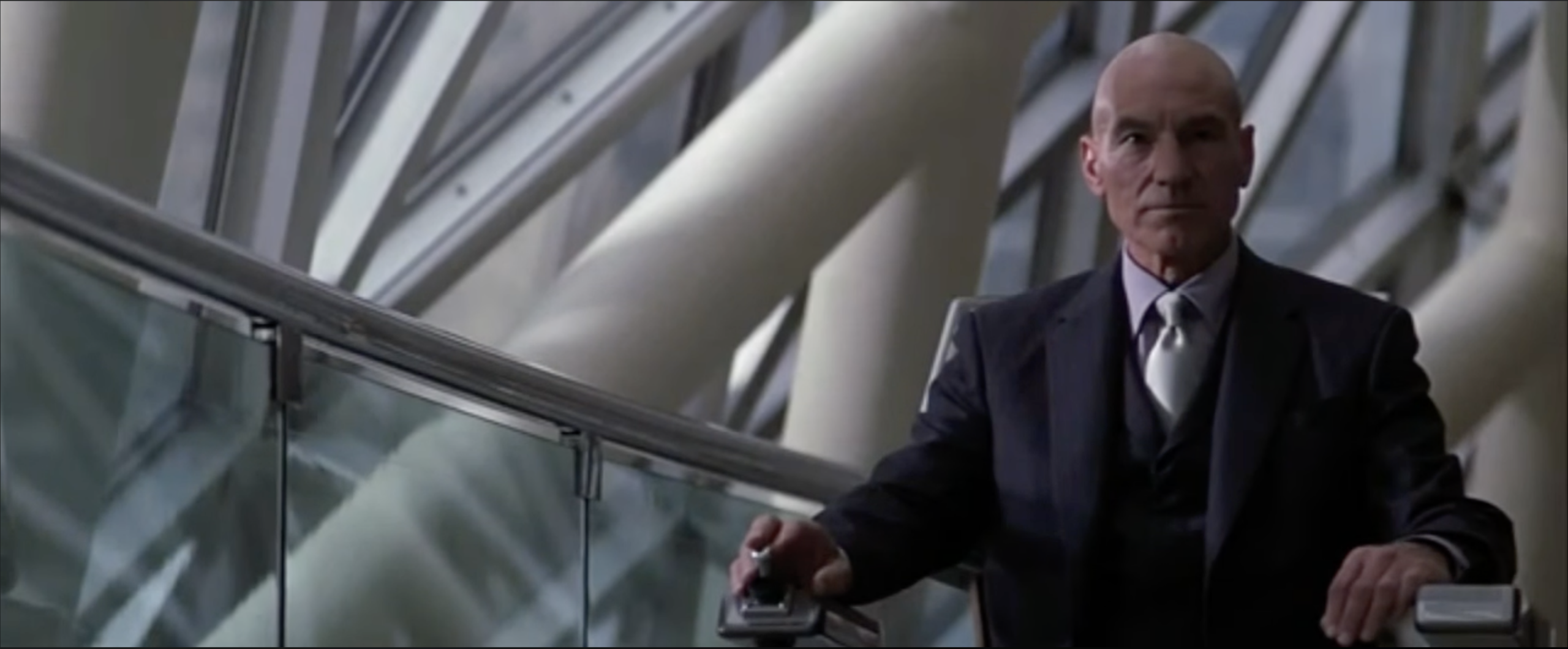
Few actors score a single iconic on-screen role. In 2000, Stewart was chosen to play Professor Charles Xavier in the X-Men. He would go on to play “Professor X” in eight films while alive, and soon to be a ninth when Avengers: Doomsday comes out later this year. For me, Stewart’s greatest film performance as Xavier, or otherwise, was in the uncommonly grim Wolverine film, Logan. In Logan, Xavier is suffering from a degenerative brain disease that has caused him to lose control of his telepathic powers. When Xavier seizes, he becomes a risk to everyone around him. For a character who has pledged his whole life to humanity, his affliction is painfully cruel.
Logan is the rare Marvel film with mortal consequences. Part of me is still surprised it was made at all. Both Stewart and Hugh Jackman (as Wolverine) give arguably the two best performances in any Marvel film. I can recall the very fine film critic Matt Zoller Seitz stating on Twitter (and I’m paraphrasing): Of all the things I might have expected from Logan, thinking about my relationship with my grandfather was not one of them. Stewart lets go of vanity completely in Logan. His performance is sad, rueful, heartbreaking, and in its way, majestic.
Stewart returned to the role of Picard in 2020 for three seasons in the rave-reviewed Star Trek: Picard. The budgets were bigger, and the scripts sharper than on Generations. Stewart was as grand as any Trekkie would have hoped.
One column can scarcely mention every notable performance in Stewart’s career. He was nominated for four Emmys, three Golden Globes, three Emmys (winning one), five Olivier Awards (winning two), three SAG Awards, and one Tony. He could also play against type, as he did in Green Room, where he played the film’s terrifying villain.
In his final film role before his death, Stewart voiced Sir Richfield, an older, literal, black sheep with a painful past in The Sheep Detectives. Talking animal movies are typically my kryptonite. Talking CGI animals are usually double kryptonite. But The Sheep Detectives is so impossibly charming, well written, and acted that any resistance of mine was futile. Stewart’s Sir Richfield is dignified, brave, a little bit surly, but ultimately true. When the courageous old sheep sacrifices his well-being for members of the flock in danger, well, let’s just say something landed in my eye.
Sir Richfield gave of himself for the lives of others. Stewart gave his whole life for our entertainment. I know it’s not the same thing, but it sure feels close on a day like today.
Patrick Stewart died on October 28, 2026. He was 86 years old.