
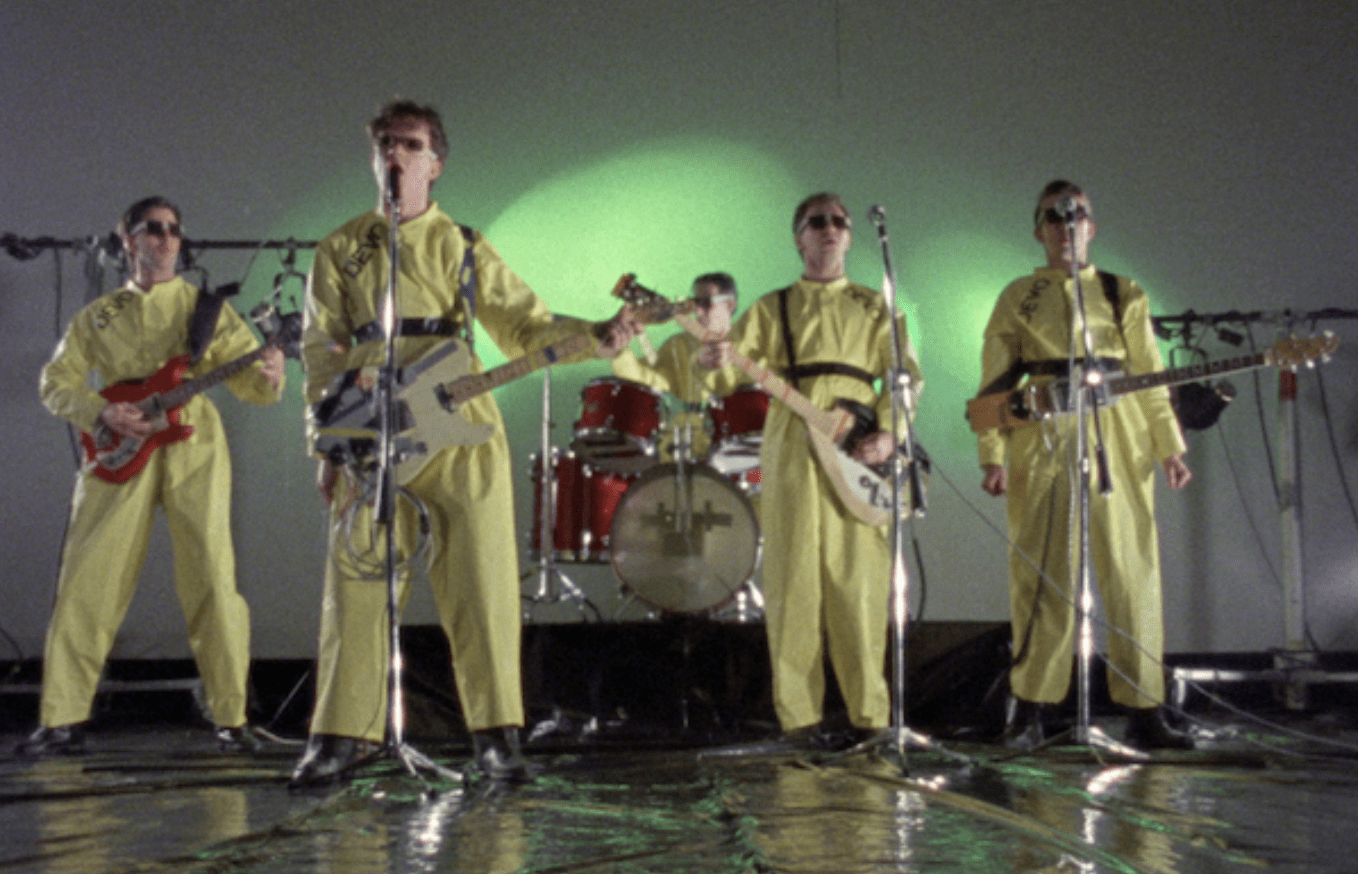
I was too young to appreciate Devo when they came on the scene in 1978 with their first album “Q; Are We Not Men? A: We Are Devo!” featuring a genuinely off-the-wall cover of The Rolling Stones’ chestnut, “(I Can’t Get No) Satisfaction.” The Akron, Ohio band didn’t permeate my consciousness until MTV arrived on the landscape and played Devo’s biggest hit, “Whip It,” relentlessly. I liked both “Satisfaction” and “Whip It,” but I never grasped the subtext in their music. To me, they were a novelty band.
Devo, the new Netflix documentary charting the band’s classic years (1973-1988), directed by the gifted filmmaker Chris Smith, aims to restore Devo’s significance, as well as illuminate their prescience. Boy, does it ever hit the mark.
The members of Devo were all on or near campus when the National Guard opened fire on student protestors at Kent State in 1973. An echo that can be heard and seen in our present day in DC and LA as armed members of the guard walk the streets of those two cities—everything old is new again. De facto band leaders Mark Mothersbaugh and Jerry Castle (featured most prominently in the film) debuted their band live that same year. Horrified and outraged by the shooting and what they considered to be a vile response to the bloodshed, they took their angst and poured it into artful subversiveness.
For those who are as ignorant as I was before seeing Devo, the revelation of the band’s radical progressive nature is, well, revelatory. Thought of as a New Wave band, Devo also had aspects of punk rock in their sound (especially in their early days). While Mothersbaugh bristles at the notion of Devo being referred to as a punk band (he thinks they were too intellectual for that label), their anti-establishment bent and their full-throttle pace of play argued otherwise.
Early in the film, a quote plays over the images, “If the captain says the ship is sinking, you don’t call him a pessimist if it is.” Devo may have presented their view of the world with humor and a quirk, but upon further investigation, their harsh view of their day emerges. Take their 1980 single “Freedom of Choice,” which includes the lyric:
Freedom of choice
Is what you got
Freedom from
Is what you want
Essentially, “Freedom of Choice” states that people are sheep who just want to be told what to do. Our modern life does not make a strong argument that Devo was wrong. We live in a society attached to outdated ideas, as if the future is still in coal, manufacturing, and nationalism. If that’s the case, we are in big trouble. As Castle states in the film, the inability of society to progress is rooted in a lack of imagination because people “can’t imagine it any other way.”
Mothersbaugh and Castle are revealed to be more pessimistic than ever about the state of the world. They had hoped we would get smarter over time, but they see no evidence of it. It’s a bit of an irony for a band that looked at their music and art as Devo-lution. That term was intended as a description of their effort to deconstruct music to its most base (not basic) form. How were they to know that the world around them would devolve over the last forty years?
Devo was an art project as much as a band. Inspired by David Bowie (who would later endorse the band), Andy Warhol, the Dadaist movement, and junk culture, Devo may have been the first true “mixed-media” band. They made their own costumes, their own adverts, and their own short films (with Castle directing most of them) to go with their music—what we commonly call “music videos” now. Ahead of their time in the area of video in particular, their films/videos set them up well to be in constant rotation during MTV’s early years—no one else had a music video catalog.
Devo was a band with an indie spirit before indie labels existed. With no other way to distribute their music widely, the band had no choice but to go with a major record label. Warner Brothers (and Virgin in some international territories) didn’t understand the band; they did understand record sales, and against all odds, Devo sold a surprising number of records (over 1.5 million at current count). Even so, Devo could see their own end coming. At what point would their ironic take on (and wily embrace of) consumerism make them so mainstream that they would no longer be in control of their caché?
Maybe the tipping point was a Honda Scooter ad featuring the band, or simply the fickle nature of MTV and the public that was (and is) eager to move on to the next big thing. Whatever the case, Devo fell out of fashion, and the cracks in the previously united band began to appear.
So much of what Devo did went over our heads. Take their video for the song “Whip It,” a clip that, at first glance, appears badly dated and misogynistic. Everyone around the band believed the song to be about masturbation or masochism. The band embraced this misconception by leaning into the latter theory when “Whip It” was actually written from an aspirational point of view—focusing on one’s ability to overcome obstacles. In doing so, the video for their biggest hit intended to make fun of dumb white guys and their view of women. The thing about dumb white guys is they often don’t get the joke, and that’s precisely what happened with “Whip It,” which paradoxically made the song into a huge hit. On the other side, feminist groups decried the video’s surface-level message as well. It seems nobody got the joke, which somehow became the gift that keeps on giving, even to this day. Satire has always been the most difficult form of art to convey. “Whip It” is proof in musical form.
Eventually, the machine and changing tastes swallowed them whole. For one of their last tours, Devo created a backdrop where visuals would project onto a screen, in sync with the music. This artistic choice was well ahead of U2 and their massively successful Zoo TV tour. Unfortunately, Devo’s spiraling stature didn’t allow their latest experiment to flourish, and Warner Brothers dropped them.
What makes Smith’s film feel so vital is that he takes the band’s failed concept and uses it to make Devo, which includes relentless, fast visuals that play throughout the film. At one point, it occurred to me, “He’s turned the film into a Devo song!” Smith’s marriage of sound and vision so accurately reflects the band’s own that a sort of symbiosis occurs, and it’s exhilarating.
Earlier this year, Devo played at the SNL 50 Homecoming Concert. As I watched them perform, I remember thinking, if they dropped out of the sky in 2025 instead of 1978, they’d still be more radical than anything else out there.
Devo was not a novelty band. They were a Devo-lutionary band. A band that predicted the idiocracy we live in now. I didn’t get it then, but thanks to Smith’s outstanding film, I get it now.