We use our clothes to express how we feel, but we also use items in order to hide parts of ourselves. We cloak our bodies to hide our shape or things we are insecure about, and we can use the tightness of a shirt in order to show off. Every queer or trans people has a personal journey with the clothes in their closet, and that is epitomized by the costume design for Adrian Chiarella’s Leviticus, an unsettling portrait of how we see ourselves and protect ourselves from the dangers of others determined to hurt us. Costume designer Zohie Castellano dresses these young men from the inside out, highlighting that our most volatile emotions can be expressed by the threads on our backs.
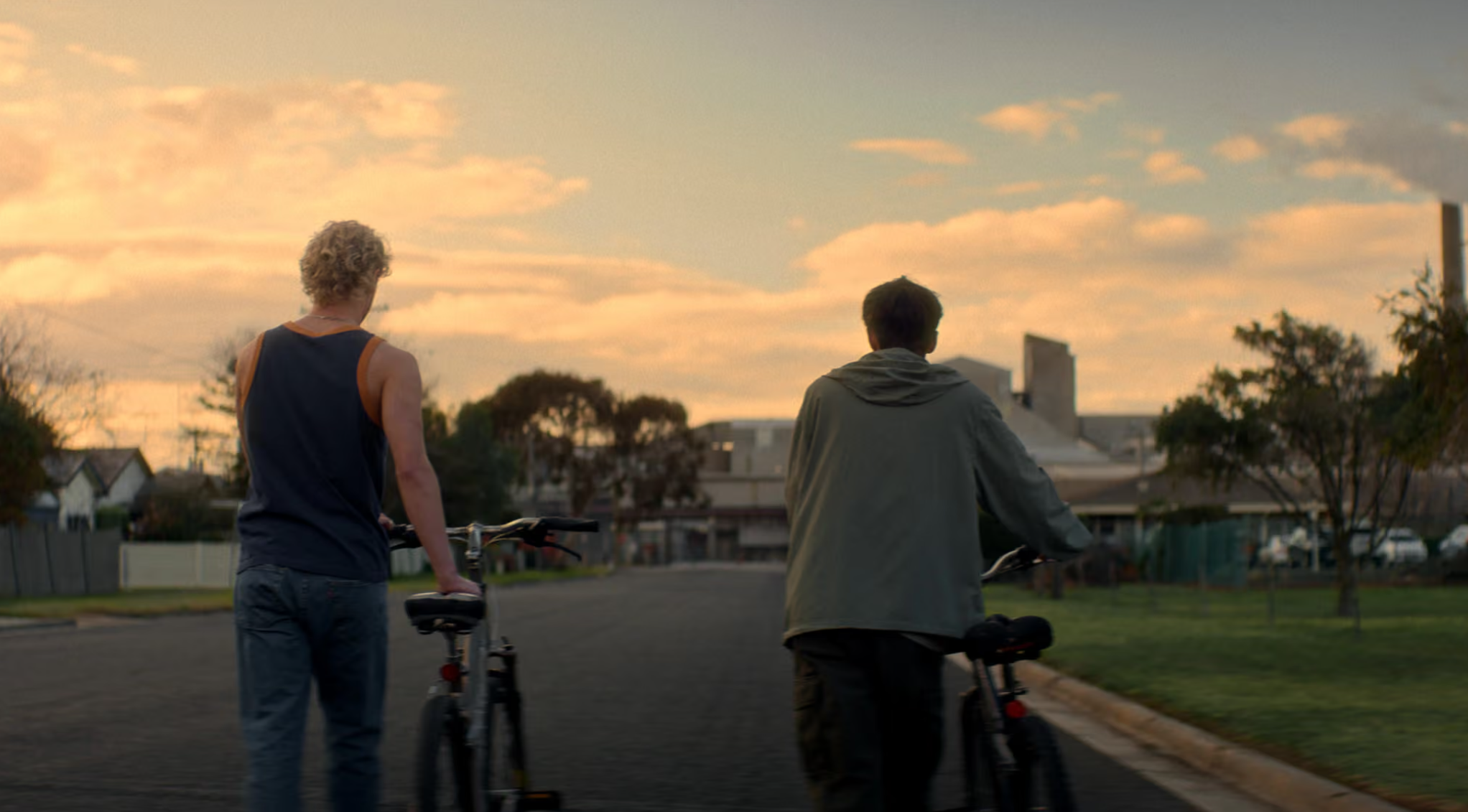
When we meet Joe Bird’s Naim and Stacy Clausen’s Ryan, they are at the precipice of becoming physical with one another. The chemistry between them is about to spark into the next step, but I couldn’t help but notice how they are dressed in front of one another. Ryan is taller and beefier, and his clothes hug his frame–sometimes with no sleeves. Naim, on the other hand, it quieter and more introspective, and his hoodies hang on his body loosely. It’s not just about backstory but about how they feel about themselves.
“We had some backstory where we talked about how Naim’s father had passed away in the six months before, which is why they moved to that town in the first place,” Castellano says. “His mother is looking for spiritual answers in this religious community, but Naim was also getting bullied by other boys at school. There was this complexity to how they all connected to each other and how Ryan has this bravado, which he uses to protect himself. Naim has shrunk into himself, because he doesn’t want to show off his body too much because of all the conflicting feelings he was having internally. Ryan, in a way, is showing Naim a kind of confidence by stepping into himself more. Stacy [Clausen] is quite gorgeous, and every boy is different in how they choose to deal with presenting themselves.”
I mentioned to Castellano that some of Ryan’s tops reminded me of the boys found in XY Magazine from the early 2000s.
“It’s also my understanding that a lot of gay boys love their arms,” she jokes. “That’s still a thing. right? I’ve noticed that t-shirts are often tight to show off some biceps. It’s a vibe.”

How do you create items to wear for a villain that becomes more threatening when more people come in the room. The churchgoers often wear black and beige–unassuming shades that don’t normally hint at something horrific. Castellano doesn’t just think about what can fit into a closet or how a color palette could influence the mood of a scene–she dives deeply into the psychology of what these characters may have been told or be fearful of. There is something quite primal throughout Leviticus, and she went back to nature to underline that natural feeling.
“I really went back and looked at how the title of the film influences our story,” Castellano says. “The title really came from how a priestly tribe would gatekeep spirituality, which can create a distortion–it’s a huge topic, but that was my interpretation. We are dealing with a demon manifestation, but the real demons are really the super judgmental church community as opposed to being compassionate, loving people that are accepting of others. I wanted to work with that, and a lot of the textures that I chose to use on those people were pulled from images that I found in the script like frogs and spider webs. Ryan kind of tricks Naim that there’s a spider on him at one point and then I used the textures of those animals and others, like snakes and lizards, to inform the audience. I wanted to show there was a kind of demon texture of the church community in a more subtle way, and some of those people really evoke a sense of unease. Bethany Ryan, the production designer, and Tyson Perkins, the cinematographer, had a lot of conversations to how we wanted the community to look. There were these pink blinds to cast this pink hue over the congregation, so you could almost see the repression from the self-imposed prison that they put themselves in.”
A character that quite literally changes the course of the lives of the young men in Chiarella’s film doesn’t even have a name (The Deliverance Healer), so Castellano knows that his costuming was essential. I kept wondering if his black outfit would look different depending on the light of the room, and Castellano wanted a less noticeable texture for his clothes. The more you look, the creepier they are.
“He is, in a lot of ways, the most important character, because it all hinges around him,” she says. “I met Adrian for coffee before pre-production, and he was one of the first people that we talked about with this symbolic script images and frogs. That was kind of where we went with him, and Adrian mentioned that he was kind of a traveling salesman, in a messed up way. Maybe he’s pressed his suit incorrectly, and when you do that it leaves this shine and it brings this idea of a frog. It’s a subtle detail but with this demon texture, you kind of have to go against your instincts, and I had this push back. I knew it was right for the character. My costume buyer found this op-shop, shiny suit and the next time we see him, it’s a more casual version, so I went with the leather. It just felt really right without being too heavy handed.”
Before we parted, I told Castellano that I would want to take a few items from her designs for myself. Naim’s jewelry stuck out to me as well as a blue flannel shirt worn by Ryan–it felt only fair to take something from each of them.
“I would’ve taken the knit cardigan that Arlene wears,” she says. “Mia Wasikowska really wanted it, so she got to keep it. It was custom-made, so I was very touched that she wanted it. Otherwise, I love accessories, and finding unique pieces is surprisingly hard to get. I find myself on Facebook Marketplace a lot, so they might be from an estate sale. Jewelry is so personal.”
Leviticus is streaming now on Hulu and Disney+.