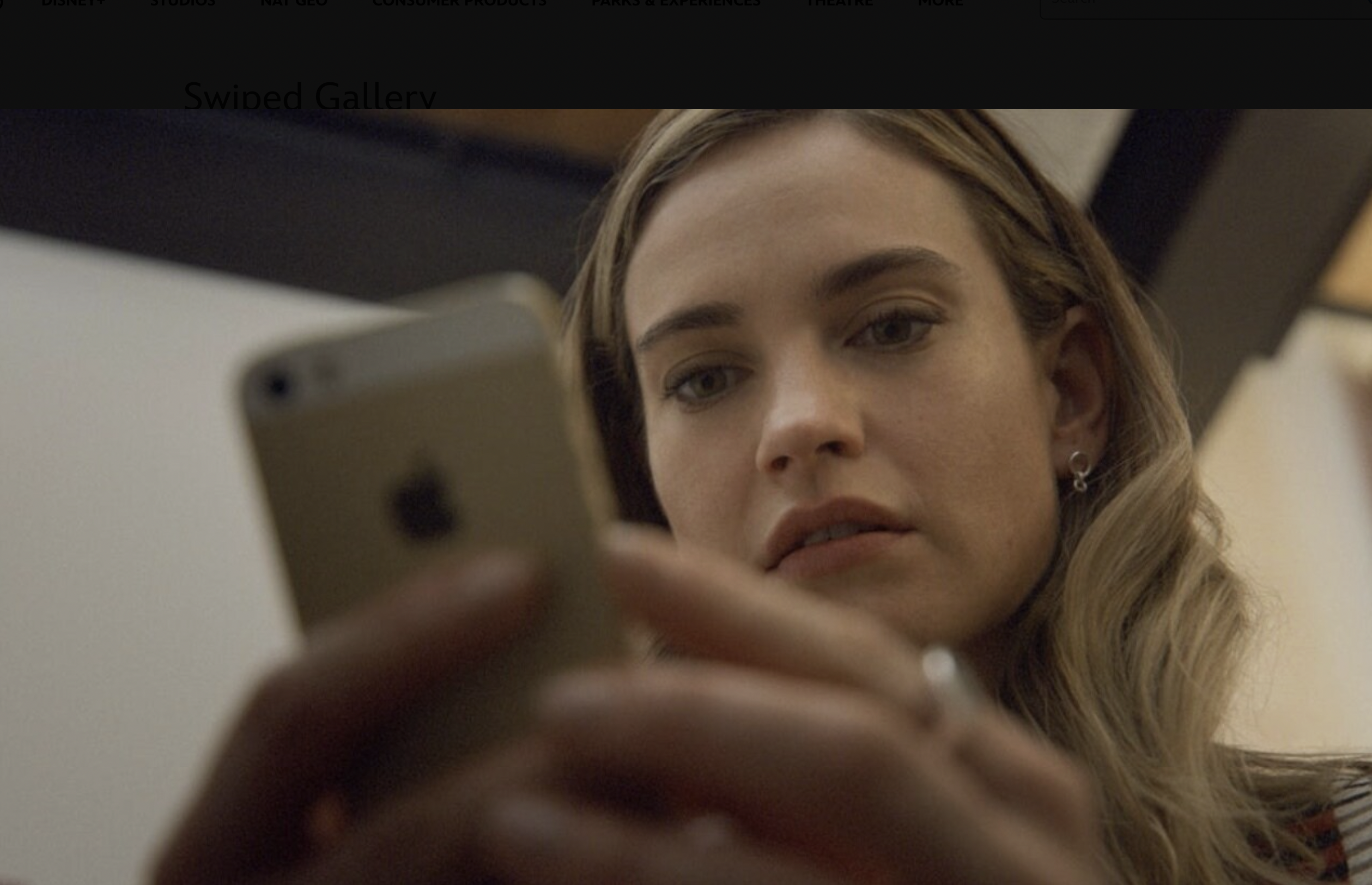
Lily James has carved out a fascinating career since first breaking through as the lead in Kenneth Branagh’s live-action version of Cinderella (2015). Over the last decade, she has earned strong notices in projects like Downton Abbey, Baby Driver, Darkest Hour, Little Woods, The Dig, Pam & Tommy (which earned her an Emmy nomination), The Iron Claw, and Relay. Last year, she took on the part of Whitney Wolfe, the co-founder of Tinder and the founder of Bumble, in the Hulu TV film, Swiped.
At first, it may seem easy to dismiss a film about a woman who helped create two of the most successful dating apps in existence. But underneath that all-too-brief synopsis lies a story of a woman fighting to carve out her own space and identity in the world of tech bros. As usual, James brings a tremendous amount of natural empathy to her portrayal of Wolfe. She also doesn’t shy away from Wolfe’s missteps and faults, creating a well-rounded character, made all the more palpable by the fact that Whitney Wolfe actually exists.
In our conversation, James and I discuss Wolfe’s journey to equity and success by going “first.”
The Contending: I knew Whitney Wolfe had been a major part of Tinder, and then that she had created Bumble. When I sat down to watch the movie, I thought where’s the drama? She was just wildly successful. And then I went oh, she did all that in the world of men. That was when I felt my male blind spot kick in. When you were looking at taking on the part of Whitney, is that something that connected to you, her managing her way through the world of tech bros?
Lily James: The tech world is something I didn’t really know much about. I know that it’s male-dominated. I know the tech bro stories, partly because there are so many movies about them. (Laughs). But this one is from the female perspective. We are looking at this world through the eyes of a very young woman who goes on to break down so many boundaries, and I thought, God, why don’t I know it? Then, as I learned more and found out about this sexual harassment case, and then subsequently this non-disclosure agreement so she can’t talk about her story, I thought that’s interesting. It makes the responsibility of telling this story so huge and much more nuanced. When you look at Whitney’s story as a part of a larger pattern of women being sidelined and silenced, this is a story that has such great power and could really contribute and has important themes, and ultimately is a champion story of great success: what she overcomes, what she creates, how she passes through such setbacks that would cripple most people. She uses that to carve the next chapter of her career and become the youngest woman to take a company public and become a self-made billionaire. It’s such an inspiring story, so deep, so rich, so playful at times, with all these young kids creating these apps. It’s nostalgia, even though it’s only 2012. There was so much in it that I felt honored to get the chance to explore and tell this story, and I was super passionate about bringing it to life in an elegant, dramatic way.
The Contending: When I was watching the movie, I thought of the writer Colette and how, for a long time, she wrote these books, and a man put his name on them. And Whitney created the name Tinder. She created a lot of the marketing that made it so successful. She was the one hustling in the fraternities and the sororities. That sense that, in certain spaces, men want the work of women, but they don’t want to credit women. They want to be kings. I assume that was part of the energy you felt in this film.
Lily James: I think Whitney’s story is so prevalent in so many different industries. This isn’t really a movie about dating apps. It’s about women in business, about toxicity in a workplace, and about honoring women for the work that they do, and believing women when they speak and talk out about their experience, and people being held accountable for their roles and their actions. I felt emotionally and spiritually connected to this story and felt that it was important and timely. It’s a period piece, 2012. But there’s so much more; it’s still so prevalent and important to explore the themes of this story and the narrative. It’s changed me as a person, as great roles do. It’s such a gift to be an actor and get to explore different worlds and different people and to live inside the skin of Whitney and create my version of her, because it very much is. This is a cinematic version of the story, all sourced online. There’s a synergy at this moment in my career, getting to play women like Whitney, and simultaneously building a production company and wanting to take hold of the reins in my career. I take agency in championing the stories I want to and how I can contribute as an actor and as a storyteller, and all these big ideas. There was a collision with this project where I felt they could feed off one another.
The Contending: You’re right, it’s a period piece, but the work that Bumble does, and Tinder, it still exists in the space we’re in now. A movie that comes to mind about modern dating is Materialists. That was a movie that I thought really talked about building relationships and what’s important in relationships in our modern era. I thought this movie did that, too. In your character’s case, there’s a two-part factor. You’re trying to build an app that connects people, and users submit a sort of resume before going on a date, which is a fascinating concept in itself. Maybe less so now, but certainly then. You have a workplace romance in the film. So there are two things going on here in conjunction: the dangers of workplace romance, and, particularly at Tinder, the dangers of dating apps that aren’t managed ethically.
Lily James: It was uncharted territory in terms of the speed and the rise of these companies and the way in which these apps completely shifted culture, and they have a huge responsibility. It was so new and exciting for me to explore. We really wanted to lean into that youthful, kinetic energy where decisions are being made every second, and we don’t even know, or we are perhaps not considering, the impact that they are going to have. I think what’s so remarkable about Whitney is that, going through everything she went through when it came to Bumble, she’s been so intentional in how she built that app and so aware of what she’s trying to achieve, and she continually campaigns to make the internet a safer place for women and protect women, which is so desperately needed. It’s such a frightening place online. I also think ultimately, looking at how we can use tech in a way that there’s still some interaction, connection, that we’re not all just becoming totally isolated. It feels so relevant now, given that Whitney has taken the reins back at her company. It felt really wild that our film was launching at the same time that Whitney was making a big step in her career back into running things at Bumble. I’m so excited to see how that goes and the impact she continues to have.
The Contending: I dated a handful of women from dating apps, and they told me the kinds of messages they were receiving. I wasn’t getting those messages because women don’t typically send gross messages to men, and I was like, “Holy shit, where are the guardrails for women? What Whitney decided to do was to create an app that has this feminist quality, where it protects women and gives them control. It’s a fascinating concept in a world where great ideas on paper have collateral damage, whether it’s the internet, social media, or 24-hour news.
Lily James: Exactly. It’s so true and also really striking when you actually look at the stats on how many women are in power, in the tech world, or creating startups. It’s so drastically low because it’s much harder for them to get financing and backing, and that needs to change. Our ambition with the film was in that realm too: to encourage women to get into STEM and to own the space that they deserve. I think there is now a different, younger woman who’s the self-made billionaire. But for a long time, Whitney held that title. I’ve even heard her say, “I shouldn’t have; someone should have come in by now.” That’s a reflection of the state of affairs in terms of women being given the right platform.
The Contending: When Whitney left Tinder, she wasn’t given the credit she deserved. She was left out of the Time Magazine article as a founder, even though the CEO of the company called her a founder at a party. Then she was dating a guy at the company, and God knows this happens a lot—sometimes we start dating somebody, we think they’re great, and then four months later we’re like, oh Lord, the real person shows up. For her to leave Tinder and to have her character assassinated essentially and be made into a “whore,” I hate to use the word aloud, but she was called that in the office. The need, I think, for women to run companies becomes so significant when you see this sort of treatment, the social media scorn, and the taking away of credit for accomplishment.
Lily James: It was really hard to portray that part of the film. It was really hard learning that part of the film. It sadly feels very familiar, and I get really scared about how dangerous it is online and in the media when people are torn apart. It’s like a public stoning of individuals. I find the story of how she channeled her experiences into something great a reminder that sometimes those setbacks, personal and professional, can be the making of you if they’re channeled into good. This is a pre-Me Too story. We would hope that now, post-Harvey Weinstein, women are heard and listened to, and there’s a different sort of energy. But I think, from everything I learned and researched, Whitney was in uncharted territory. It was really frightening the tide that turned against her. As a young person, navigating and handling that is seriously impressive.
The Contending: Myha’la plays your closest friend in the film. There’s two scenes that you have with her that I want to focus on.. One where she dresses you down for essentially being the woman in the room who didn’t know how to throw the ladder over. Whitney didn’t know how to operate in this space. She didn’t know how to throw the ladder over. At first, that creates a rift in your friendship, and then you come back later, and your character takes accountability. I remember watching the film and thinking she was trying. She’s nice, she’s kind. But there is something that has to happen behind niceness, kindness, and going along with something because you’re becoming successful, that is paramount. There’s an accountability, there’s a responsibility to it. Whitney, owning that responsibility, I thought, was really significant because otherwise it would’ve been very easy to just make Whitney a victim who became successful.
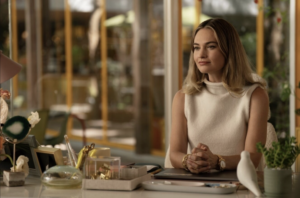
Lily James: I had no interest in playing a perfect version of her or skirting around some of the harder issues and conversations she was part of. Especially in a bit of cinematic narrative, you need the character to have the dark night of the soul and to be really confronted with the mistakes that they’ve made along the way, their blind spots, their ignorance. Watching a character move through that, learn from it, and make changes is essential. I have an amazing acting coach that I worked with on this movie, and she is just incredible. She was such a rock for me in this experience. She said the lead character can’t win every scene. You’ve got to show them at rock bottom, you’ve got to show them behaving badly. Like that scene with Myha’la in the bar, I really think that people need to be shocked by Whitney and maybe not even like her in that moment. And that’s okay because we’ve seen what she’s been through. We behave badly when we’re struggling and when we’re going through a lot. Bringing that level of humanity to it was very important to me. I hope we achieved that by creating a well-rounded character. This is bigger, it’s a look at a person and their ability and their growth and how they overcome circumstances, which is a story that is a universal hero’s journey that’s beyond the tech world or anything. It’s a compelling narrative.
The Contending: You’re such a naturally empathetic actor that it was really easy to follow along and just get caught up in what was happening to your character. But in that moment when you are challenged, of course, your character is like a lot of people who are defensive in the moment, “I wanted to do right.” In this day and age, being criticized almost always results in a non-apology and a defensive reaction. To watch a character absorb this painful criticism and come back and say yeah, you were right, I think, is really important.
Lily James: Yeah. I have had so many messages from women after this movie came out, writing to me on Instagram or whatever, saying thank you for the story, and sharing their own experiences of potentially toxic workspaces or how they’ve managed to get out of toxic relationships. I’m always so moved when I hear those stories because it’s so widespread and across so many different industries. I was able to draw on my own experience and really try to be as vulnerable about this as possible, not shy away from the darkness there. I think that’s why people have responded so well to the script and to Whitney initially. And then, I hope, to the film too.
The Contending: In a previous life, I worked in ed tech at a place with an office with these alien egg-shaped silent spaces and all these other weird things. Nobody used those, by the way. (Laughs). They might have sat in it for a minute to see what it is like. When I’m watching the movie, and I’m seeing the slide, I’m thinking, where are the adults in this business?
Lily James: There were none.
The Contending: That’s what was so striking about it: Whitney is more adult than these people are, but, at least in the Tinder part of the film, she has to play this game to fit in and be successful, even with all the harm that’s done to her.
Lily James: Our director, Rachel (Lee Goldenberg), worked at Funny or Die for a long time. I think some of the stuff in that workspace environment with tech bros was very real to her own experiences, and so a lot of that writing is very much channeled from her. I think she captured that really effectively. We all have to adapt to our surroundings to move forward. There’ll be a moment in most of our lives when we ask, “Where are my boundaries?” What are my non-negotiables, and how much am I willing to compromise? We didn’t want to shy away from the fact that our version of Whitney, our interpretation, was grappling with that, and at what point, potentially, did she lose sight of her core values and what she really believes in. As women, there can often be no role model, particularly in that space. She had no one to look up to; she was figuring this out for herself. This all felt like fertile, beautiful, real stuff to explore in this film.
The Contending: The thing about trailblazers is they exist because no one else has blazed the trail. One of the hardest things in the world to do is to go first.
Lily James: Whitney’s whole mantra is make the first move. Just do it. Go.
The Contending: That’s what makes the last line of the movie so great. Just previously, she’s found this partner in Andrey, who seems very different from the folks at Tinder. In some ways, he is. By the way, I didn’t even recognize Dan Stevens as Andrey.
Lily James: He’s so talented. He’s so transformative, no matter what he does. Some actors, you’ll always see them. You see that actor, and that’s beautiful, and then some actors just disappear into every single role. And with Dan’s, you’re like, whoa, where’s Dan gone? It’s so incredible.
The Contending: Whitney thinks she’s found this new male partner who isn’t like the other guys. And like I said, in some ways he isn’t. But in other ways, and in ways that are important, he hasn’t been managing his own ship as he should be, either. It creates this situation where Whitney has to decide, if I’m going to do this differently, I can’t go along anymore.
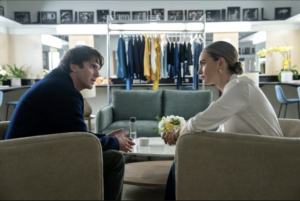
Lily James: There is creative license there, because it didn’t happen exactly in this way, but when she decides, okay, this is what I stand by, no matter the consequences, no matter what I might lose, I am going to speak out. I’m going to speak my truth. I’m going to protect those around me and stand by the women around me. I got chills every time I gave that speech because it felt so necessary to hear those words now and to see someone who leads with integrity and morals. As a culture, we’re losing that now, and it’s a scary place. So it stands out when you are looking at someone who’s not willing to compromise and not willing to be corrupted.
The Contending: What I loved about Swiped is that it makes it very clear that courage does not exist in the absence of fear. You have to be afraid to have courage. There’s a great song by Jason Isbell called “Be Afraid.” It says, “Be afraid, be very afraid. Do it anyway.” That’s what I felt in your character.
Lily James: Oh, I love that. Thank you. I love that courage doesn’t exist in the absence of fear. It’s so true. What I loved is that sometimes the rock bottom moments, where you are on the precipice of giving up, are actually where great inspiration might lie, those crossroads moments. Whitney has talked very openly about that moment in her career and journey. When we shot that sequence in the apartment, we left the cameras rolling, and at the end of the movie, it’s quite a stylized sequence. There’s a billion different ways that we could have shot that, where really the camera was just there, and I was losing it. I felt like in order to do justice to her story and celebrate the highs, you have to lean into the darkness. You have to show the peaks and the troughs of this story. And it felt essential to me that we leaned into the darker moments of this, and we were unafraid. That was difficult because there were all these legal restraints, and we had to handle it with great care. I was pretty drained after this one.
The Contending: The last line in the movie, when another man comes into your office and says, “I want to fund you; I want to support your venture.” And he’s about to talk, and you say to him, “How about I go first?” There is a change in your facial expression that doesn’t exist throughout the rest of the movie, a steeliness that you’ve built up to.
Lily James: I loved that final line. There was this full-circle moment. I wanted to see a young woman really growing into herself, where she doesn’t need to push, force, or fight anymore. There’s an innate confidence and growth and belief in herself–the amount of times I’ve wanted to say that!–but there’s also a lightness to it. There were different ways that I delivered that line. We shot that right at the end of the movie, so we’d had a lived-in experience of the film. I always want to mark the trajectory of the character. This could have been a TV series. There was so much more and so much more time we could have spent. Her building of Bumble was so difficult; it wasn’t easy. We show it in a montage because that’s how it goes, and we only had an hour and 40 minutes. She experienced a lot of setbacks in making that; none of this shit is ever easy, and particularly for women. That being said, I wanted that moment to show real growth in her as a woman. I thought that was such a pinnacle moment where she just says it. It’s a mic drop moment at the end of the movie.
Swiped is streaming now on Hulu and Disney. James is being considered for an Emmy nomination in the Outstanding Lead Actress in a Limited or Anthology Series or Movie category.