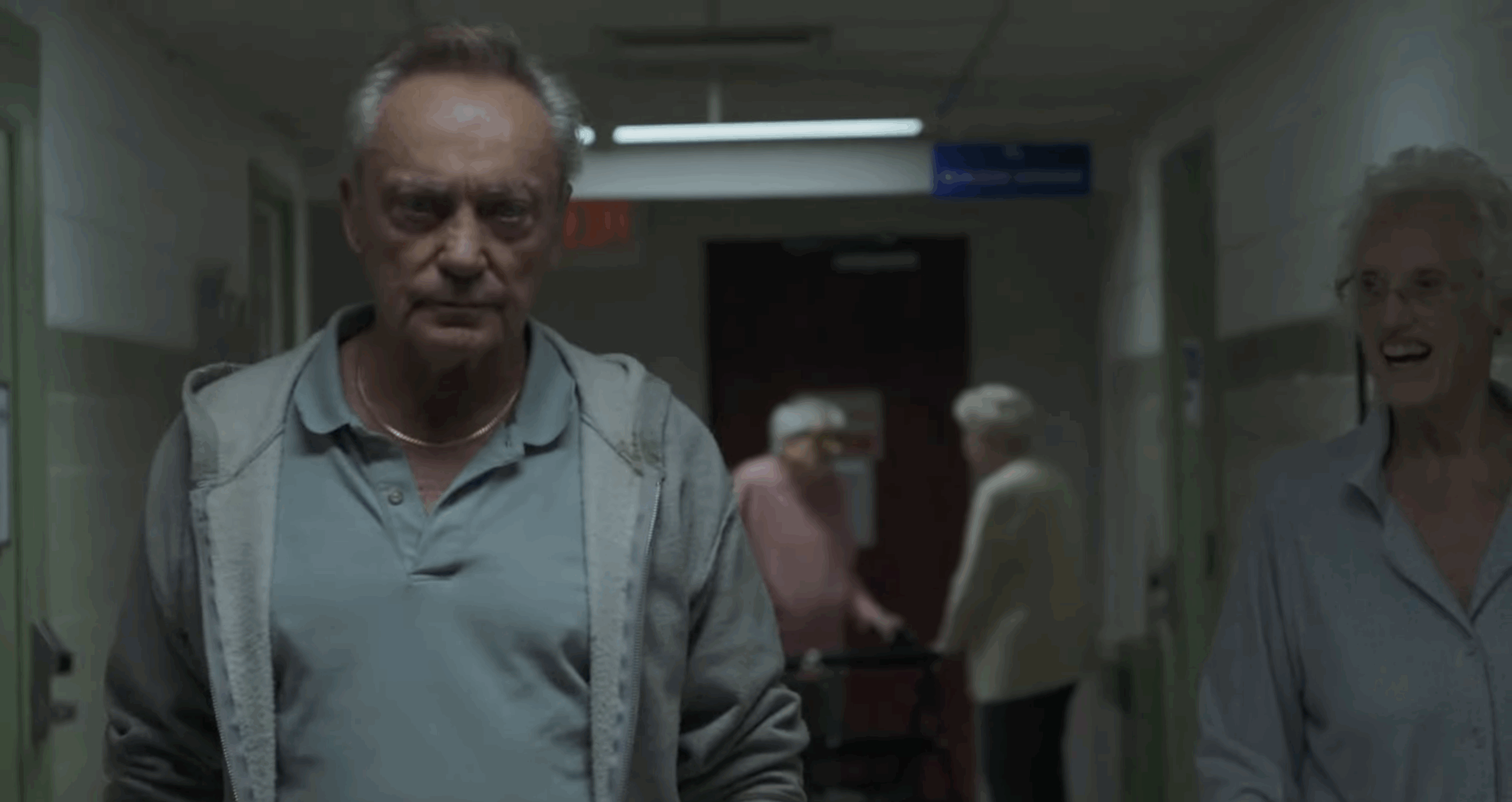
Udo Kier’s life began with a bomb. Born in Cologne, Germany, in 1944, the hospital where he was delivered was met with Allied bombs just as Kier came into the world, and he and his mother had to be dug out of the collapsed building to be saved.
Kier made a couple of movies in Germany before crossing the Atlantic and appearing in two Andy Warhol Factory films, Flesh for Frankenstein (1973) and Blood for Dracula (1974). Neither of the Paul Morrissey camp-horror films was well received by critics at the time, but both went on to become cult classics. Just as critically for Kier, the Warhol films put him on the map.
Dario Argento’s 1977 horror touchstone, Suspiria, gave Kier his first critically appreciated film. Kier’s friendship with the German New Wave auteur Rainer Werner Fassbinder resulted in four consecutive collaborations: The Fifth Commandment (1978), Fassbinder’s monumental miniseries Berlin Alexanderplatz (1980), as well as Lola and Lili Marleen (both 1981).
By the early ‘80s, Kier had established himself as an art film regular. His parts were often small, such as “Gay man” in Paul Mazursky’s Moscow on the Hudson (1984) starring Robin Williams, but the films were often significant. Kier was unique in being an openly gay man working in the film industry. His unabashed self-acceptance made him an icon in the gay community.
His flamboyant persona and talent caught the eye of many great directors. Gus Van Sant (My Own Private Idaho, Even Cowgirls Get the Blues, Don’t Worry He Won’t Get Far On Foot), Lars Von Trier (Europa, Breaking the Waves, The Kingdom, Dancer in the Dark, Dogville, Manderlay, Melancholia, Nymphomaniac), Wim Wenders (The End of Violence), Elias Merhige (Shadow of the Vampire), Werner Herron (Invincible, My Son My Son What Have Ye Done), Alexander Payne (Downsizing), S. Craig Zahler (Brawl In Cell Block 99, Dragged Across Concrete), Bart Layton (American Animals), Todd Stephens (Swan Song, for which Kier received an Independent Spirit Award nomination for Best Actor), and Kleber Medonca Filho (Bacurau, The Secret Agent). To have your name listed in the credits of all of the aforementioned films is to have one hell of a resume.
Big-budget Hollywood films eventually came calling, too. Kier could be seen in Ace Ventura: Pet Detective, Johnny Mnemonic, Armageddon, Blade, End of Days, Surviving Christmas, Grindhouse, and the 2007 remake of Halloween. There was also plenty of camp. Aside from some of the Hollywood films listed above (there’s some overlap, here), Kier also had roles in the Pamela Anderson disaster Barb Wire, FeardotCom, BloodRayne, and Grindhouse.
He even appeared in two Madonna videos (Erotica and Deeper & Deeper). You’d have to look long and hard to find a more eclectic filmography than the one owned by Kier. Sometimes his iconography overwhelmed a proper assessment of his ability, which brings me back to his most recent film, the 2025 Oscar Contender from Brazil, The Secret Agent.
In Kleber Mendonca Fliho’s excellent political thriller, Kier plays Hans, a Holocaust survivor who fled one oppressive regime to end up in another (Brazil’s military dictatorship) three decades later. Again, Kier doesn’t have many scenes, but he does have one of the best ones. Relatively early in the film, Hans is harassed by three local cops who wield power and stupidity in equal measure. The officers force Hans to pull up his shirt to expose scars from torture at the hands of the Nazis. Kier pulls up his shirt, revealing his wounds, and suffers his humiliation while gazing upward. In that moment, the wordless Kier accomplishes so much more than he might have with dialogue. His expressive face connects the pain the powerless feel under the heavy hand of tyranny. From Europe to South America. It is a profound and powerful sequence, made all the more so by Kier’s humanity.
Udo Kier was an icon and an artist.
Udo Kier died on November 23, 2025. He was 81 years old.


![James Cusati-Moyer On the World Premiere of ‘Sacred Creatures’ at Edinburgh International Film Festival [VIDEO]](https://thecontending.com/wp-content/uploads/2026/08/SC_MicRay_10_Courtesy-Nicolas-Villegas-H-120x86.jpg)