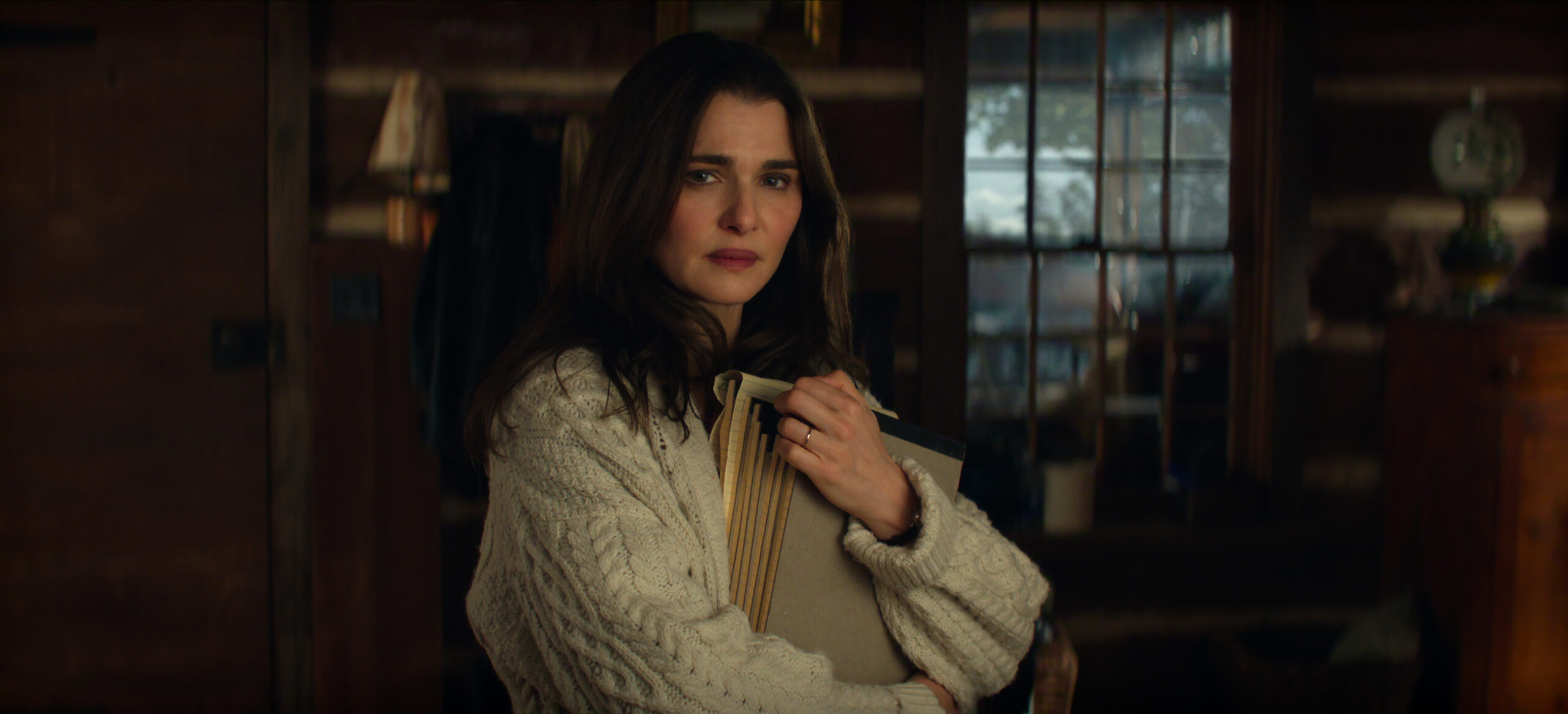
The first time that Rachel Weisz turned to look directly at the camera in Julia May Jones’ Vladimir, I gasped. How lucky are we that her character, M, decides to turn to us–yes, we as a collective–so we can join in on thirsting over the new literary hunk in town? We consume so much with our eyes through the gaze of Weisz’s M, and we become giddy with these unsuspecting glances. Is fantasizing better than actual consummation? Vladimir edges us with equal parts yearning and intelligence while dissecting the differences in generational consent and sexual education. It stimulates the mind as much as your senses.
M and her poet husband, John, are dealing with scandal from the very first episode. He had multiple consensual affairs with students, and he is not under investigation by the university where they both work. If you ever had dreams of attending a college within a small town, the setting of Vladimir will make you swoon almost as much as the restrained lusting does. Everyone knows everyone’s business, and even though M is public about knowing of her husband’s extracurriculars, the stain has begun to rub off on M’s reputation as well. ‘John and I have always had an arrangement,’ she tells us. ‘The kids today would call it an open marriage, but without all the awful communication.’
When Leo Woodall’s Vladimir enters the picture, though, M immediately lights up. And why wouldn’t she? Portrayed with seductive ease by Leo Woodall, it’s no wonder she feels like it’s her turn to consider a dalliance. It might surprise some viewers that a physical relationship doesn’t begin right away since M and Vlad (I can call you Vlad, right, Mr. Woodall?) have an instant spark. He trusts M almost implicitly, but that might be because other professors at the university feel too at-home with the school’s traditions and “that’s how we’ve always done it” attitudes. This is the slow burn seduction that we’ve been waiting for: the kind that’s more about the chase and the pursuit than the carnal act itself.
Jones’ provides many obstacles in the way in the form of Vladimir’s wife, Cynthia, an adjunt professor who the younger students take a shining to, and his respect for his family. Other scripts would have had an affair burst through in the first episodes, and M and Vladimir would try to shuffle off their feelings and deny their expectations of each other. Vladimir seems more concerned with the flirtation and the waiting. At M’s encouragement, the camera lingers on every part of Woodall’s head: the nape of his neck, his ear, his chin, his stubble. Her fantasy of him inspires her as much as it turns her on as she begins to write a follow-up to her first book. When Vladimir attends a pool invitation instead of his wife, even John notices his looks. ‘You’re very sexy, Vladimir,’ he says as the pool day carries on. John Slattery, in full relaxed, “call me John, not professor” mode, offers a different version of sexy.

There are many moments throughout this season about how M should be behaving. She should publicly denounce her husband’s behavior. She should’t attend a meeting for business alumni. As her need to release begins to climb, the more reckless she becomes as editing seems to throb as it cuts back to the images M has in her head of Vladimir touching her or dominating her. Miriam Silverman, as buttoned-up Florence, represents the prying eyes of those who want to curb or dictate M’s behavior as it reflects onto the university. Silverman, a Tony winner for The Sign in Sidney Brustein’s Window, is delightfully rigid. Her back always seems straight as she honors the school’s and society’s honor code. But you can tell there is something lurking to let loose, and Silverman brings so much color to her screentime. Perhaps, in another timeline or world, M and Florence could toss back some shots and gab about their shared flirtation with danger.
Weisz connects with us with naughty assurance. We become her accomplice, her confidante, and her witness as M’s need for her colleague begins to whirl around wilder and wilder. She has always been able to take material by the scruff of the neck, but she’s an absolute marvel in her indecision here. We share her disappointment, her cunning, and her longing. It’s the kind of performance where you never know what she is going to do next. Weisz is sexiness incarnate. I love how costume designer Luis Sequeria incorporates the color red throughout the season, and the production design, by Sharon Lomofsky, is stellar. The wallpapers throughout M and John’s home are incredible.
Any time M and Vladimir share a scene together–no matter how small the interaction–they flicker off. It doesn’t matter if they are talking about literature or their respective marriages. Weisz and Woodall are incadescent. When he tells her, ‘My wife says I have a thing for crazy girls,’ we blush since he mentions his marriage in the same sentence as what gets his motor running. So much of Vladimir is about how not one marriage fits all but also how so many of us judge the kind of marriage that we don’t have. Should the students of this university loosen up and listen to M’s analysis of Rebecca or The House of Mirth and other classic literary heroines? Why should the students and other faculty assume that M should conform when she is only going after what her mind and her body tell her to?
Vladimir is thrillingly rebellious. A fiery tribute to the fires and desires that we should always be curious about. Dare to lean into the restraint.
Vladimir is streaming now on Netflix.