“Inspired by true events.”
Eif Rivera’s feature debut, Killing Castro, is being sold as a reimagine version of history blending Cold War historical drama with political intrigue. So as long as you don’t mind your history with some speculative bells and whistles added, you will have a blast. Rest assured this is no JFK, where Oliver Stone put forth a perspicacious theory behind the Kennedy assassination. (Because who the fuck still believes the corrupt Warren Commission’s insane notion that Oswald acted alone?) This movie blends real and fascinating facts—Cuba’s revolutionary leader Fidel Castro’s 1960 visit to NYC to address the United Nations at a time when our country’s leaders wanted him dead—and turns it into a riveting thriller involving the CIA, FBI and even the Mafia—all of whom tried to kill Castro many times, but somehow always bungled it.
It’s easy to watch this film and dismiss it as sheer fantasy but released CIA records prove that the screenwriters (Thomas DeGrezia & Leon Hendrix) did their homework. But then they added their own ideas that take the film somewhat into silly thriller territory.
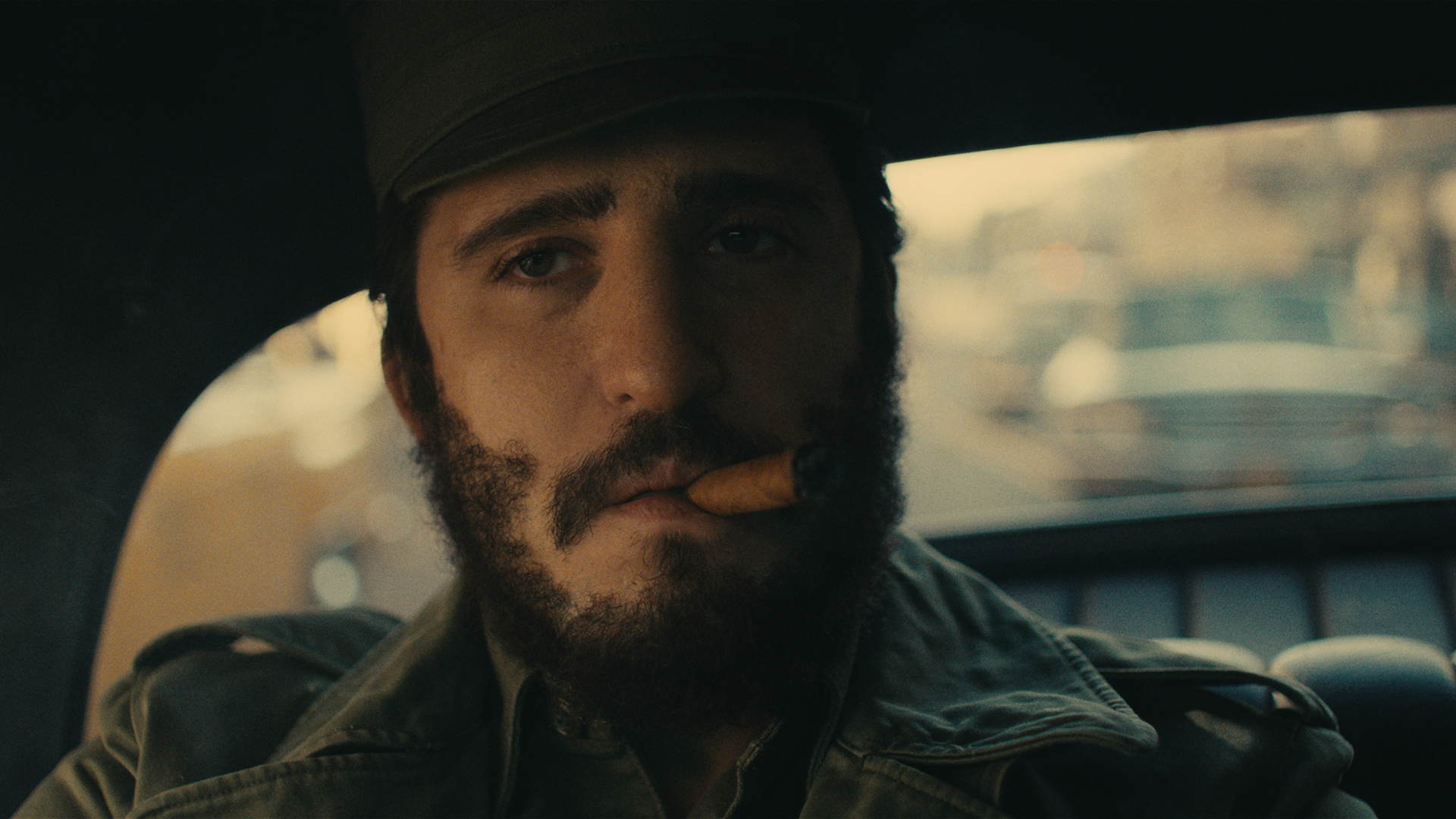
The narrative has Castro (a dastardly Diego Boneta) unwelcome at any New York hotel (fact-ish, it’s rumored he left his previous hotel) until the Hotel Theresa in Harlem, extends an invitation (fact), via the Black activist Malcolm X (Kendrick Sampson) (fact-ish, whether he was invited by Malcolm or Malcolm seized on the opportunity is up for debate). Soviet leader Nikita Khrushchev, also in town, took it upon himself to journey to the Theresa to meet with Castro, a savvy political move showing the world, “by going to a Negro hotel in a Negro district, we would be making a double demonstration against the discriminatory policies of the United States of America toward Negroes, as well as toward Cuba.” (from Khrushchev’s memoirs). The Eisenhower administration was not happy and did not want Castro to deliver his speech (obvious fact). Did they want to stop him “at all costs?” Possibly.
In the summer of 1960, the CIA recruited operative Robert Maheu (Al Pacino, having a blast), who was working for Howard Hughes at the time, to orchestrate the assassination of Castro. Maheu visits mob boss Sam Giancana (Paul Ben-Victor) who, along with his Johnny Boy-like flunky, Johnny Rosselli (Logan Marshall-Green, so good I wanted more), agree to “remove” Castro. All this, astonishingly, has been proven via CIA records. The how and why that none of the attempts panned out is where the writers get a bit too ’80s action-adventure creative and the story goes more than a bit wonky—if Maheu is such an expert at what he does why would he–and I cannot finish this sentence without giving too much plot away. I will say the cinematic exclamation point near the very end, while understandably satisfying, felt facile (and so easy to disprove by simply checking one’s actual death year).
A lot of time (too much) is devoted to a young translator (and our narrator) Leonel (Xolo Maridueña) along with his relationship with the daughter of the hotel owner (KiKi Layne). Both become ensnarled in the politics and intrigue. And it’s through Leonel that we are able to follow much of the story. Suffice to say they’re not the most exciting characters.
Rivera, a music video director, captures the period quite well.
This is Pacino’s meatiest role since The Irishman, which should have won him a second Oscar.
Much of Killing Castro is dizzyingly entertaining conjecture. One of the most intriguing aspects about the film is in its almost sympathetic portrayal of Castro vs. how bloodthirsty and downright bumbling the Eisenhower Administration is depicted. But the film is also a taut and tense look at a time right before the world was brought to the brink of nuclear annihilation, via the Cuban Missile Crisis. That alone, makes it a worthy sit. I just wish less time had been devoted to wild speculation.