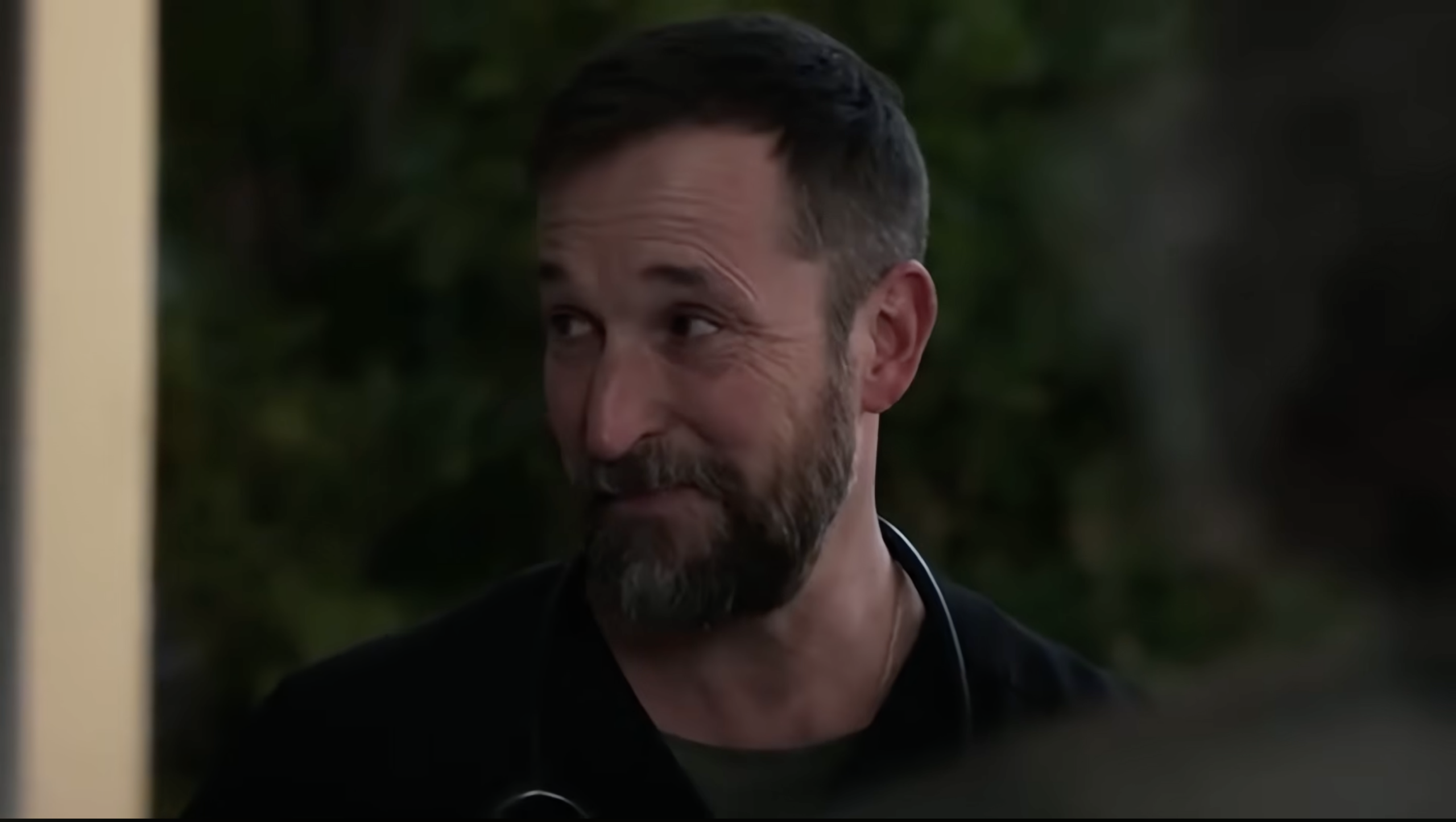
Unlike its multi-award-winning first season, this year’s model of The Pitt didn’t build up to an exterior crisis that nearly overwhelmed the beleaguered emergency center. Sure, there was a wildly inconvenient loss of internet service that forced the staff to go analog while tracking their patients’ welfare, but there was nothing like the mass shooting event that provided the climax of the initial season.
The Pitt has always noted the chaos and strain of working in an understaffed emergency center, and the impact on those who provide care. Hell, one of the first scenes in the pilot is of Dr. Abbot (the terrific Shawn Hatosy) standing at the edge of the hospital’s rooftop, and, quite possibly, considering a dive. Let’s also not forget Dr. Langdon’s (Patrick Ball) self-medication through the theft of hospital pharmaceuticals, just so he can get through a shift.
Season two expands upon the theme of burnout and dark thoughts on the part of those whose job it is to take in the most acute cases, diagnose them as quickly as possible, and then attempt to piece those suffering back together, to keep them alive.
Because the first season of The Pitt ended with such a high-pitched crescendo, it might be easy to undervalue the early episodes of the show’s sophomore turn. This 15-hour shift is more of a slow burn, which, with equal measures of boldness and confidence, trusted its story and, just as notably, its audience.
Noah Wyle’s Dr. “Robby” Robinavich has always served as the center of this large ensemble (all of whom are given more grace notes than any writing staff should be able to scribe), but in season two, as the real-time hours go by, it becomes more and more apparent that the healer is slow walking toward a future that may be short-lived.
Having not taken a vacation for years, Robby has decided to take a three-month sabbatical, jump on the back of a fairly newly acquired motorcycle, and head out to parts that are unknown even to himself. Considering what Robby went through last season, struggling with his grief over the death of his mentor from COVID, and being unable to save the life of the girlfriend of a young man he is a surrogate uncle to, it’s not difficult to understand the roiling angst just below Robby’s sometimes surly, but usually professional surface.
As the season moves forward, so does the evidence of Robby’s depression. He snaps harder at his residents (especially Dr. Mohan for having a panic attack). He makes cryptic comments about patients out in the open. The worst of which is when an addled construction worker falls from a beam and will never regain normal function. Robby suggests he should have slipped from a greater height, because death would be better than what the man is facing.
The most revealing conversations regarding Robby’s mental status are had with Duke (Jeff Kober), an aging gearhead whom Robby has befriended over their shared love of motorcycles. Duke comes to Robby’s emergency center and is diagnosed with an aortic aneurysm—a condition the afflicted sees as more of an inconvenience than anything else, despite Robby’s attempts to persuade him otherwise.
Over the course of the first thirteen episodes, the relationship between Duke and Robby, in terms of care and advice, begins to flip. Duke starts to recognize that lost look in Robby’s eyes, and his fierce need to get out of the hospital, which is in a heated battle with Robby’s gut feeling that the place won’t survive without him. The idea that Robby’s emergency center is incapable of functioning without his presence speaks to his ego and his desperation.
Robby doesn’t trust incoming Attending Dr. Al-Hashimi (welcome cast addition Sepideh Moafi) to take over for him. She has years of experience, seems to be lacking not a shred of confidence, and Robby yet, can’t quite hand over the reins. Al-Hashimi does things differently. She is at the forefront of using AI for charting to improve efficiency, allowing doctors to see more patients. Robby, not without reason, doesn’t trust AI for matters so delicate as accurately noting all of a patient’s health details. Still, there is no reason to believe that Al-Hashimi is going to take a wrecking ball to Robby’s emergency center. That is, until Al-Hashimi exposes a health concern of her own to Robby, furthering his “should I stay, or should I go” conundrum.
In bits and pieces throughout the season, we discover facts about Robby that are among the many weighing on his mind outside of the hospital. His mother abandoned him when he was eight. He is unmarried and unattached. He once pictured himself as a doctor who would reach his current age with a wife and two children preparing for college. The typical midwestern/rustbelt nuclear family.
All Robby really has is the hospital—a place where he has done extraordinary work—saving many lives. But if the hospital is all Robby has. Is that enough? It’s not just the challenge of treating the sick and injured, or dealing with the draconian bureaucracy of the modern healthcare system; it’s also the fact of being surrounded day after day by death.
Robby is such a good doctor that it’s not difficult to see how he has been able to compartmentalize the wins and the losses, but now the losses aren’t just coming from inside the hospital; they are coming from his outside life, and what little of one he has. It would be easy to chalk up Robby’s struggle to that of a midlife crisis. That assessment would not be incorrect, but it would surely be wanting. For Robby, his lifetime is piling up on him, and not only does he not like what it amounts to, he can’t see how it will change for the better
When the only place your life makes sense is in a state of constant 15-hour shift chaos, well, you may have a problem. In episode 14 of The Pitt, Robby (in an astounding sequence of controlled anguish) tells Duke, “I don’t know if I want to be here anymore.” Duke replies that he understands. He doesn’t see how anyone could spend more than a few moments in an underfunded, understaffed emergency care facility. But Duke misses Robby’s meaning. A meaning Robby makes clear when he chokes out the words “I don’t know if I wanna be anywhere anymore.” If you’re a person who has ever had that thought pass through your head, and I have, I can’t imagine that line landing with anything less than devastating force.
At that moment, we find that all the bread crumbs dropped throughout the season have led us to this place. Robby’s desire to get on a motorcycle and just drive is about more than a reprieve or a vacation; it is a crossroads in his life. One direction leads to continuation, the other to an end. As Duke puts it, “That’s not riding. That’s running.”
In Bruce Springsteen’s great 1975 road anthem, Born to Run, he sings of jumping on the back of a motorcycle with his gal Wendy behind, arms “strapped “ across his “engines” and hitting the open road. It’s a song of hope, even if the destination is unknown. But Born to Run is a young man’s song. It’s a song about getting out, finding a better place, and finding it with a partner.
Robby is no longer a young man. He is not full of hope. He has no Wendy. It’s too late to get out while he’s young. He is a lost, heartbroken man about to get atop a vehicle that Springsteen called a “suicide machine” in Born to Run.
As the season came to a close, Robby has still not left the hospital. His bike is just outside the sliding doors. If he does choose to take that two-wheeled vehicle and run it over an uncertain blacktop, the question he will have to ask himself is whether he’s on a motorcycle or a suicide machine.