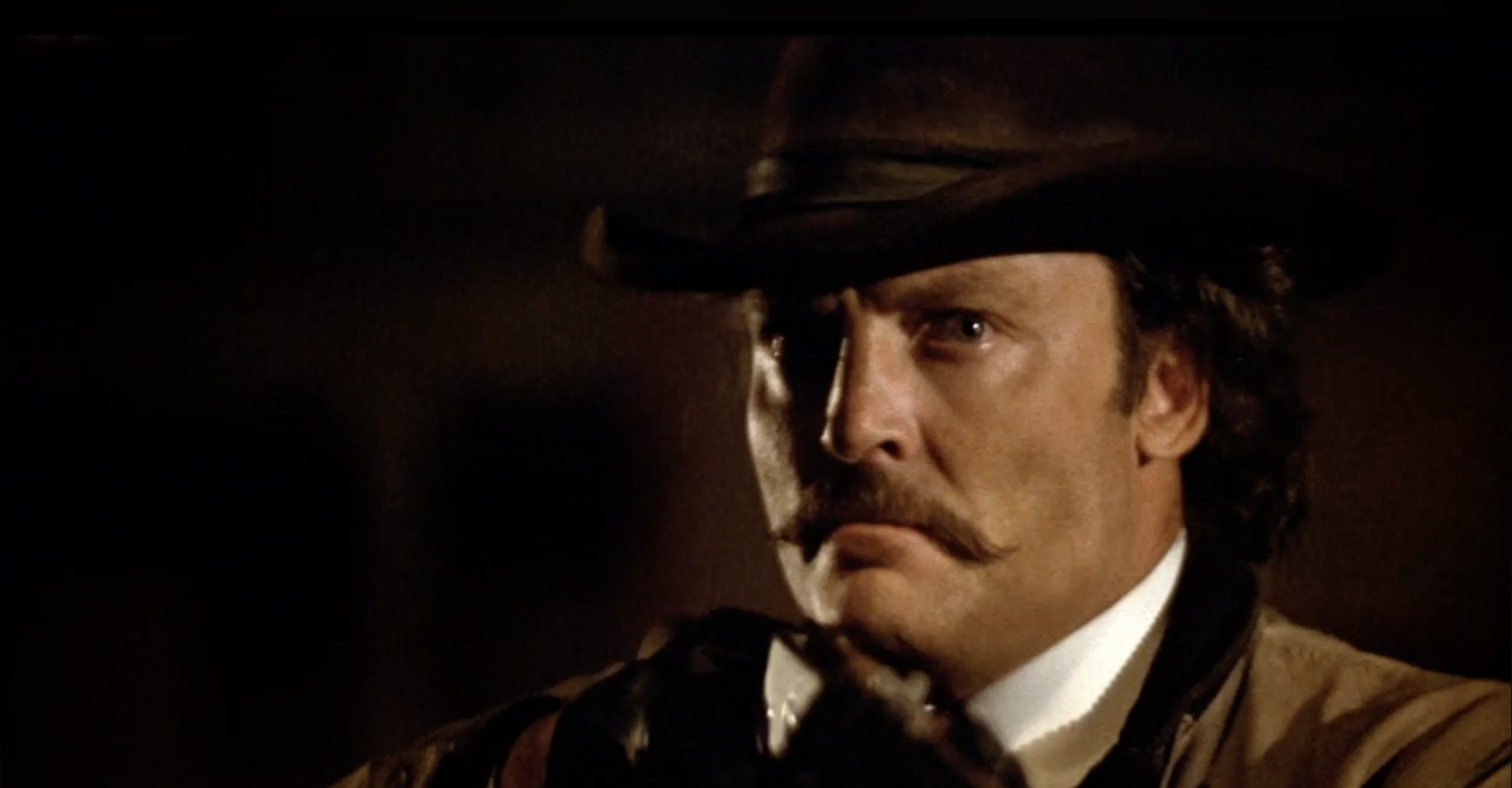
Stacy Keach was born with a cleft lip and a partial cleft palate. The surgeries required to correct the conditions left Keach with a scar under the right side of his nose, just above his lip. Growing up, I doubt anyone looked at Keach and thought he would one day be an actor, let alone a leading man. But Keach had plans, and they didn’t include not acting.
I first saw Keach on television in the mid-80s as Mike Hammer, an adaptation of Mickey Spillane’s tougher-than-leather private eye, which aired on CBS from 1984 to 1987 and again in 1997-1998. At least the actors have played Spillane’s gumshoe since the author brought him to the page in 1947, but none were better than Keach. Despite the restrictions network television put on the pulp that could be displayed in the series, Keach was absolutely aces. Charming, handsome, and dangerous. His every line reading seemed infused with either double entendre or a barely-cloaked threat. He was a bad man.
I later discovered how much range Keach had as an actor and as an artist. In a career that contains more than 400 screen credits, it’s impossible to list all of his memorable roles, but from a personal standpoint, I do have my favorites; here they be:
In 1980, Keach made the Western The Long Riders for Walter Hill. Keach played Frank James. His brother James played Jesse James. David, Keith, and Robert Carradine played the Younger Brothers, and Dennis and Randy Quaid played Ed and Clell Miller. Hill directs The Long Riders as if he wanted to top Sam Peckinpah’s The Wild Bunch, and I’ll be damned if he doesn’t get close. Stacy Keach proved to be first among equals in a film featuring a casting coup of gifted brothers. Every moment on screen, he is completely authentic. The same characteristics he would later bring to Mike Hammer were on display. Every time Stacy Keach smiles in The Long Riders, you’re not entirely sure if he’s warming up to someone or about to shoot them. The Long Riders is a great, oft-overlooked Western and deeply worthy of discovery.
When Keach decided to go full-on bad guy, he could be even more terrifying. In 1998’s American History X, he played Cameron Alexander, a white supremacist leader manipulating his two sons (played by Edward Norton Jr. and Edward Furlong). All the attributes he brought to his “good guys” were no less useful when he broke bad. It’s just that his sinister charm left less than a 50/50 chance of causing harm. Edward Norton Jr. earned an Oscar nomination for his performance, and it was well deserved. But Keach’s antagonist supplied the dark weight in the film.
I had the distinct pleasure of interviewing Holy McCallany last year for the fifteen-year university of his gone-far-too-soon boxing drama, Lights Out. The series ran for only a year on FX, a victim of low ratings and the network’s unwillingness to give the show a chance, despite the great reviews it received. McCallany starred as Patrick “Lights” Leary, a retired champion who risks his life to get back in the ring because of money problems. Lights Out is as much a family drama as it is a sports series, and Leary’s birth family may not be good for him at all. His brother (Pablo Schreiber) is his manager, but he isn’t taking care of Patrick’s money. His sister (Elizabeth Marvel) sees him as a meal ticket. Then there’s his father, known as ‘Pops,’ who is also his trainer. Stacy Keach plays Pops, the kind of “sports dad” who is very dangerous to his child. The kind who lives vicariously through his child, and controls him through guilt and feigned genuineness. ‘Pops’ is as dangerous to “Lights” as his opponents are.
When I spoke to McCallany for the show’s anniversary, he spoke of the great admiration he held for Keach. In large part due to his performance as a boxer on his last legs in John Huston’s great prizefighter drama, Fat City. For all of the many, many great performances Keach has given, Fat City will always be his calling card. As Tully, Keach plays a 29-year-old boxer who is so past his prime that he picks produce with migrant workers in Stockton, California, just to make ends meet. He takes a protege named Ernie (the great Jeff Bridges) under his wing. Ernie will soon learn that Tully’s path is one he won’t want to follow. Keach is fearless in the wrong. His hair is thin, his eyes full of regret, and his honor is lost. Not for a moment do you think Tully is cool. But boy, is Keach ever great in the role. Tully presents as the oldest 29-year-old on earth. He’s not living, he’s surviving, if only just. It’s one of the great performances of the ‘70s—a decade full of memorable turns.
Last year, Keach appeared in his final role, playing the remote, selfish, and emotionally unavailable father to the title character (played by George Clooney) in Jay Kelly. As the film comes to a close, we see what Jay’s dad never gave him and, therefore, how much he took from him. They do not reconcile. Nor does Jay reconcile with his two daughters. Jay has found great success as an actor, but he’s just as bad a father to his children as his father was to him. Through Keach, we understand what broke his son so long ago, and all the accolades in the world of film won’t make up for it.
Stacy Keach was a remarkable actor. His career included numerous highly regarded stage performances (many in Shakespearean plays). He was also a talented musician who sang backup and co-wrote songs for his one-time paramour, Judy Collins. Hell, as if to prove there was nothing he couldn’t and wouldn’t do, he even appeared in a Cheech & Chong movie (Up in Smoke – 1978) as Sergeant Stedenko, a bumbling narcotics officer.
When you have run the gamut from Shakespeare to Cheech & Chong, you’ve done just about everything.
Late in Fat City, Tully and Ernie end up at a rundown diner. Ernie looks around the restaurant at the losers who populate the establishment. One of them is Tully. In that moment, he sees Tully as everything he doesn’t want to be. Something tells me that when Jeff Bridges looked at Stacy Keach on set, he saw everything he hoped to become.
Stacy Keach died on November 10, 2026. He was 85 years old