
In 2022, my wife and I took a couple’s vacation to Ireland. Being lovers of brown beer, the two husbands on the trip made a sojourn to the Guinness Factory in Dublin, where we got the official tourist tour. At the end of our history lesson, we went up to the top floor to enjoy a pint. For whatever reason, Guinness tastes better in Ireland than it does in the States. It’s richer, more full-bodied.
When I learned that Steven Knight, the creator of Peaky Blinders and A Thousand Blows, and the screenwriter of Spencer, Eastern Promises, Maria, and Locke (which he also directed), was writing and producing a series based on the Guinness family, I was more than a little intrigued. Aside from enjoying their beer and having been to the Guinness factory, I’m also of Irish descent. You could say Knight’s House of Guinness was made for someone like me.
However, somewhere between thought and expression lies execution. House of Guinness is certainly well-crafted and acted, but it is so overly stylized that it often gets in its own way. Essentially a succession drama depicting what happened with the family fortune after the death of patriarch Benjamin Guinness, the story of the family is rife with natural intrigue.
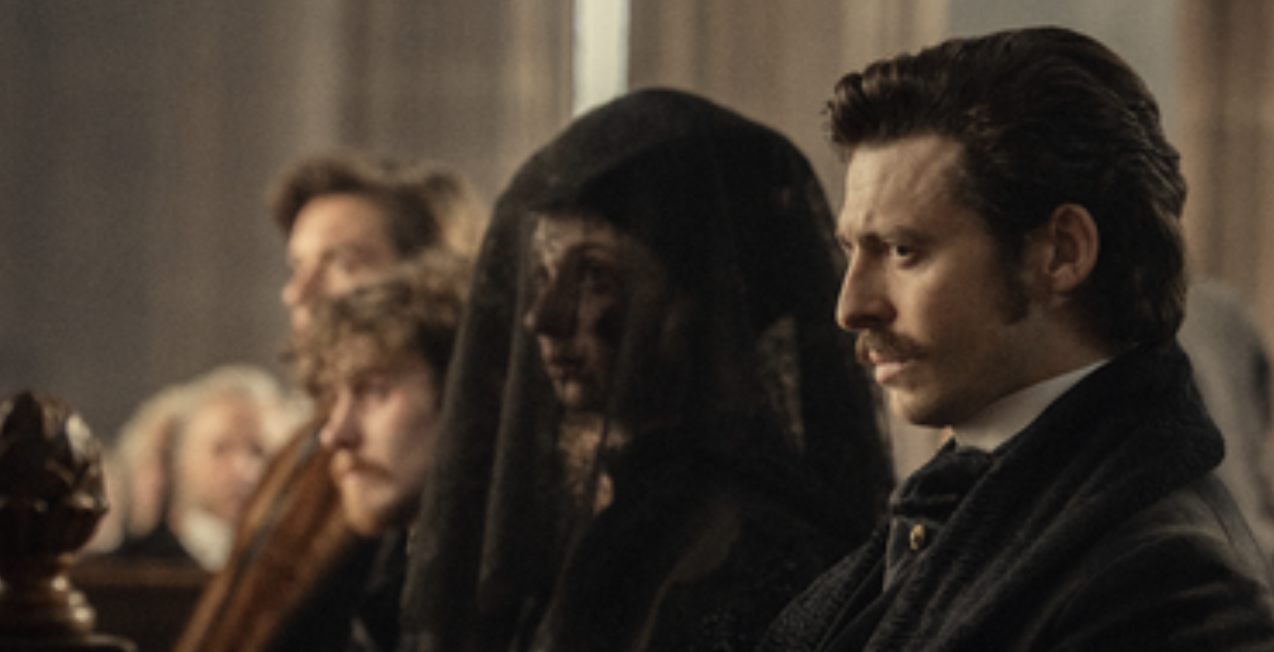
Guinness left the bulk of his fortune to his two eldest sons, Edward and Arthur (played by Louis Partridge and Anthony Boyle, respectively). The youngest son, Benjamin (Fionn O’Shea), is left only a modest stipend due to his degenerate gambling and alcoholism. The only daughter, Anne (Emily Fairn), is intelligent and capable, but being a woman in the 19th century, she is given little agency in the Guinness business by her father.
Within the will, there is a poison pill: if either Edward or Arthur opts out of the family brewing business, that brother will be left all but penniless. This directive isn’t an issue for Edward, as he has plans for expanding their product into the United States. Unfortunately, for Arthur, who would rather cash out and return to London and live out his days as an aristocrat, their father’s arrangement brings him no pleasure.
There is a lot of drama to mine from these basic circumstances, and at times, House of Guinness is very effective at doing just that. Unfortunately, the show’s flourishes threaten to overtake the compelling storyline.
Title cards land on the screen with an excess of pedantic authority. Anachronistic needle drops (many supplied by Irish rock band Fontaines D.C. and the militant Irish rap duo Kneecap) clash with the 19th-century setting. There is also a close-up shot during the reading of the will that can’t settle for the inherent drama of the moment, insisting on an eerie and distracting bit of score layered over the camera’s swift, tight shot. Even the cinematography is a tad too beautiful. 19th-century Dublin may have been stunning and ornate in the places the well-heeled frequented, but even the grungier parts of the city don’t seem as dirty as they should. At times, I found myself wondering if Guy Ritchie was the director of numerous episodes (he wasn’t).
Still, despite itself, House of Guinness is often quite entertaining. Each of the series’ eight episodes begins with the disclaimer, “This Fiction Is Based On True Stories.” As you might guess, in the type of show that I’ve described, there’s a sizable amount of fictitious, or at least heightened, history on display in House of Guinness.
The chief “take a rumor and run with it” affectation is that of Arthur’s sexuality. The real Arthur Guinness was rumored to be gay, and his marriage to his wife was considered more of a pact than a love match, but there is no proof that Arthur was a homosexual. That being said, the decision to portray Arthur’s unconfirmed sexuality as truth adds a significant layer of risk to the character and the family’s fortunes.
While Edward wants to focus primarily on the business, it is in the family’s best interests to have Arthur run for his father’s seat in parliament. To do so requires a wife to establish “decency,” and a rigor that Arthur has little to no desire for. One of the first rules of putting on any filmed production is to cast well. In that regard, lining up Anthony Boyle to play Arthur was a four-ace decision.
Over the last couple of years with diverse roles in Manhunt (as John Wilkes Booth), Masters of the Air (as a real-life World War II American bombardier), and in the brilliant Irish Republican Army series Say Nothing (as IRA legend Brendan Hughes), Boyle has established himself as one of the finest young up-and-coming actors around. As Arthur Guinness, Boyle, again, does not disappoint. Boyle fully embraces his character’s closeted sexuality, conservative politics, guilt, self-loathing, and the resentment of his circumstances. When discussing marriage with a potential wife, Boyle’s Arthur addresses the nature of their prospective future thusly, “I will, from time to time, function in other places and in my own way.” Boyle’s delivery of the line finds that perfect simultaneous sweet spot of being both specific and non-specific. The mixture of subtlety and rage born of frustration in Boyle’s performance anchors the show even when it threatens to fall off its axis.
The in-country divide between Catholics and Protestants (with the Guinness clan being of the latter), as well as the dissension that exists between those who want an independent Ireland (the Catholics) and those committed to the crown in England (the Protestants), is often at the forefront. Those who have an interest in the long festering religious and political feud between the two factions will likely enjoy the pre-“Troubles” era strife in House of Guinness. While I certainly wouldn’t recommend House of Guinness for its finite historical accuracy, on a broader level, the show effectively highlights the issues of its Irish day and showcases the fractured state of the country.
Mostly, though, House of Guinness is just fun. It may be masquerading as prestige television (The Crown it ain’t), but its excesses are not without rewards of their own. The series is never without energy; if you can get used to the deployment of modern music, you can appreciate the quality of the songs chosen. It’s incredibly well-made, and it has Anthony Boyle at the center, adding more nuance than the show probably deserves. I would also say that after the first two episodes, the series begins to settle in and become more classically engaging.
As the final episode closes with a cliffhanger, it’s clear that Knight intends for more seasons of House of Guinness. Netflix may not have officially announced a renewal of the show, but Knight himself has stated that he intends to make several more seasons of the series. Streaming channels have become notoriously fickle in their renewal process, but should Knight be correct in his assessment of the show’s future, I hope he will consider idling back just a little. The dynamic nature of the family story doesn’t require as much embellishment as it receives in House of Guinness. If Knight were to lean in the direction of better taste (something he’s entirely capable of), House of Guinness may well rise above its current status as a guilty, but not too guilty, pleasure.