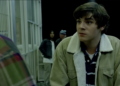
With Fatherland, Polish filmmaker Paweł Pawlikowski (Ida, Cold War) fashions a sorrowful, minimalist, yet wholly hypnotic look at a devastated and divided post-WWII Germany by focusing on celebrated Death in Venice writer Thomas Mann (Hanns Zischler) and his return to his home country after fleeing the Nazis and living in the U.S. for 16 years. He is accompanied by his loyal, politically-outraged daughter, Erica (Sandra Hüller).
Fatherland is a fiction, based on real characters and events.
The film is Poland’s International Feature Oscar submission. And it’s a strong contender for a nomination.
This stark, penetrating pic, economically written by Pawlikowski and Hendrik Handloegten, begins in 1949 with a revealing conversation between Erica and her “like twins” brother, Klaus (August Diehl, so effective in just one scene), with the camera locked on him only, naked, as his bedmate dresses in the background. On the phone, the sibs discuss how much they miss one another as well as the current situation in Germany, which he likens to choosing between “Mickey Mouse and Stalin.” “I don’t believe in anything anymore,” he dejectedly admits, “It was always you and me against the world,” he then sweetly tells her.
Erica holds out hope that Klaus will join her and her father in Frankfurt where Thomas will be honored with the Goethe prize, representing a desire to celebrate lasting German culture, despite the new East/West division. Alas, her conversation with Klaus will be their last.
Father and daughter travel from Frankfurt to Weimar for him to be feted in both cities and deliver speeches about the necessity of art and the spiritual and moral future of Germany. “You think your speeches are going to make a difference?” she asks him in one of few outbursts of anger towards him. But the resentment is there and truly begins to seethe once Thomas informs her, rather matter-of-factly, of her beloved brother’s death by suicide.
The sexual orientation of the three characters is never overtly mentioned, but in reality Klaus was openly gay, And Erica was unashamedly bisexual. They actually shared partners in their theater youth group. Their father, Thomas, despite having married and fathered six children, had a lifelong attraction to men—some historians have tagged him a repressed homosexual.
I bring this up because, well firstly, it’s fascinating, but, also, Klaus and Erica’s sexual fluidity, in particular, are representative of the Weimar Republic’s accepting and liberal views on same-sex attraction, right before the Nazis seized control and ended any type of tolerance in Germany. Both sibs also dared to be critical of Hitler in an early 1933 cabaret show. Of course, the show was banned a month after premiering, but Erica revived it in Zurich, Switzerland, until the Swiss gave in to Nazi pressure a few years later.
None of this is showcased in the film, yet all of it is remarkably woven into the fabric of the narrative, some of it ever so subtly, part of the genius of the work.

The Erica we meet in Fatherland has the weight of fighting fascism on her shoulders, as well as loving her distraught and depressed brother, then having to mourn his passing–all the while standing by her “cold-blooded narcissist” father (her words). She was an actress, writer and rally driver (!) and railed against fascism until the day she died. She also attended the Nuremberg trials as a war correspondent.
Hüller’s sometimes tempered, sometimes explosive performance is a joy to behold. She gifts us a most beguiling figure, someone who is intensely grieving, but also has a job to perform. Her understandable anger at what her fellow Germans accepted AND supported for over a decade reads all over her face. And so does her deep anguish mourning her brother.
Łukasz Żal’s stunning black-and-white cinematography enhances the bleak and evocative nature of the journey through the ruins, figuratively and literally. The film is shot in the Academy aspect ratio (1.37:1).
While the story has been fictionalized it will awaken an excitement in ravenous rabbit hole divers like me who yearn to absorb so much more about certain famous historical and literary figures. Watching Fatherland had me ordering books on the Manns, watching a doc about the sibs (narrated by Vanessa and Corin Redgrave) and working Wikipedia like mad. That’s my happy place. As is diving into extraordinary films like this one.
Watch my VIDEO chat with Hüller.
Fatherland is screening at the 64th New York Film Festival beginning October 4, 2026. TIX/MORE INFO
The film is being released in theaters, by MUBI, October 23, 2026.