1975 was a banner year for cinema—just gander at the Best Picture Academy Award nominees: Stanley Kubrick’s Barry Lyndon, Sidney Lumet’s Dog Day Afternoon, Steven Spielberg’s Jaws, Robert Altman’s Nashville and Milos Forman’s One Flew Over the Cuckoo’s Nest. The latter pic won the Oscar, but it could have easily been given to Nashville or Dog Day Afternoon.
Lumet’s film is quite simply a masterpiece, gritty, poignant, funny and cutting, perfectly capturing the restless Nixon-era New York and a gaggle of its inhabitants. And it gave us a complex anti-hero to root for, Sonny Wortzik, brilliantly embodied by Al Pacino. Important to note that Pacino was the first major star to play a gay role in a studio film.
Dog Day Afternoon was rightly awarded an Oscar for Frank Pierson’s screenplay, which was loosely based on a Life magazine article, “The Boys in the Bank,” about a real-life 1972 Brooklyn bank robbery—so loosely, in fact, it won in the Original Screenplay category.
I just rewatched this gem a few weeks ago and it holds up magnificently.
In order to enjoy the stage production, written by Pulitzer Prize-winning playwright Stephen Adly Guirgis (Between Riverside and Crazy), one must come to terms with the fact that Dog Day has been refashioned as a rollicking comedy—with bits of dramatic moments—designed for broad appeal. And awash in just how little has changed in our society since the 1970s. Now, whether the comic tone was the creatives’ initial intent is a good question. But this is not your father’s Dog Day Afternoon. It is, however, quite entertaining.
Initial critical reaction has not been kind, though. One wonders if the press reported tensions between Guirgis and Mark Kaufman (head of Warner Brothers Theater Ventures) during previews has something to do with the negative reactions.
Many complain that the lean on laughs robs the piece of suspense. But this Dog Day isn’t about whether Sonny and Sal are going to get away with the heist…or end up incarcerated…or worse. If you’ve been living in some cave and don’t know the basic plot, it doesn’t really matter since they are obviously doomed from the get-go.
This Dog Day, to me, is about connection and understanding in a world that seeks to divide and spread hate—something supremely timely.
Guirgis manages to avoid most of the dialogue from the film and alters quite a bit of the structure, which is most refreshing since too many of these screen-to-stage adaptations (and there are way too many) usually try to reuse all the popular film quotes as well as recreate most of the movie, scene for bloody scene.
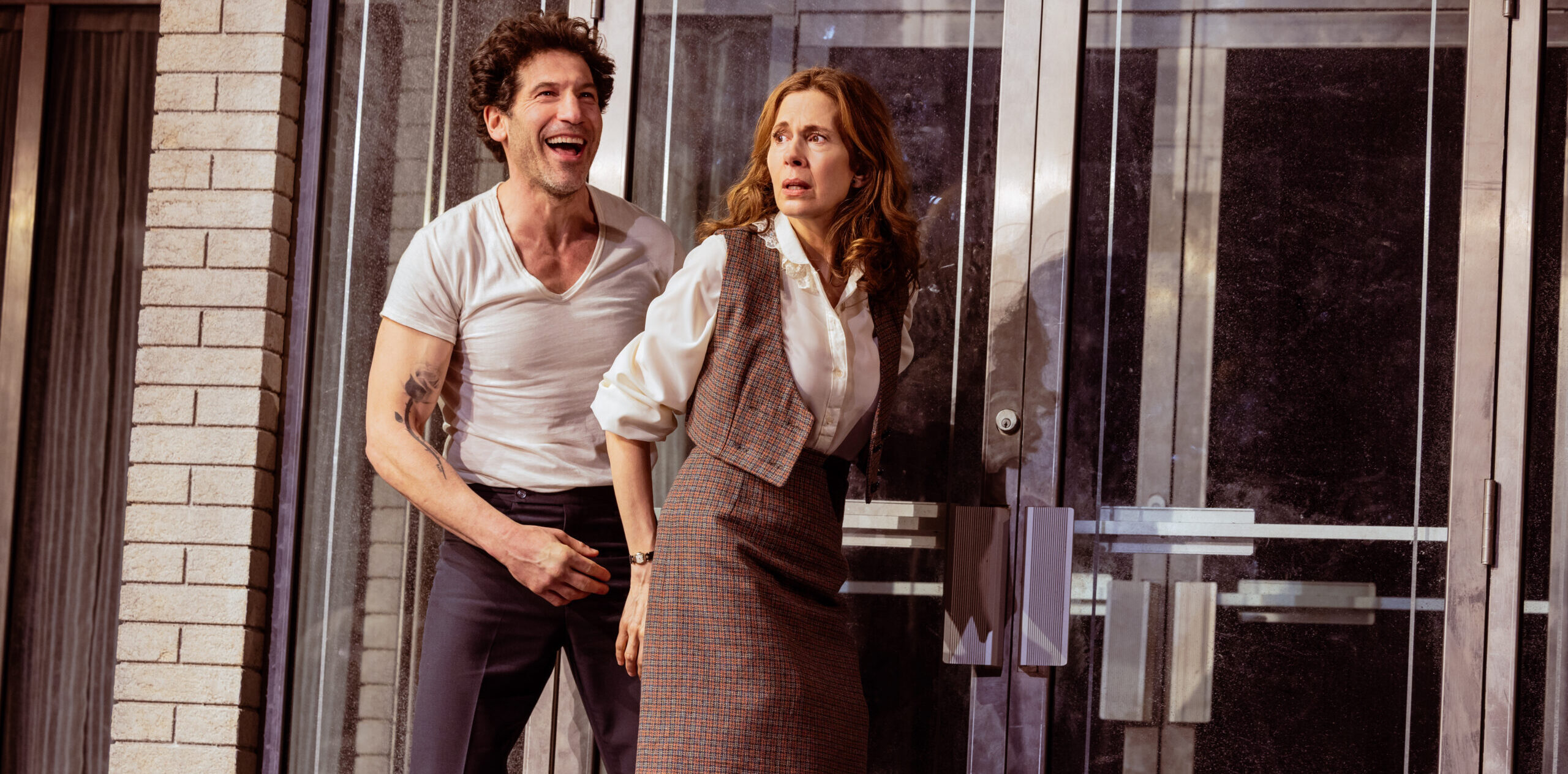
The play is set in and around a Brooklyn bank in 1972, where Sonny (Jon Bernthal), Sal (Ebon Moss-Bachrach) and Ray Ray (Christopher Sears) attempt to hold up a bank, each with their own reasons, but Ray Ray flees just as the antics get underway. From there, Murphy’s Law begins to takeover.
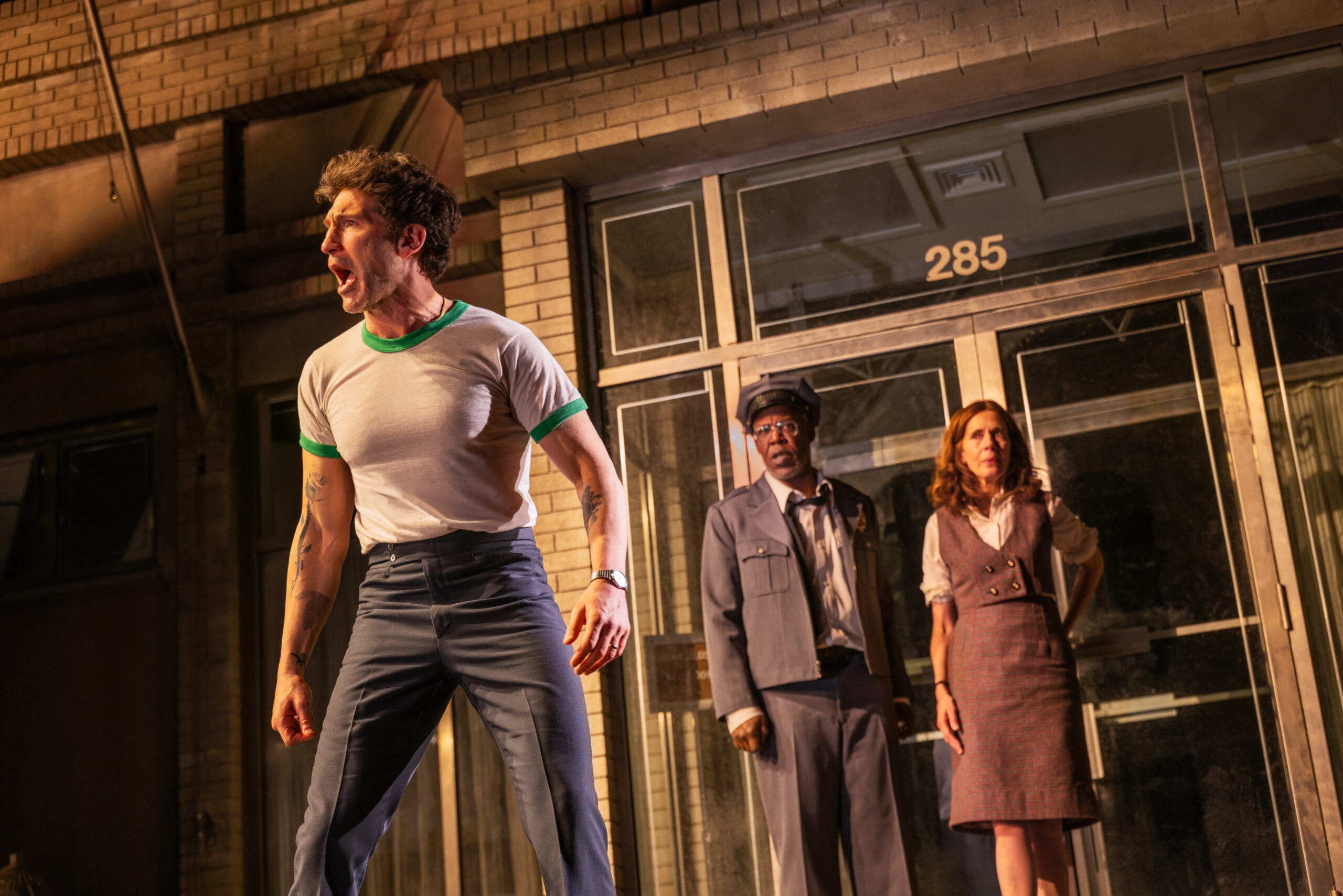
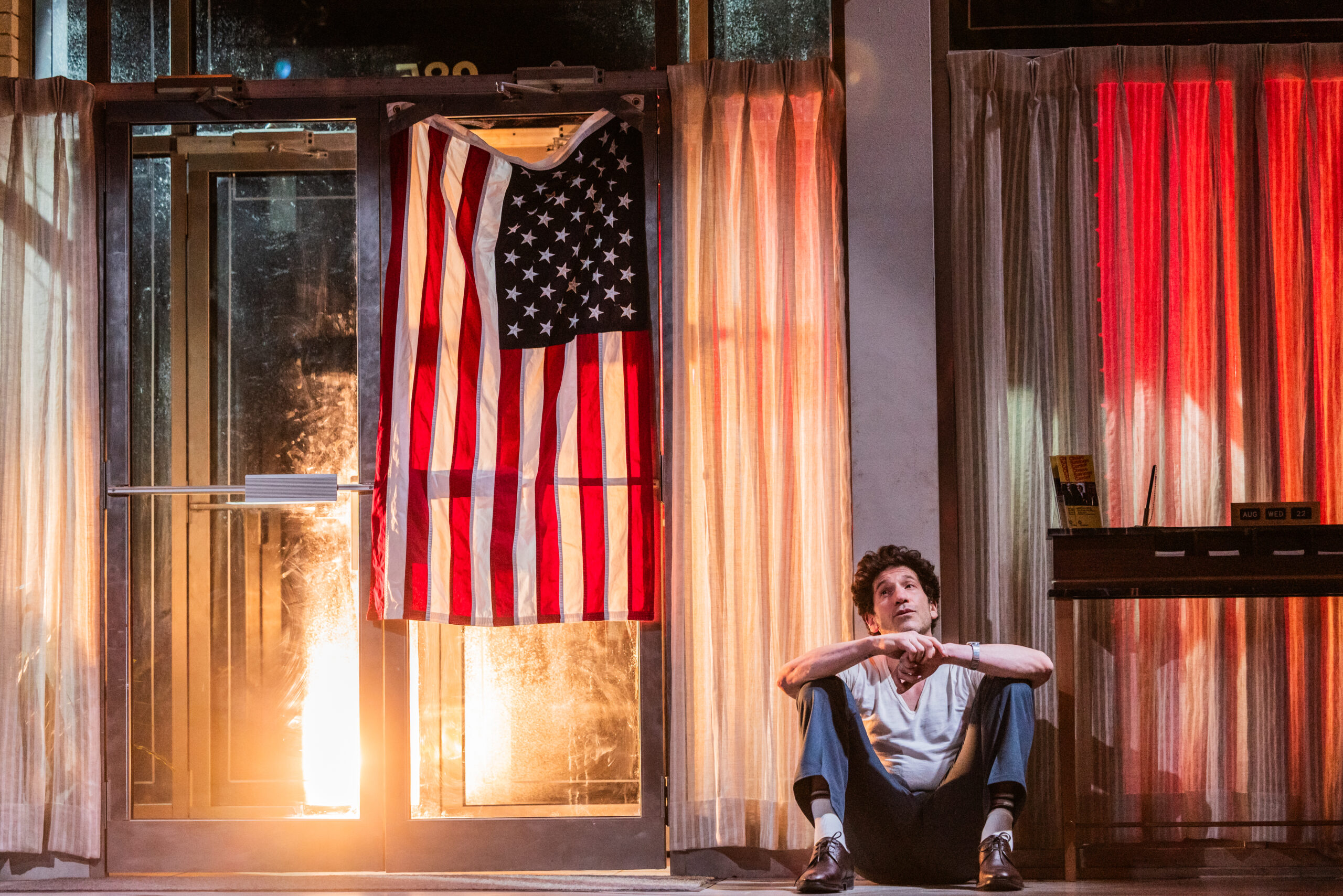
Directed with a deliberate (I hope), anarchic style by Olivier Award winner Rupert Goold (King Charles III), Dog Day is an acting showcase for the two Emmy-winning co-stars of The Bear—especially Bernthal who imbues Sonny with a sexy swagger and charisma to spare but also shows us his incredible vulnerability and child-like nature—riddled with confusion and indecisiveness. The actor does take command of the stage when necessary, which is quite often. He sometimes sounds like Pacino’s Sonny, but that’s really where the similarities end.
Moss-Bachrach’s Sal is rather a mess. He’s probably on drugs. He’s slugging NyQuil. He doesn’t like to be touched. He seems to be fine with killing people, in theory anyway—so he may be psychotic. He remains an enigma. John Cazale’s Sal was much more of a loose cannon—someone we believed would definitely pull the trigger if necessary. Sal knows that if he’s caught, he’ll go away for good. But I wasn’t convinced stage Sal was ready to die.
The perpetually delightful Jessica Hecht makes the most of her role as head teller Colleen, who is initially annoyed by Sonny, but begins to take a liking to him…and even to the situation. Her reaction to discovering Sonny is gay is priceless: “I knew it from the moment he walked in!” Hecht deserves a Tony nomination just for her botched attempt at comforting Sonny late in the play.
The dialogue often reflects on today’s current events by taking potshots at the media, politicos, the police, the filthy rich (Sonny’s Rockefeller rant could easily be about Trump) as well as just how fickle the public is. Everything old is, indeed, new again and my audience ate it up.
And Sonny (and to a lesser degree Sal) represents the little man who is constantly trampled by an unjust system and is forced to take matters into his own hands, with fateful consequences. Luigi Mangione, much? Both Sonny and Sal are also marginalized people which makes the story even more compelling…and appropriate for today.
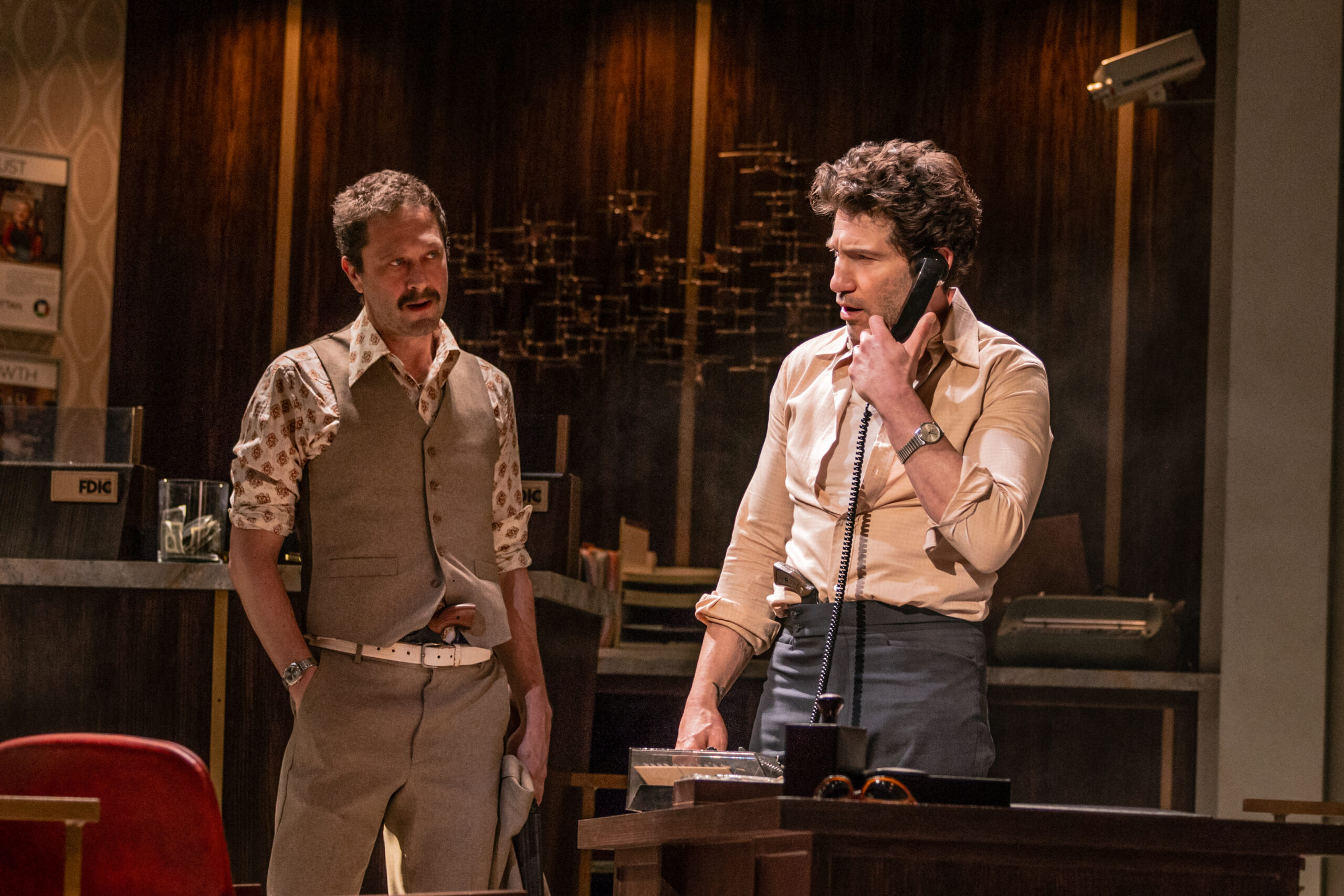
The show isn’t in any way perfect. Guirgis’s jokes don’t always land, and the treatment of the Security Guard character is ridiculous, even for a comedy. In addition, most of the bank staff, except for Colleen, have little nuance. And the FBI agent is just a cartoon.
Also, the way the Sonny and Leon (Esteban Andres Cruz) story is handled will definitely divide people—especially those pesky woke watchdogs. I had no issue with it. But I do wish they’d been given a scene together instead of a phone call. So many liberties have already been taken with the real story, why not take a significant one and show us a true connection?
All that said, it’s a hilarious and satisfying evening of theater—if you are willing to let it be its own thing.
Dog Day Afternoon is performing at Broadway’s August Wilson Theatre (245 West 52nd Street) for a strictly limited engagement.
For Tickets and more information visit: DOG DAY