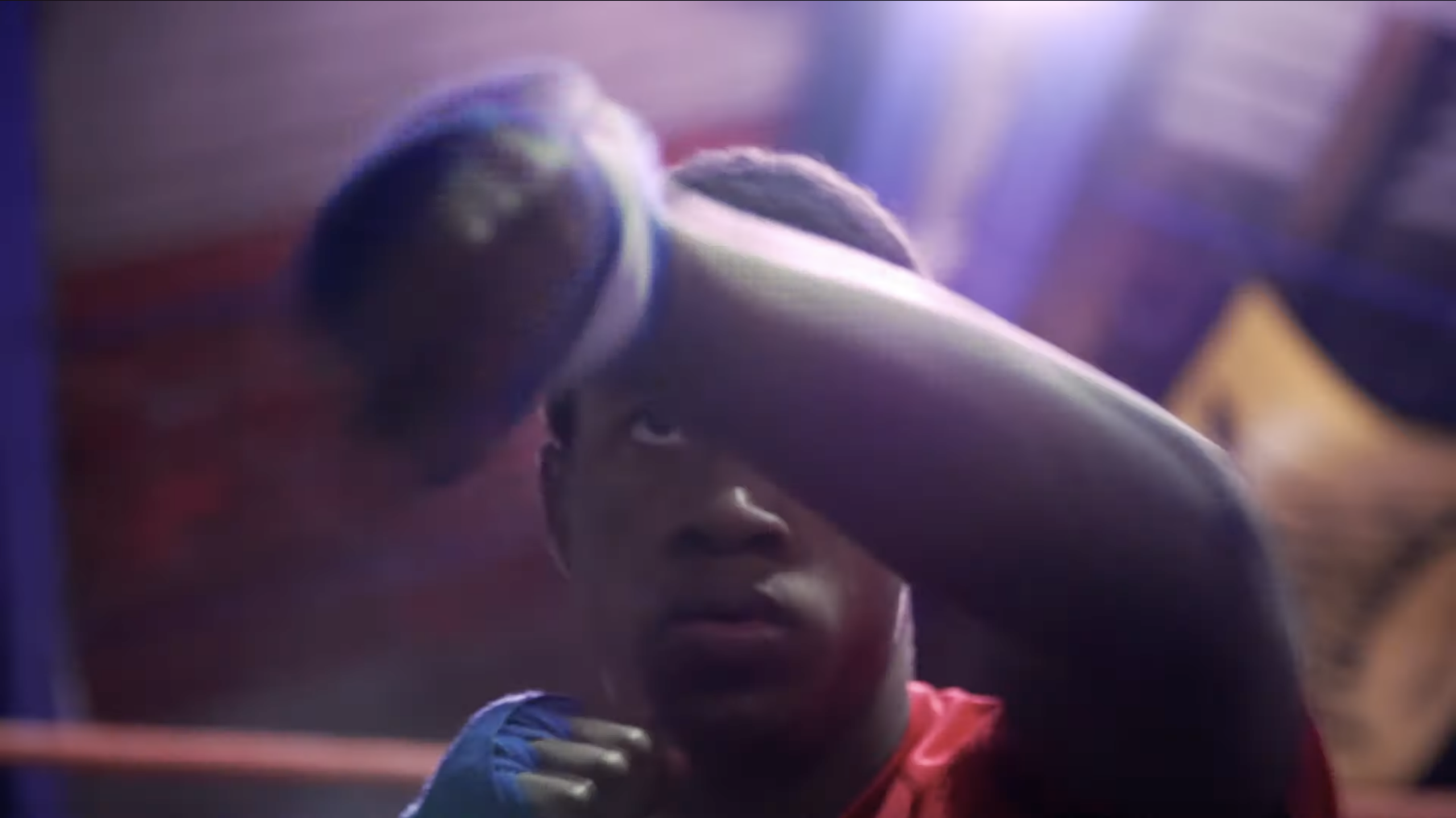
You rarely find a documentary that covers ten years of an athlete’s life in real time. Director Francesco Saviano’s On the Line doesn’t just follow one boxer over a decade, but three. One will become a world champion. Another will find a new path. And one will meet with tragedy.
The film begins in 2013, introducing Danny “The Miracle Man” Jacobs, Will “The Power” Rosinsky, and Patrick “All” Day. All three are talented, up-and-coming prospects out of New York City.
Saviano could not have asked for a more diverse sampling of boxers. From how they fought to how their careers ended, Jacobs, Rosinsky, and Day present three possible outcomes that may not cover the full breadth of a boxer’s possibilities, but they do offer an expansive view of what it’s like to make a career out of orderly violence. As one subject says in the film, “Even when you’re getting better, you’re still getting punched in the face.”
Jacobs, the best known of the three, hails from the rough-and-tumble Brownsville neighborhood in Brooklyn (the same neighborhood Mike Tyson came from). Raised by his mother, grandmother, and aunts, Jacobs presents as thoughtful and warm. Jacobs is not only a tremendous talent, with his fast hands and punching power, but he also mentored Rosinsky as the two fighters progress through the fight game.
Rosinsky is the classic “lunch pail” fighter. He’s not flashy, but he’s fundamentally sound, strong, and full of grit. Unlike most professional fighters, Rosinsky, who came from a working-class background, has a second potential career path. Trained as an EMT, Rosinsky becomes an NYC firefighter. Rosinsky has a touch of pragmatism, which complicates his fighting career. When it comes to boxing, you can’t moonlight and be great. Both feet have to be in the sport. Rosinsky will reach a crossroads and have to choose.
Patrick Day had a most atypical background for a fighter. Born in Freeport, Day is the son of Haitian immigrants who assimilated remarkably well in the United States. Day’s father was a doctor and his mother a translator for the United Nations. Day earned an associate degree in nutrition from Nassau Community College and a bachelor’s in health from Kaplan University. It is often said that fighters enter the ring because they have no other options in life. Day couldn’t have been more opposed to that stereotype.
Saviano was incredibly fortunate to select three such engaging and likable subjects to focus on. All three are so easy to root for. But boxing careers are fraught with peril, and On the Line will break your heart as you cheer Jacobs, Rosinsky, and Day on.
And peril certainly comes for all three. Jacobs has a bout with cancer that should have killed him—a malignant snake that wraps itself around his spine. Rosinsky faces the possibility that he’s hit his ceiling in the sport after a couple of questionable judges’ decisions in losses he suffers. Day also faces multiple setbacks in the ring that threaten to derail his ascent. In boxing, a young fighter can go from “prospect” to “suspect” after just a couple of losses. Once Jacobs recovers from cancer, he goes on a miraculous run of victories that bring him to the pinnacle of his profession. For Rosinsky, a man with a family, the equation is much different. He must ask himself whether boxing is worth it, or whether a stable job as a firefighter is the better bet. Day loves boxing so much that leaving the sport is never a serious consideration for him, despite three setbacks in the ring that leave him on the periphery of contention.
We all like to think of love as a good thing, but it can also be a dangerous one. Late in the film, fellow boxer Sean Monaghan relays a conversation he has with his uncle, who asks the fighter, “If I give you a million dollars will you quit boxing?” To which Monaghan replies, “You can gimme ten million dollars and I wouldn’t stop boxing.” While Patrick Day didn’t say those words, it’s clear he shared the same sentiment. It’s a dangerous sentiment for a boxer to have, although some would likely argue that it is a necessary one. To be great, an athlete often needs a certain tunnel vision that flies in the face of reason. Patrick Day had that kind of vision. It’s a view that comes at a price. The outcome of Day’s final fight as it relates to his record is meaningless. A win or a loss on your official record matters little when you are fighting for your life. In Day’s last bout, he is fighting for his life.
The result of that fight ripples throughout the boxing community and beyond. It extends to Day’s family, friends, fellow boxers, and his trainer Joe Higgins, who will surely be haunted by the fight for the remainder of his days. Higgins is a boxing lifer. He doesn’t know anything else, and he can’t/doesn’t want to do anything else. Day’s story is proof that when a fighter is broken in the ring, those closest to him become broken, too.
One of the strongest subjects to sit for the film is longtime promoter Lou DiBella, who has worked with some of the biggest names in the sport. He has made his life in boxing, but it has cost him. DiBella practically seethes with anguish over his involvement in a profession that has made him who he is, but has also taken much from him. He is relentlessly conflicted by his association. One wonders what ghosts haunt this man who doesn’t have to take the physical punches but is forced to fight the ethical, moral, and psychological blows that keep coming and never stop.
On the Line is unusual and remarkable not only for how long it spends with its subjects, but also for its artful, unvarnished depiction of “the loneliest sport.” On the Line gets under the nailbed of the fighter’s hopes and dreams, and how they are rarely fulfilled and so often end in disappointment and even tragedy.
Saviano’s bold film doesn’t shy away from the often seedy and frightening underbelly of boxing. The film all but argues that in a sport where bloodshed is a basic expectation, pain, suffering, compromise, and being surrounded by questionable characters are both part and parcel.
Few films about the sport have presented the beauty and the anguish of boxing so well. It says something that the film’s most artistically effective moment is also its most horrific. Late in Day’s final fight, the screen goes black. We can hear the announcers comment on the bout with growing concern. We do not see what causes that concern. We can only imagine it, and the imagination can be cruel. Staring at that black space on the screen, we are reminded of how alone a boxer is once they step in the ring. It’s just them and another fighter trying to take their head off. In that moment, we are also reminded of something else:
Why we fear the dark.
On the Line is available for rent or purchase now on Amazon Prime and Apple TV.