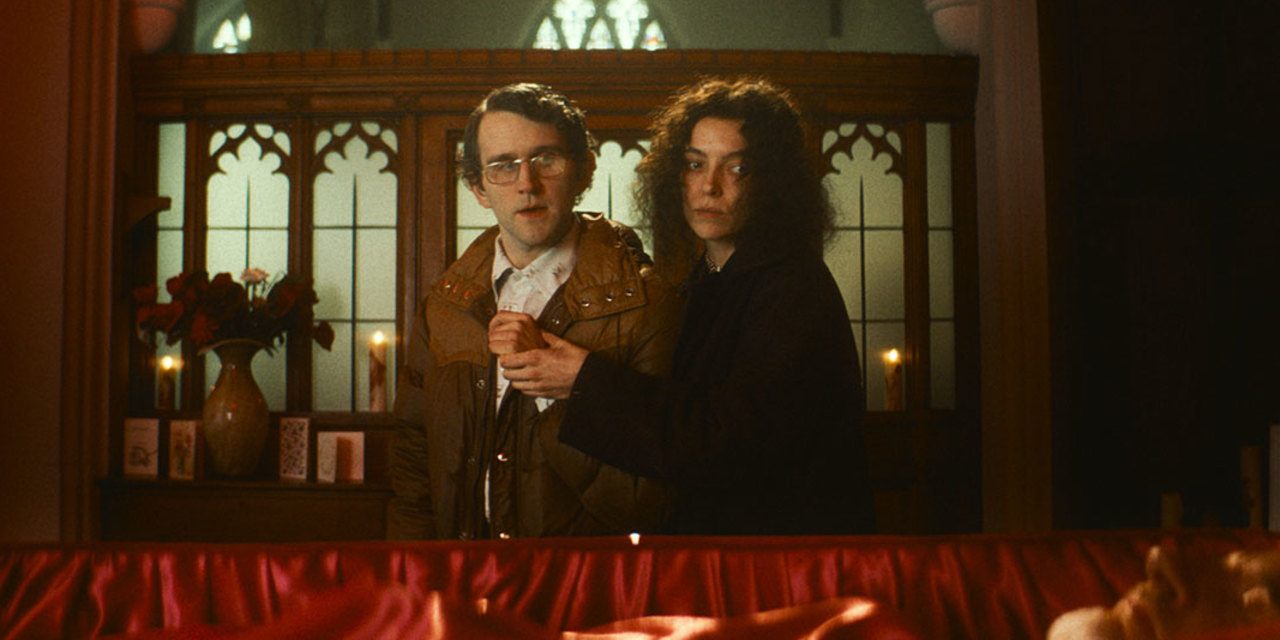
A woman drags the body of deceased sheep through the grass to the back of her van in the opening moments of Theo Rhys’ wild, wily, and wholly original musical, Stuffed. We barely see her face because of her curly, windswept hair as she rushes to snatch the carcass before anyone sees her almost like if any eye contact will give her away. At the same time, a lonely man brings his own birthday cake to his factory job in the hopes that it will create some form of connection between him and any of the people he sees day after day. Some of us glide through the world knowing that we are misunderstood while others long for the kind of connection that helps us feel whole. Rhys’ unique vision is a testament to the longing of the human heart as its invigorating score and go-for-broke performances stretches the skin of the musical genre.
When Bernie Marshall comes home after his failed birthday, he sees a newspaper ad asking how he would like to be remembered. Rhys film immediately taps us into the loneliness of Stuffed‘s characters but also different kinds of regrettable solitude. His mother is the only person who knows his giving heart, but her mind is slipping from her grasp with each passing day. He collects obituaries of people who share the same name as him, as if seeing his name in print will give him a tiny burst of energy to continue on. Bernie is inhabited with palpable, anxious energy by Harry Melling, our current (and rightful) King of the Forlorn–forlorn fella? Melling knows how to ask an audience to get closer to him without actually requesting it as his eyes continuously hunt for meaning and his tentative voice quivers like he’s afraid to speak.
Bernie’s curiosity leads him to Jodie Comer’s Araminta, an amateur taxidermist and mortician (and aforementioned sheep snatcher) who has a reputation around town that she knows that she should ignore. We also bring our preconceived notions to who this woman is from the beginning, and we see her tend to the needs of an injured, lost dog in an early scene where she shows the animal some mercy. When she convinces Bernie to touch a dead body in their first meeting, something shifts. Araminta’s hand guides Bernie’s touch, and we understand how someone could embrace death and not be afraid of it. “You only die once in a lifetime,” Araminta says, a line that will provoke introspection and reflection as much as this film’s nimbleness inspires chuckles. She expresses that one of her biggest dreams is to stuff a human being after he or she has passed on. People in town assume that she is violent or that she kills animals in order to display them as trophies, but that misconception is where Rhys’ film swerves from expectations. Araminta explains (and sings) about how her preservation is not about death but legacy and, ultimately, love. She wants to wake up every day and say good morning to not just her animals but also someone that she carefully and painstakingly cared for. Will Bernie be the first human to consent to being stuffed by someone who understands and connects with his need for connection?
Most of us have wondered what happens to us after we die, but that is different than securing a legacy. As we get closer to the end, will we all consider how we were be remembered? We are not in control of how those narratives are built. For Araminta and Bernie, exploring and preparing for death fuses them together in the unlikeliest of romances. She is fulfilling a lifelong dream while he finally has someone who gives him thoughtful consideration. I kept thinking about the clinical practices of taxidermy might lends itself to intimacy. Araminta would be touching parts of Bernie that no one has grazed or even seen before: the underside of his skin and his organs and even his blood.
The easiest comparison one can make, at least in the realm of the musical, is to Stephen Sondheim’s Sweeney Todd and Mrs. Lovett. They share bonds, secrets, and songs away from other citizens of London, but that love story has a different purpose and viewpoint. And a little bit of bloodshed, of course. Instead of grinding bones and flesh, though, Stuffed does not concern itself with vengeance or even hatred. Rhys allows Araminta and Bernie to dance and revel in their secretive, seductive plan, but there is a disarming shyness to buried feelings from both directions that come when you least expect it. Araminta even gifts Bernie a set of his own eyes as a gesture of their partnership.
With its kooky clarinet and tuba influences in the score, Stuffed is dementedly entertaining. When Bernie quits his job at the sandwich factory, Melling dances without abandon for the first time his life, his limbs operating on a new level. Melling proves, once again, what an emotionally available performer he has become. Comer is absolutely ferocious channeling Aramita’s rage, pride, empathy and confusion with full-throated glory. Both actors excel in their respective scenes alone, but their chemistry unlocks something transcendent in each other.
With so much talk of death, Stuffed‘s beating heart flutters and then grows with each revelation and new musical number. Rhys’ vision is macabre, achingly romantic, and blindingly original.