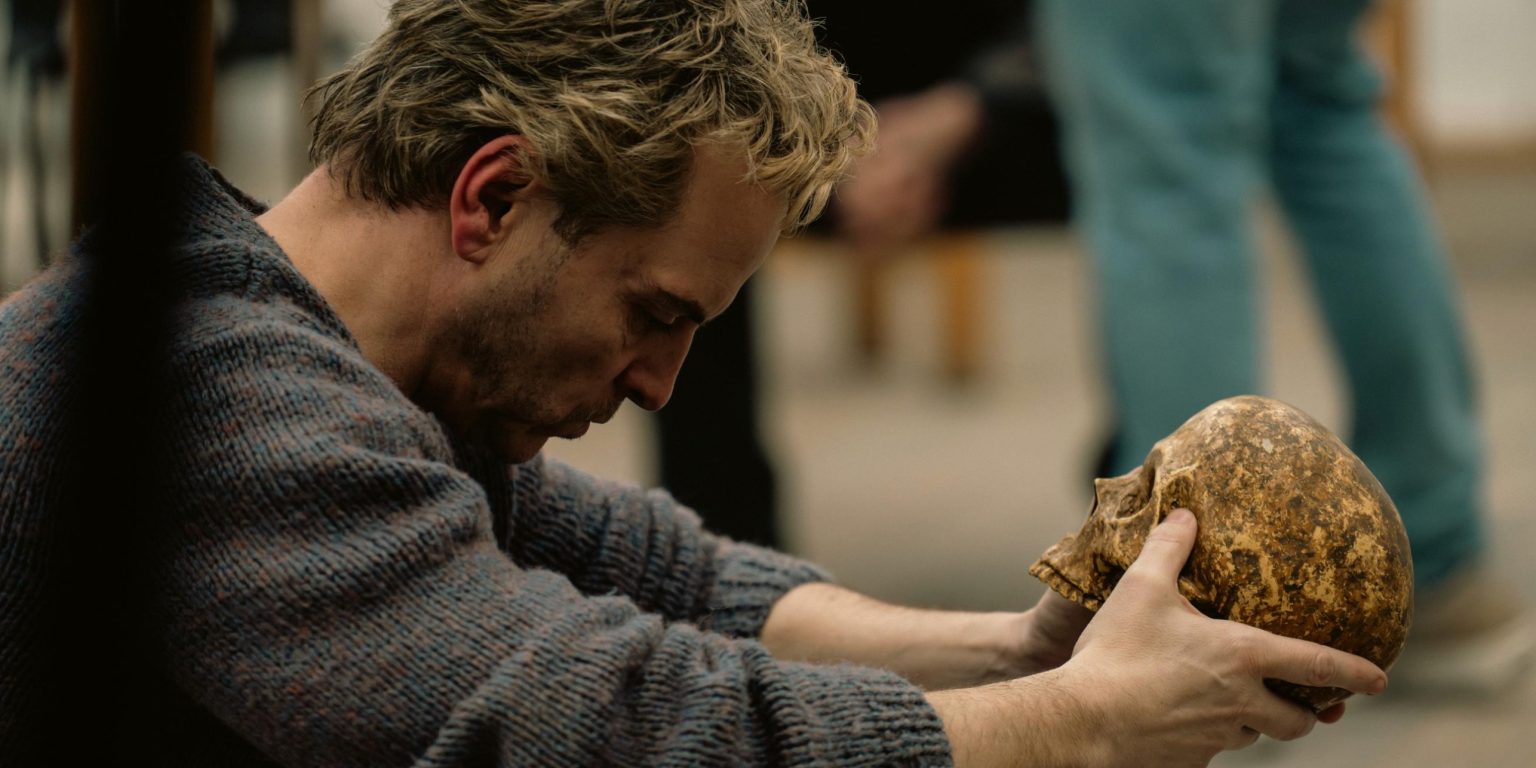
There is a lot of talk about the body in Simon Stone’s Elsinore, and that extends to both the text of William Shakespeare’s Hamlet and Ian Charleson’s struggle with AIDS. After the first lesion appears on Charleson’s face, right near his temple, his fingers probe the pock, as if he is studying his enemy. When we find him holed up in his apartment in the dark, I wondered how much he kept touching it as if he hoped he could wipe it away with enough concentration. There is a tragic inevitability to Stone’s film even if you are unfamiliar with Charleson’s health struggles even when determined to star in the gigantic Shakespearean role. Andrew Scott gives absolutely everything in a performance that will define his career.
Charleson cannot get out of the shadow of the success of Chariots of Fire, specifically the iconic music. Drivers hum it to him as he rides uncomfortably in the backseat, and a woman makes eyes at him when she spots him in the lobby of his doctor’s office. He wants to audition for better roles, but continuing to work in film is not as easy as some might assume. “I wish I had something decent to audition for,” he says before he is relegated to test for procedural roles where the dialogue makes Charleson cringe and giggle during his screen tests.
When Daniel Day-Lewis walks off stage in the opening moments of the National Theatre’s production of Hamlet in 1989, it becomes a bit of fodder around town. Charleson has a bit of fun joking about the seriousness of the actors who perform at the National Theatre (“That building…” he muses) with his best friend Patsy (a fabulous Billie Piper), a casting director, who eventually serves an unofficial guardian at home whenever his condition worsens. Elsinore quickly becomes about two worlds colliding: a man who is losing time when the most famous part of all becomes available to inhabit.
The body does not know the difference between trauma it is experiencing and the intensity that an actor puts upon themselves. Can this actor meet the physical demands of one of this magnitude? Scott’s Charleson never wavers in his determination while Olivia Colman’s Margaret Johnston, the only physician caring for patients suffering from HIV and AIDS, doesn’t agree. She assumes that taking on this role is ridiculous folly, and Margaret sternly tells Charleson over and over again that his body will not heal if he continues this pursuit of glory on stage even as the nurses and other patients in the ward help him run lines as they grow sicker and sicker. David Dawson’s Derek Jarman, a director that Charleson worked with early in his career, insists that Charleson needs to go public with his diagnosis in order to help their community, but Charleson balks at the notion, insisting that he will have failed as an actor if the audience sees a man dying of AIDS on the stage and not the Prince of Denmark. Johnny Flynn’s Richard Eyre, the play’s director, agrees to keep Charleson’s condition a secret from the rest of the company while keeping a close eye on him.
Death is a heavy theme throughout Shakespeare’s play, so how does someone ultimately confront that certain demise? Scott brings this role into his bones so much that it becomes part of his being, and this is his most physical role we’ve ever been gifted from this actor on screen. Some of his most demanding physical work has been on stage (please find a recording of his performance in Coward’s Present Laughter…you will love), but there is a tender immediacy to every moment he is on screen. I almost do not have the words to express what this performance means to me. Scott’s Charleson is facing tragedy, but he never plays the tragedy even in the darkest moments. It’s such a mammoth, all-consuming performance filled with immense, unadulterated joy and passion.
Stefan Gregory’s score is delicate and warm, perfectly enhancing the beats of Charleson’s journey while never becoming overbearing. There is a stark difference between survival and living, and Scott, and Stone’s film, vow to live.
When Charleson arrives at the National Theatre, he requests to see the stage and he asks how many seats there are and learns there are 1,100. He makes a comment about the number of eyes that will be on him every night, and, in that moment, we instantly understand his need to perform. The seats look like they shoot up to the sky. The stage is life, because we witness real life on it with every new creation. Theater is the most immediate artform that we have because we can see the actors’ spit, see their chests rise and almost feel their breath on our faces as the words and air shift in the room around us. Work on the stage endures because of the inherent vitality built into the artform, and just because the actors walk into the wings or we see them bow after a performance, it doesn’t change that feeling.
As Charleson, Scott grips you in his pursuit of living. Many actors have assumed the role of Hamlet, because it is the steepest mountain to climb–perhaps some want to play the part in order to prove that they can do it. Charleson, a lover of words, performance, and connection, needs the role of Hamlet to strengthen his soul. The best kinds of performance on stage live in our memories, because they shake us so deeply. Stone’s enthralling film allows the merging of Charleson and Scott to live on forever.
Elsinore opens in select theater on November 20.