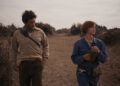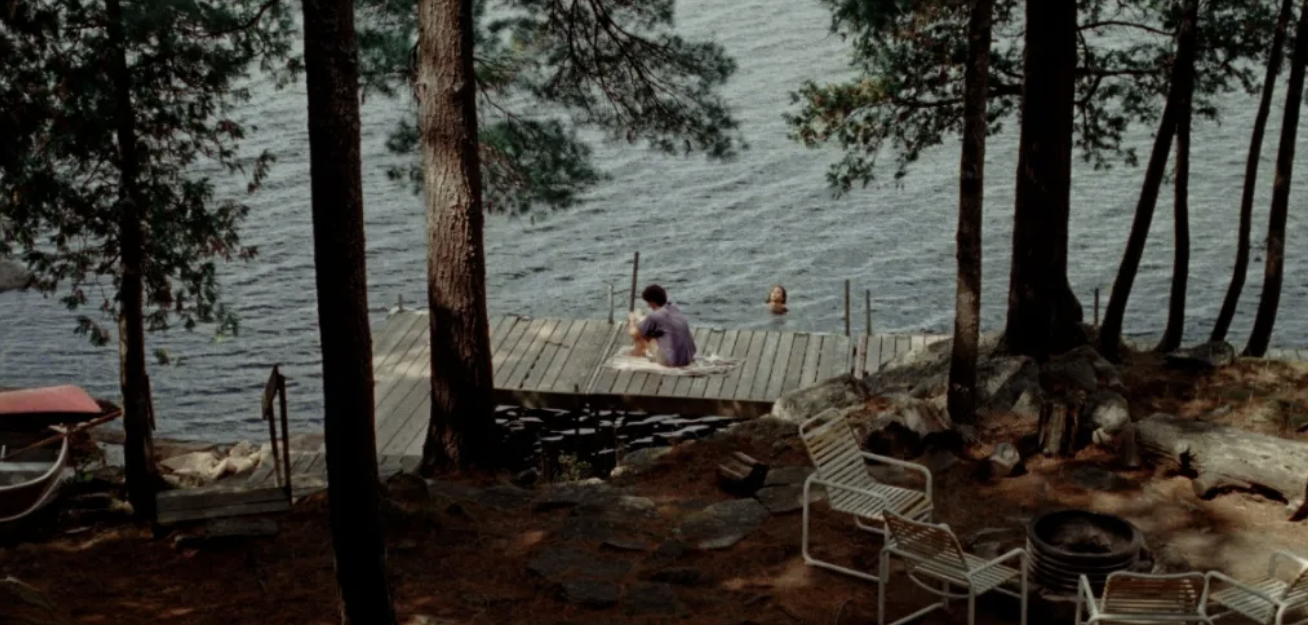
So much lingers in Michael Petruzzelli’s It Comes In Waves. The sun kisses the bodies of a trio of young people as they spend time on the lake while water on their shoulders refuses to dry with time spent on the creaky dock. Do you remember when you liked someone so much, but you didn’t know how to manage your feelings? When your desires were bottled up that it actually scared you to make eye contact with that person? Summer is a season synonymous with heat, desire, freedom, and possibility, and Petruzzelli’s film mixes all of these feelings together into a plaintive, thoughtful film about how memories and grief don’t just linger but have deep, inescapable life.
There is an exchange of glances by a campfire that I cannot forget from Petruzzelli’s film. Anton Gillis-Andelson’s Toni’s eyes keep darting in the direction of Isaac Kragten’s Paul as they spend time with Alexandra Rada’s Bella, as she tells stories of a friend’s drunken escapades. Paul works at a local corner store and Bella gently encourages Toni to speak to him, as if she can pick up on her friend’s attraction before he would ever admit it. “You’re always so alone” she tells him one day at the lake, and Petruzzelli’s camera effortlessly captures Toni’s eyes trying to figure out how long his gaze can stay on Paul’s face as they sit by the fire.
When stolen glances become conversation and that conversation gives way to flirtation and then skinny dipping, you can feel the hearts of the characters opening. By the cover of night, Toni and Paul allow themselves to get physically closer in wordless sequences like them sharing a bed together as they try to get comfortable and their faces drift closer. I felt myself holding my breath as I heard them inhaling and exhaling in each other’s faces. There is a moment shared through a window that feels sexy before it transforms into something desperately bittersweet.
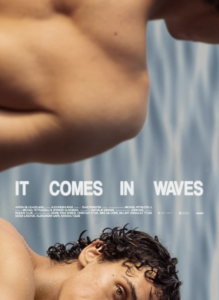 Gillis-Andelson is a captivating presence on screen. We almost feel the heat in his cheeks when he blushes or looks away, and his caution while flirting is as tangible as when we see Toni overcome with sadness and newfound emotion. Patruzzelli’s script, co-written with Spencer Glassman, uses words sparingly but effectively as Gillis-Anderson’s eyes showcase Toni’s sensitivity, nervousness, and hunger.
What we may not expect, though, is how Petruzzelli’s narrative splits and layers on top of itself, as this story simultaneously invites us to witness Toni’s romantic coming-of-age but also a forced maturity. This is a film about the events in our lives that we cannot explain and probably don’t have the words to put to our emotions when we feel our first pangs of loss. We have a choice to remember our youth as something auspicious and as bright at the summer sun even when that summer season begins to grow chillier.