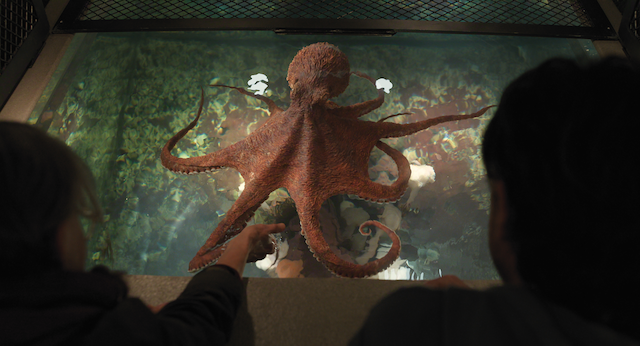
How do you make an octopus come to life on screen? Director Olivia Newman reveals the secrets behind shooting her Emmy-nominated TV Movie, Netflix’s Remarkably Bright Creatures.
For Remarkably Bright Creatures director Olivia Newman, the 2026 Emmy nominations are a reunion of sorts. Actors Yahya Abdul-Mateen II and Colman Domingo, who both starred in her first feature film, First Match, also received nominations for Wonder Man and Euphoria, respectively.
“It’s just been mind blowing to watch their careers explode,” said Newman. “And I hope I get to see them. You know, we’ve run into each other here and there over the years, but it would be amazing to see them in person again.”
And Newman’s career has exploded as well. After directing 2022’s Where the Crawdads Sing, producer Bryan Unkeless sent her another best-selling book to adapt…with Sally Field already attached.
“Being able to read the book [Remarkably Bright Creatures] and imagine Sally in the role of Tova was extremely helpful,” said Newman. “And the book just moved me so deeply. And I thought, ‘We’ve got to figure out a way to turn this into a movie.’”
But how do you turn a book with a sentient octopus into a movie? Did Newman ever feel daunted by this seemingly impossible task?
“Yeah, many times,” Newman laughed. “All the way up until the end. The challenge for me was there is absolutely no way to make this movie without Marcellus being in it and playing matchmaker between Tova and Cameron (Lewis Pullman); he has to be part of the movement of the story. He can’t just be a fun little side character; he really has to be integral to their story. But I really didn’t want him to distract the viewer from the real human experience that’s going on at the center. If octopuses could be trained, I would have trained an octopus and done everything with a real octopus.”
But of course, there aren’t many octopus actors waiting in the tank. So Newman had to utilize visual effects to make the octopus look like a real octopus, while also making audiences attach emotionally to it without anthropomorphizing it too much.
“We had this incredible team with Untold [Studios] and Chris Ritvo, our VFX supervisor who really understood the mission. And everything the octopus does in the movie, they would show me footage of a real octopus doing in real life, so we were never coming up with or imagining movements for this octopus that we wouldn’t be able to see an octopus do in real life. That was the biggest challenge”
While no “fake” prop octopuses were used, Newman and her team did employ puppets.
“We had a puppet made specifically for lighting reference,” said Newman. “It was the same color and texture and could catch the lighting for our visual effects team to be able to capture the exact kind of lighting of the octopus. And we had some weighted puppets for when Sally has to pick up the octopus and put it in the bucket so it would feel the same weight that Marcellus would feel. And for eyeline reference, we would always describe exactly what the octopus was doing.”
Newman storyboarded all of the scenes with the octopus, so they could talk the actors through where they were in relation to Marcellus. However, there was nothing in the frame. That was just left to the actors’ imagination.
As for the magic of Marcellus’s narration, Newman didn’t know what his voice sounded like while shooting.
“Alfred [Molina] was cast when the movie was done,” said Newman. “And for me, figuring out the voice of the octopus was the biggest decision that I had to make. And I really felt like I needed to see his whole story arc before I could settle on a voice and a rhythm and a texture for Marcellus.”
Molina could see the scenes when they recorded him in the studio, to see what the octopus was doing.
“And what’s amazing about Alfred is he’s got so much stamina and so much range in his voice that we could play and try different rhythms and textures and sort of really be very specific about where Marcellus is in his sort of aging, dying process, because it was really important to me that at the beginning of the movie, we get the sense that he is frustrated and annoyed to be trapped in this tank. And he knows his time is running out, but he’s not. There’s still time left to do lots of shenanigans. But by the end, we really want to feel him slowing down and losing his energy and that the audience needs to be so attached to him by that point that we don’t want to hear Marcellus without breath and this sort of support that Alfred gives him in the beginning. So it was so fun to play with him.”
Just as Marcellus likes to move around, so did Molina.
“He was very physical when he was doing the voice recording. He would watch the screen and imitate the movements that Marcellus was doing on screen to imagine what it felt like to be that octopus moving through water.”
Remarkably Bright Creatures is streaming on Netflix.