Maurice – 4K-UHD/Blu-ray – Kino Lorber
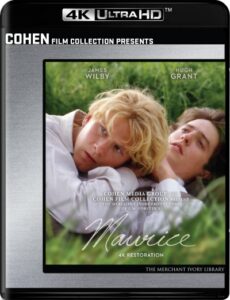 James Ivory’s Maurice is a milestone in gay cinema and rightly considered one of the most significant queer films of all time. It was also quite audacious for 1987 when queer films usually ended tragically, depicting the perils of being gay in Edwardian England, but then daring to allow a happy ending for its two male lovers.
The follow-up to the Oscar-winning Merchant Ivory surprise success, A Room with a View, Maurice was also based on an E.M. Forster novel, but one that while written in 1913-14, was not published until 1971, posthumously. Foster himself was gay and open with close friends but closeted to the public.
It’s seemingly incomprehensible today (but is it?) that there was a time, not that long ago in England when homosexuality was a seriously punishable offense. Maurice examines one young man’s internal and external struggle living in a horrifically repressed and maddeningly critical world that is trying to force him into leading a life that contradicts his natural sexual orientation.
Maurice Hall (James Wilby) and Clive Durham (Hugh Grant) become fast friends at Cambridge but as they grow closer, romantically, they are forced to keep their feelings secret. “Omit the reference to the unspeakable vice of the Greeks,” one of Maurice’s professors insists during a class reading of Plato’s Symposium, punctuating society’s hypocrisy and outraging Clive, who desires Maurice but wants to keep their relationship platonic. Maurice craves more but goes along with Clive, who panics when one of their mates is arrested for homosexuality. So, he decides to marry a woman, urging Maurice to do the same.
In an attempt to be cured, Maurice visits a doctor (Ben Kingsley) who tries to hypnotize him straight. Kingsley has some of the best lines in the film including, “England has always been disinclined to accept human nature.”
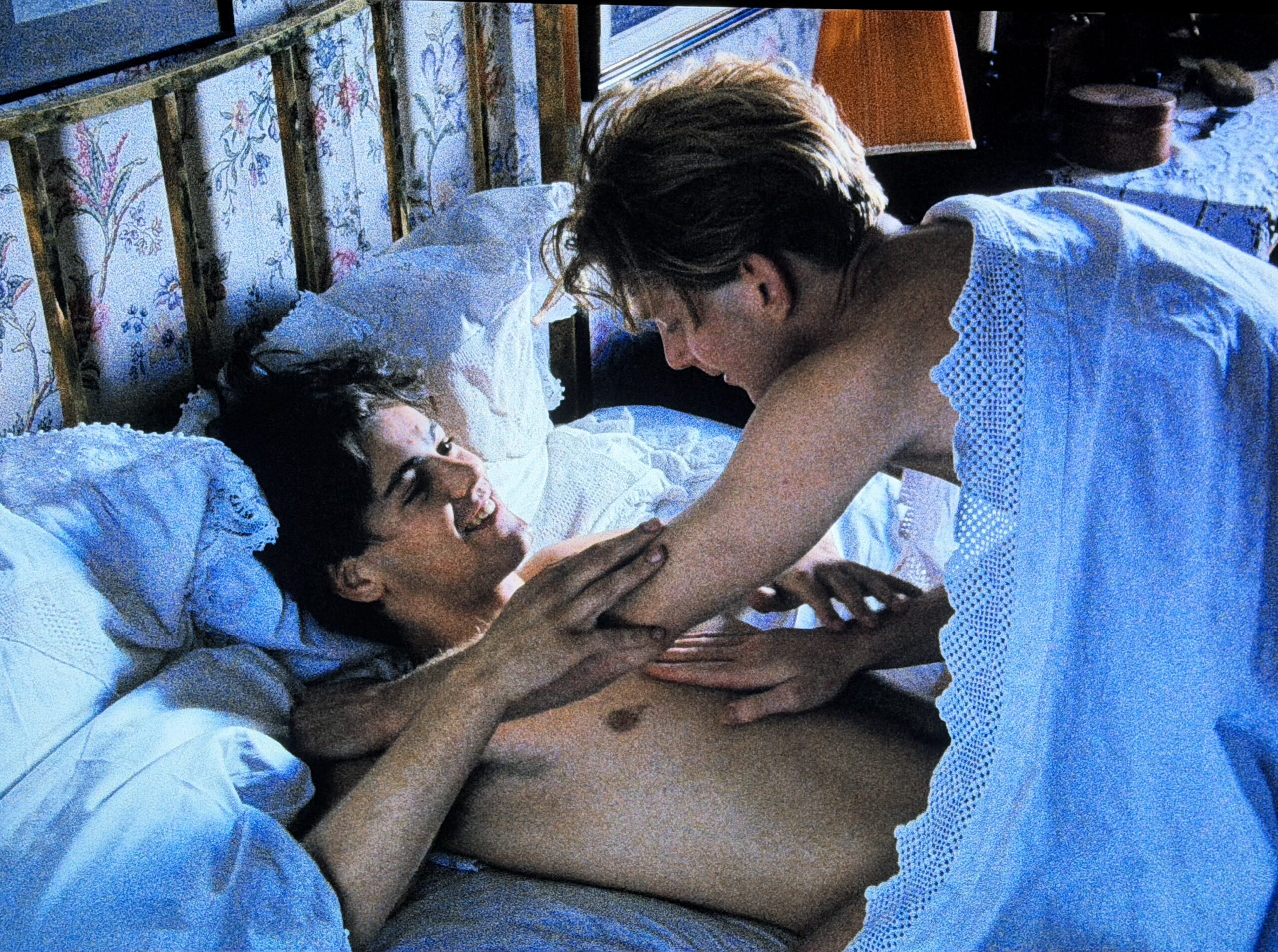
Suffice to say the cure does not take and Maurice embarks on an affair with Clive’s under-gamekeeper Alec Scudder (Rupert Graves), after Alec takes it upon himself to climb a ladder and slip into Maurice’s bedroom, via an open window. It’s an incredibly startling and romantic scene–one that had quite a profound effect on me when I was younger.
As is usually the case with Merchant Ivory, class is explored and the wealthy’s hostile attitude towards the working class is justly excoriated.
Ivory wrote the script with newcomer Kit Hesketh-Harvey, when Merchant Ivory’s go-to writer Ruth Prawer Jhabvala passed, feeling the subject matter wasn’t really in her wheelhouse.
A Room with a View breakout Julian Sands was set to play the titular character but left the project at the last minute—there are still conflicting accounts as to why. The role went to Wilby, who has grown on me with repeated viewings, and I am now able to fully appreciate Wilby’s incredible transformation from self-loathing to confusion to acceptance to prideful elation.
The unknown Grant, who would go on to become an international film superstar, makes such an indelible impression that we understand Clive’s fear and sympathize with his misguided choices.
Graves has the trickiest part and delivers such a wickedly startling yet authentic performance, brimming with youthful yearning, he should have easily received an Academy Award nomination. The film, strangely, was only nominated for Jenny Beavan and John Bright’s costumes—strangely because Merchant Ivory’s previous film, A Room with a View, received eight Oscar nominations the year before and won three awards. Homophobia in AMPAS? What do you think? Lest we forget the Crash defeating Brokeback Mountain debacle almost two decades later.
Denholm Elliott, Billie Whitelaw, Judy Parfitt and Helena Michell are all wonderful in smaller roles.
Kino Lorber’s newly restored 4K disc, presented by Cohen Film Collection, is a sumptuous feast for the eyes. Pierre Lhomme’s gorgeous cinematography pops magnificently. And Richard Robbin’s lovely score sounds fantastic.
The fab special features are all ported over from the Cohen Media Group’s 2017 Blu-ray edition and features a number of chats with Ivory as well as The Story of Maurice, a lookback doc produced for the 2002 Special Edition DVD. The plethora of deleted scenes is a highlight and includes a fascinating subplot involving Maurice crushing on a young and handsome office worker played by Adrian Ross Magenty, who would have a more prominent role in Howard’s End.
There was a reason that, for decades, the name Merchant Ivory meant unmatched quality, literary cinema. Maurice is a prime example. It’s a film that gets better and bolder with age. And this Kino Lorber 4K is tribute to its enduring cinematic status.
https://kinolorber.com/product/maurice
Hang ‘Em High – 4K-UHD/Blu-ray – Kino Lorber

Any movie that opens with cows puts a smile on my face. Then you have Clint Eastwood saving a calf that can’t quite swim herself across a river. I’m smiling widely. Suddenly, a few seconds later, a posse of nine men on horseback splash-ride across that same river and, in less than five minutes, hang Eastwood for a crime we all know he didn’t commit, because it’s Clint Eastwood, for film’s sake!
The men leave prematurely (a silly plot device we easily forgive) as Ben Johnson (future Oscar-winner for The Last Picture Show) rides up and shoots Clint down. See, he’s a U.S. Marshall and it’s 1873 in Oklahoma Territory (pre-statehood). Eastwood’s character Jed Cooper, lives, of course and is exonerated and then deputized by Judge Fenton (Pat Hingle) to ostensibly help bring lawbreakers to justice, but Clint, I mean Jed, is seeking revenge on the nine men who strung him up and left him for dead.
Toss in a stunning Inger Stevens as a woman in search of her own revenge and Hang ‘Em High is a film with a lot going on, chock full of ’60s character actors like Bruce Dern, Ed Begley, Alan Hale, Jr. Star Trek’s Mark Lenard and Dennis Hopper, making the most of a ‘blink and you miss him’ scene.
From the startling opening to an ambush in a brothel to the predictable but mostly satisfying climax, the film is directed with great efficiency by Ted Post, who Eastwood worked with on TV’s Rawhide.
Eastwood was coming off his Sergio Leone spaghetti western trilogy and had a big hand in this production as well as the script, credited to Leonard Freeman and Lem Goldberg. A year later he’d make the musical Paint Your Wagon, opposite Lee Marvin and Jean Seberg.
Having gained popularity and an Emmy nomination in three seasons of The Farmer’s Daughter as the titular character, Stevens was well on her way to potential stardom delivering solid work in films like Madigan, Five Card Stud and House of Cards. But she died prematurely in 1970. Her death was ruled a suicide. She is terrific here, especially in a poignant scene where she reveals her past trauma to Eastwood.
The best performance in the film is by Pat Hingle, a judge caught in a political maelstrom in constant crisis about whether he’s making the right decisions or not. If only our Supreme Court justices felt as torn about their partisan decisions of late.
Dominic Frontiere only had eight days to compose the score and it’s fantastic. He would go on to write the rousing, Golden-Globe-winning score for Richard Rush’s The Stunt Man (1980).
The film received mostly positive reviews and became the biggest United Artists box office opening in history, even besting all of the James Bond movies at that time.
Kino gives Hang ‘Em a wonderful disc treatment—a brand new HD Master – from a 4K scan of the 35mm original camera negative. The film looks great and the sound is fab with Frontiere’s score grandly contributing to the viewing pleasure.
Both 4K and Blu-ray discs have two audio commentaries, a new one by historian Steve Mitchell and a previously recorded one by film historians Lem Dobbs and Nick Redman.
At the time of its commercial release, Hang ‘Em High was considered a revisionist western and in many ways it can still be seen that way today since it’s gritty realism and political pessimism goes against most of the binary heroic offerings of the genre.
https://kinolorber.com/product/hang-em-high
The Snowman — 4K-UHD/Blu-ray – Kino Lorber
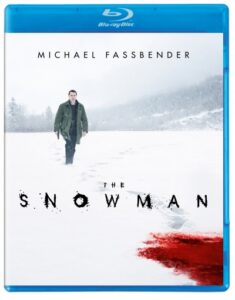
Some really good films are crapped on by critics, for varying reasons, and destroyed before they have a fighting chance —Todd Phillips’ misunderstood Joker: Folie à Deux and Robert Redford’s clever and biting Lions for Lambs spring to mind as examples. And while I wouldn’t call Tomas Alfredson’s bizarre, messy thriller, The Snowman, a misconstrued masterpiece, it’s not the dud that so many journos made it out to be upon its release in 2017. (7% on RT, come on!)
Executive produced by Martin Scorsese and based on Jo Nesbø’s New York Times bestselling novels, the film centers on Harry Hole (Michael Fassbender, always fascinating to watch), an elite Norwegian crime squad inspector who is investigating the disappearance of a young woman. The clue is a snowman found at the woman’s home, which leads Hole to think that an elusive serial killer may be at it again. He joins forces with a new and mysterious recruit Katrine Bratt (Rebecca Ferguson) to try and solve the case.
And from there, boy does the movie get muddled and convoluted, but also mesmerizing and oddly entertaining.
Charlotte Gainsbourg lends her considerable talents to an almost throw-away role, and Val Kilmer appears briefly. His role had to be dubbed because of an enlarged tongue due to his throat cancer treatment.
Alfredson does seem to prefer mood and atmosphere over clarity and coherence, but we can also blame the trio of screenwriters, Peter Straughan, Hossein Amini and Søren Sveistrup.
Dion Beebe’s startling cinematography is quite beguiling via Kino Lorber’s exquisite 4K disc.
Scorsese was originally attached to direct and one does wonder what his version would have been like and if he would have insisted on rewrites.
Kino’s extras include 25 minutes of glossy promo features as well as two new audio commentary tracks by film historian Steve Mitchell & screenwriter Michael Charles Hill and film historians Howard S. Berger and Marc Edward Heuck, respectively.
It’s not great, but it’s worth a watch, if only for Fassbender and the snowy landscapes.