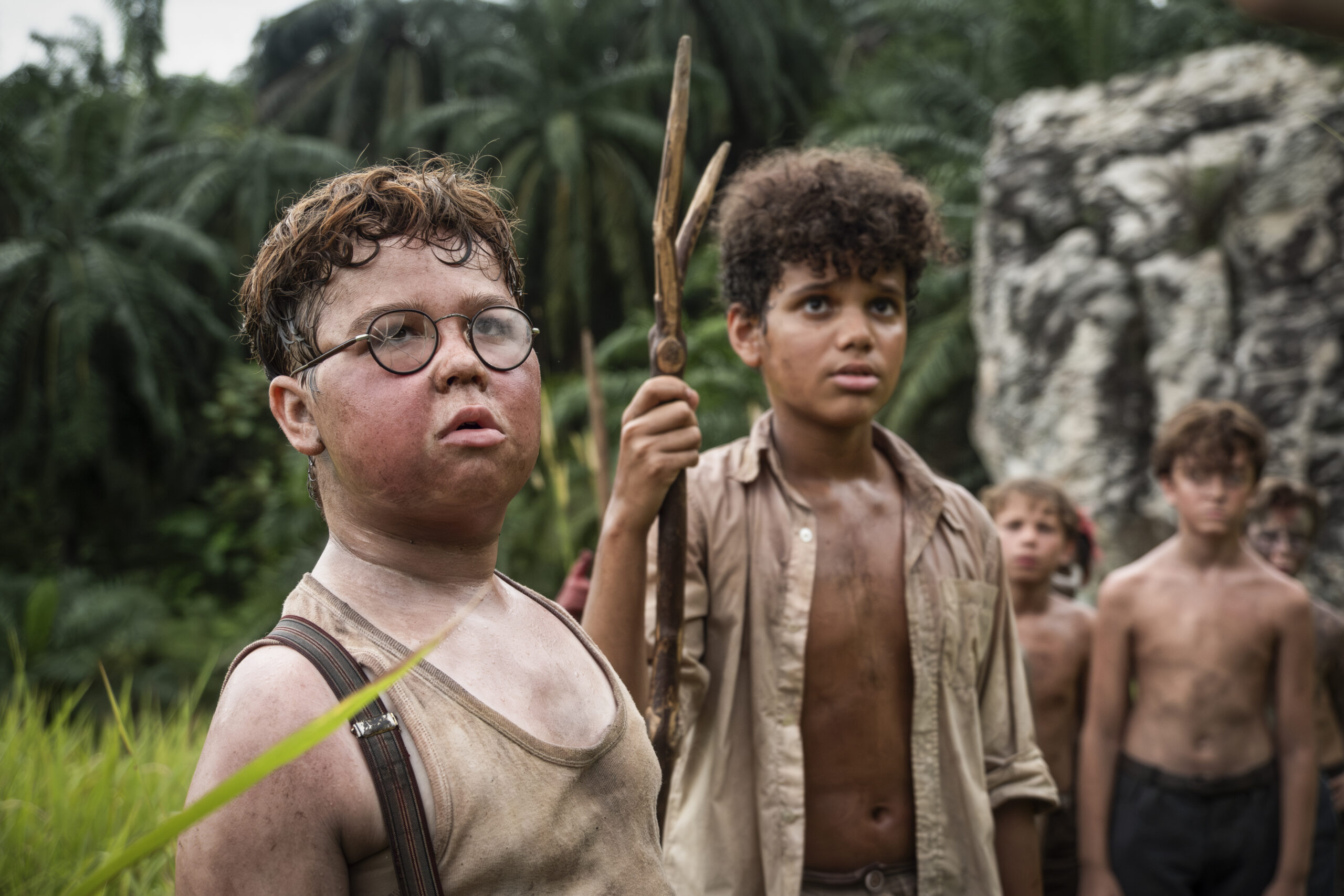
The beach in Netflix’s Lord of the Flies becomes a place for elections, negotiations, and, ultimately, murder. Maybe this entire experience was never meant to be placid and pleasant since a tragic plane crash is how these boys find themselves stranded in the first place. Marc Munden directs the entire season with a firm hand held towards the themes of Jack Thorne’s adaptation. He punctures our senses with visuals and brings this classic story to new narrative heights.
I admitted to Munden immediately that William Golding’s book always scared me for how it shows what we are capable of when it comes to human nature and survival. With Thorne writing the script, I knew that it would be a landmark limited series, and it did not disappoint. With this story being told yet again, I asked the director to tell me what it was like to approach this in a brand new way.
“My introduction to Lord of the Flies was the Peter Brook film from 1963, and that was so much later than the novel,” Munden says. “This is my fourth collaboration with Jack Thorne, and when I got the script, I phoned him, and I told him that he was able to unpack all the three dimensional characteristics of those main protagonists in a very rich way that never excuses their behavior. It could have been a sort of bleak watch even though, I think, it’s a devastating watch in a lot of ways. There’s a big difference between those two things. I wanted people to learn a lot about human nature as you go through it, and you understand the failings that we are all capable of.”
With nearly forty kids on set, Lord of the Flies had to abide by strict child labor laws, as they filmed emotionally taxing scenes. Munden reveals that he didn’t just pack up and go home after the kids were done for the day. He wanted the audience to really get steeped in the surroundings and the environment of the island.
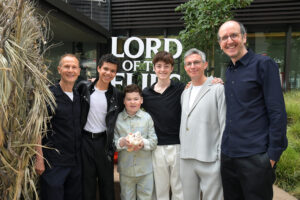
“The boys were only on set for five or six hours a day, so when you had big ensemble scenes, you could never shoot for a whole day,” he says. “So we did two things. One was that we broke the ensembles in two and we’d have people off in separate areas. The other thing is that before we really got to the stage where we’d really hone that technique, we were finishing at four in the afternoon. I had this idea that I wanted to try and film the sort of alien nature of the islands which then, in the piece, becomes an ecosystem that reflects their ecosystem. In a way, that mirrors their decline. After the children left for the day, I would film seagulls swooping in or coconuts on the beach. There was a lot of tricky scheduling around the tides and a lot of bad weather, and we lost four days to rain in the first two weeks where we couldn’t even get out on that boat. So because we were going out to these uninhabited islands around Langkawi, which was the main island we shot on. That was probably the most arduous and most taxing bit of the shoot.”
Munden and I speak about the dynamic between Jack and Simon, and he speaks to the similarities between the boys even though Jack easily displays cruelty to one of his closest friends. Even in a fractured paradise, the politics of friendship never go away. In a way, they are let loose or run wild with no parents around to maintain the guardrails.
“It’s not until episode three that you realize how close Simon and Jack are, but Jack is one of those friends that drops you when there’s more interesting friends around,” Munden says. “One thing to remember is that they are children. That’s obvious, I know, but the oldest child was twelve and the youngest was five–that’s still a big collection. When they are doing what they’re doing, they are still trying to construct an adult society with the limited knowledge that they have from their parents that they bring with them. Their parents, their teachers, their religious instructors. I think you should feel one moment with Jack that he is a complete and utter narcissist and the next you feel bad for him. We play with that image, but, at the same time, he really has a fragile who’s sort of neglected by his parents. It’s not an explanation for his behavior since Simon is neglected by his family.”
When the boys kill the boar, Munden keeps the camera right in their faces. We can see innocence being lost right before our very eyes as the actions goes near silent. Something has died by their hands in order for them to eat and continue on, but we are witnessing a true point of no return.
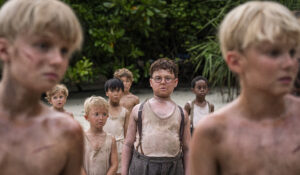
“I’d been playing with the idea of the portraits throughout, and I wanted to disrupt the narrative with that,” he says. “You see the kids when things are really pristine and then at the end when they’re these desperate souls calling out from the jungle for help. The boar hunt was an extension, and it was shot in about five minutes flat at the end of the day when we were having to clear that hill in the rainforest because there was a storm coming. Tom Lawrence, who was a coach for the kids on set, was probably on the floor as they prodded him with sticks, but, on the day, it was a lot of me shouting instructions at them about what they were really seeing. It starts as a game led by Jack–a sort of hunt–before it becomes a tragic reality. That scene is really a metaphor for the whole piece–a riposte to colonial adventure movies and books.”
The last twenty minutes of the fourth episode are tense and terrifying, as the tribes set their sites on Ralph after Piggy’s death. They try to smoke him out onto the beach, so their carnage can continue when they are met with the image of a still, solemn, and confused Naval officer. The action cuts dead immediately, as the boys realize not only that they have been discovered but they are saved at last. Munden holds our attention so raptly, and he knew that he needed to get it right.
“That’s such a significant scene,” Munden says. “We hadn’t rehearsed it, and all of these tore onto the beach to see this man standing in white, pressed shorts. They were really quite shocked, and Tom Goodman-Hill, who plays the officer, was rather devastated by them, to tell you the truth. He could see how destroyed and broken down they looked, so a lot of that is played within that context. I think the most important thing for was that, at that point, could’ve been a hugely emotional ending. But I felt that I wanted it to be quite dispassionate, because I wanted people to sit back and think about how broken they all were. That’s why there’s this John Taverner choral piece playing, which is quite neutral, and it’s quite cool in terms of its emotional temperatures.
I wanted people to sit back to have the time over that two minutes to really could have been done…think about the consequences for the boys. Jack just stands there defiantly, but Jack didn’t make it clear as to what he was thinking in that moment. I was determined for him to look remorseless, so that it leaves you with that feeling that things are unresolved in some sort of way.”
Lord of the Flies is streaming now on Netflix.