As we zero in on a remote cabin surrounded by snow in the opening moments of Tiago Pimentel’s Once Upon a Time in the Apocalypse, the wind howls almost like a siren or a warning. We naively assume that shelter can protect us from those frigid winds, but the sound does not let up even after we have found safety on the inside of that cabin. A title card explains that nuclear fallout has released enough smoke and dust into the air that winter has taken over the world, but that bitter feeling is not solely reserved for the physical world. Pimentel has created a film that plays eerily to the uncertainty of our times. Can we resist the cold and burst forth with the heat of rebellion?
The opening moments of Pimentel’s short, co-written by António Miguel Pereira, played a few tricks on me. We are not given a specific time period, but we know that we have entered a world after the second world war as Ernesto, older with a beard of white, listens to the radio of what is going on out in the world. No food can be found since all the warehouses are empty, andwhat is going on with all those babies? The camera passes by a stack of papers and periodicals that say over 80 million people have been wiped out in 45 minutes with a picture of a mushroom cloud. A voice over Ernesto’s radio explains that this current time is different that the Cold War since that took place “om a time of danger.”
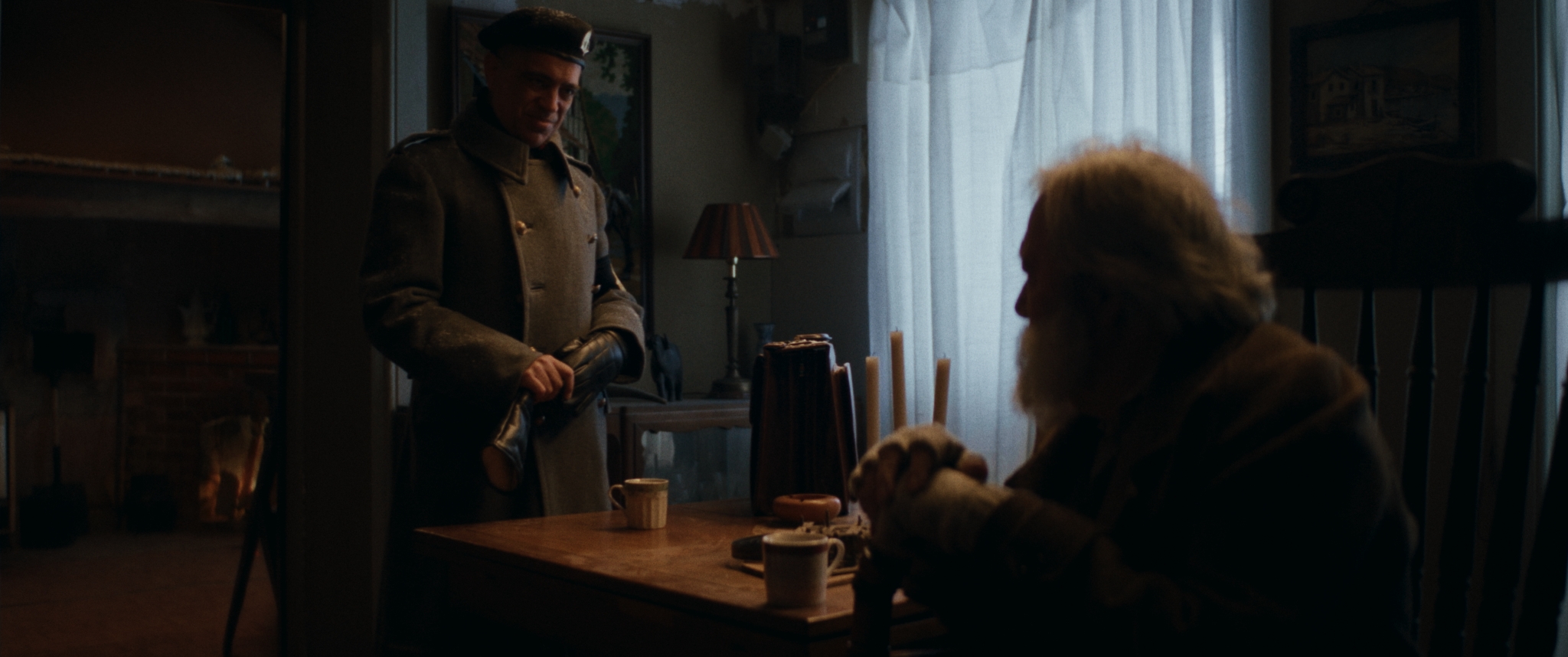
There are two entrances the change the course of the action of Pimentel’s film. Ernesto’s daughter, Helena, comes home after trying to hunt for food, but she brings with her a surpise: a swaddled infant. A heavier knock at the door brings the seemingly genial presence of Colonel Salavisa, played by Paulo Calatré, who sets the film into high gear as if a pin was released from a grenade. Salavisa tells Ernesto that he is conducting a census, and he is welcomed into Ernesto’s home. Pimentel’s camera is steady, as if we are becoming synced up with Salavisa’s point of view–his eyes comb over framed pictures and Ernesto’s furnishings. He even wipes off the tabletop when he requests a brandy before he brings up looting in the area and describing a woman that looks strangely like Helena, who is hiding herself away in a closet.
The power in Ernesto’s house, he explains, goes on and off randomly, and once the light is restored, Salavisa hears the radio broadcast that Ernesto was listening to. He hears how a voice says the government is employing “the most despicable strategies” to subjugate, and Apocalypse ratchets of the tension without being overly showy or over-the-top. Dread is used to marvelous effect throughout this entire film, as we realize that Apocalypse is the definition of “if we don’t learn from our past, we are doomed to repeat it.” We must stand up to bullies and call out fascism if we see it take hold in whatever country we live in.
Sérgio Godinho, as Ernesto, is a stable center as he mentally weighs his options of what to do with his new visitor, but the energy of the film is disrupted by Calatré unnerves you the entire film. His eyes bore into you, but in his probing, he never outwardly disrupts the narrative. In a lot of ways, he reminded me of Christoph Waltz’s Colonel Hanz Landa in the opening scene of Quentin Tarantino’s Inglorious Basterds. The production design, by Luis Sequeira, is handsomely drawn with history found in every nook and cranny.
It’s alarming to see a film hone in on the mood of the moment, but Apocalypse, tragically, might end up being more timely than we could ever anticipate. We tell ourselves that good will always triumph over evil, and Pimentel’s film is alive with the spirit of the people.



![James Cusati-Moyer On the World Premiere of ‘Sacred Creatures’ at Edinburgh International Film Festival [VIDEO]](https://thecontending.com/wp-content/uploads/2026/08/SC_MicRay_10_Courtesy-Nicolas-Villegas-H-120x86.jpg)