“Take the children and run.”
There is an almost overwhelming tension strung throughout Franz Böhm’s BAFTA-winning short film Rock, Paper, Scissors. Perhaps we feel that because our consciousness knows that the war in Ukraine is still happening, and we cannot help but feel the pain and sorrow for those who are losing their lives. In one of the most realistic war short films that I have ever seen Böhm pays his respect to a real family with unflinching authenticity.
Rock, Paper, Scissors tells the true story of a father and son working in a makeshift hospital when they realize that Russian forces are closing in on them. How do you create something as a conflict rages? We have seen feature films created during wartime, but Böhm, and producer Hayder Rothschild Hoozeer, were quick to talk about how honesty and authenticity were always at the forefront of their development and filming of this project.
“We were able to do this project by the blessing and the amazing support that we’ve received from the Ukrainian community,” Böhm says. “We were very, very mindful on how to approach this particular story that happens to be set in a war zone. An active conflict. The events are still unfolding even as we speak. That is something that was treated with the utmost respect, not just by Hayder and myself, but by the entire crew as well. The first demand that we had had for ourselves was the level of authenticity. It was very clear, for example, that we have an all Ukrainian cast, and it was also obvious to us that Ivan should be portrayed by someone from that country. For the production team, that was actually a huge logistical challenge. Getting Oleksandr Rudynskyi out of the country when martial law was still effect was an enormous challenge.
The second demand, and I think that’s perhaps where it gets a bit more philosophical, is that there are always a certain number of debates and discussions going on in how the war was and is defined by numbers. Hayder and I discussed at length how Putin’s war, at the time, was very much defined by that, and I think a large portion of this debate was circling around economic numbers and the impact of the war on how much money each country is giving towards the effort. I think what we wanted to do was a make a film that zooms in on one particular story. Our film tells a story about one family and one community, and we wanted to show the civilian perspective that sometimes gets lost when we hear about reported numbers. We wanted to make a film that showed how war makes people question things on a daily basis.”
 “The best thing about this whole collaboration is that all of the cast and crew, especially with Franz, was that we all understood the weight of the responsibility of this film and what this storytelling could achieve,” Hoozer says. “I have been to Ukraine twice since the conflict started in order to speak to the Ukrainian people, and I spoke to some who were actively fighting in the war in addition to civilians on the ground. This film exists as a direct echo of the Ukrainian national trauma. We’ve got the support of the office of the president of Ukraine who has recognized not only the filmmaking itself but also recognizes Ivan, who the story is based on, and his sacrifice. We came to this story not through politics but through people. We have had great success with the BAFTA Best British Short Film this year, and that stands less as a testament to the merit of filmmaking but more about the reality of what is happening to the people of Ukraine and its citizens. We wanted to showcase what conflict looks like from the very ground, and war is designed, by definition, to tear us apart.”
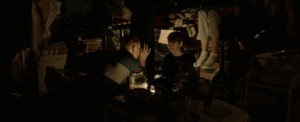
The tent where Ivan and his father work and live is a world unto itself. The camera stays tight on the action before we step outdoors and Ivan realizes just how many Russian soldiers are on their way. You cannot help but think about how close the camera stays with Ivan when he is both inside and outside. It’s almost as if Böhm is inviting us to be with our friend as the clock begins to tick down. Rock, Paper, Scissors becomes a visceral, physical experence for your entire body.
“As part of our studies at NFTS [National Film and Television School] means that we get to collaborate with other graduating students from the different courses,” Böhm says. “Hayder and I were very lucky that we were able to gather a very experienced international team, and I had the pleasure of working with our DP, Hsien Yu Niu before. We were wondering a lot about how to access Ivan’s world, and we thought a lot about the shot list, lenses, and everything related with that. I think what helped us a lot was the fact that we were able to scout locations together and that we spent so much time together. We did a lot of test recordings before the actual shoot, and I think the collaboration with our editor, Carmela Schönenberger, was very helpful to see how the different lenses felt.
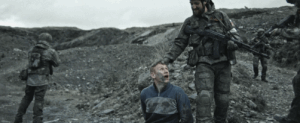 A very clear but very risky decision was to shoot the entire film handheld in order to have an experience that was aligned with Ivan’s experience. That camerawork very much, I would say, inspired both the sound design and the music as well. Large parts of the creative interpretation of the story are inspired by what Ivan might have heard or felt in his body. If you listen closely to the soundtrack, you can sometimes hear heartbeats. Sometimes when you get punched in the face or feel an enormous amount of pain, you can hear your blood trying to support your entire body, and that is something that we were really keen to try out in the musical composition.”
“There isn’t a clear divide between music and sound,” Hoozeer adds. “There is a woman giving birth at the start of the film, and that’s kind of the action that’s happening with Ivan’s father at the whole rush of the start. I remember us discussing at the beginning about how much do we want to spotlight that. How much focus do we put on that? That’s a big testament to the maturity of Franz’s filmmaking where you don’t have to point out every single thing in a scene to give it context within the storytelling. Part of the music and the sound design of that is as you hear it across the beginning of the film where you hear screaming and you can hear the noise and chatter of the pain from this woman. When it changes, then you can start to hear the soundscape change to hear the baby crying before it changes to be with Ivan outside of the bunker. We did discuss how important that moment of reality was in the atmosphere of Ivan’s life. Rather than showing you every little thing happening in that room, it builds a three-dimensional space that you can find yourself in.”
We cannot forget that this is a true story, and there might be hundreds more that we don’t see or even read about.
“What sits at the heart of this story and the heart of our film is the fact that this is not a story about war,” Hoozeer says. “It’s a record of a boy who was only 18, who not only exists in our memories. Once you go beyond that, it goes beyond the craft of filmmaking. It goes beyond the noise of the film, like with awards campaigns. At the heart of the story, it helps the audience confront the reality of being human. Behind every headline that you read is a heartbeat. There is a human.”