“Gold is a beast. To hunt it, you need bait.”
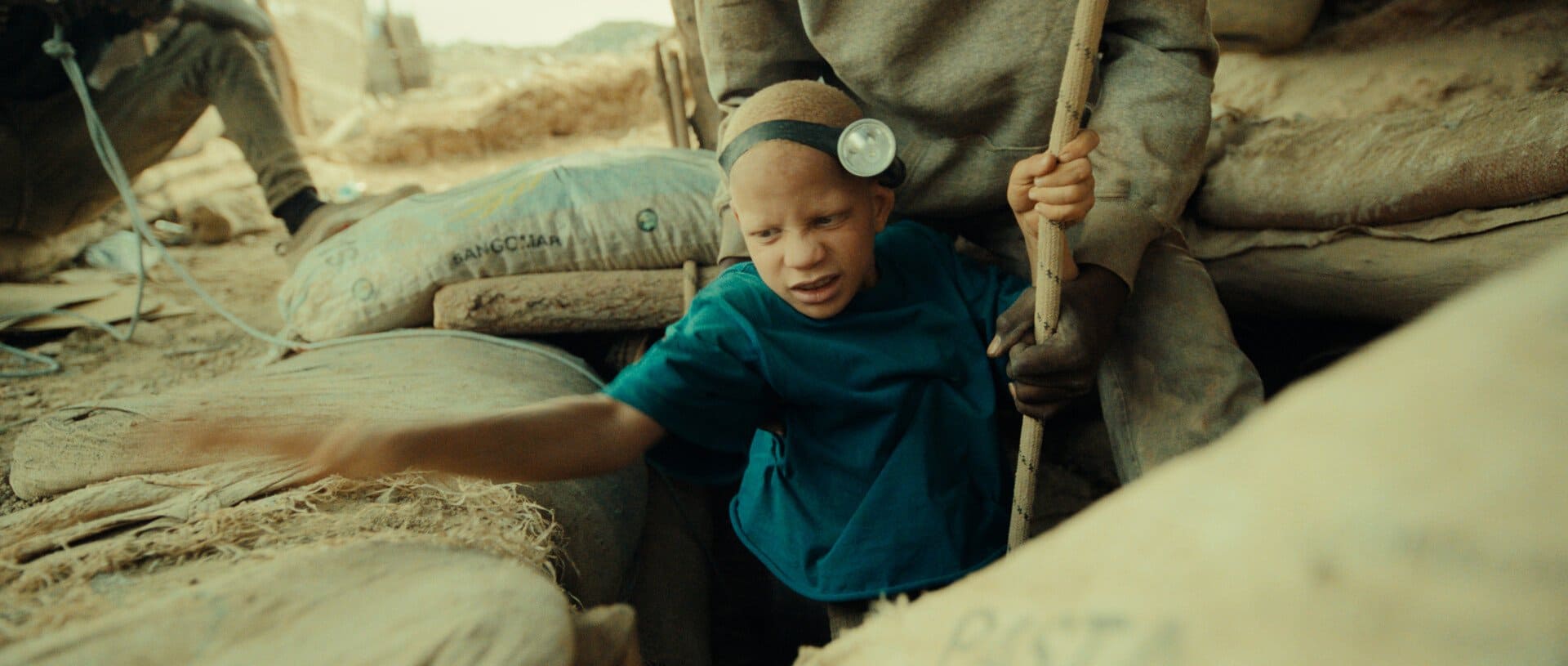
So says the opening words imprinted on a deep red screen at the top of Simon Panay’s The Boy with White Skin. We open in the bed of a truck as an albino boy shields himself from the sun under a tarp. He sticks his finger through a random hole and twists it, blocking one of the only portal of sun invading his sweaty sanctuary. By the end of Panay’s film, he will inexplicably find himself in another tightly drawn place. Panay’s film is about legend, lore, and belief. We descend below the surface and discover a world of mystery in the pursuit of ungodly riches.
Like many people, I had no idea that albino children were seen as luck to bring wealth from the mines in West Africa. Going down below the earth is something that draws Panay in, and he has made a few films about this very subject.
“I have made documentaries in West Africa since I was 18 years old, and I’ve focused specifically on artisinal gold mines since 2015,” Panay says. “I find this topic fascinating, and the deeper I fet into this wrld, the more fascinating it gets. I was filming in a gold mine in Burkina Faso for two years while making a feature documentary that was released in France in 2023. I witnessed pretty much what you saw in the film, meaning they bring albino kids down in the mine and ask them to sing in these underground galleries since they believe these kids will attract gold. They consider the gold to be alive like it’s some kind of beast that you need to attract to hunt like it’s an animal. The miners picture themselves as soldiers and not as miners. I was not allowed to film that for the documentary because they were afraid that the presence of the camera would break the magic. I saw it twice.”
I am thankful that I saw this film for the first time at this year’s Indy Shorts. When the young boy begins his journey down the mine, the woman next to me curled her legs up underneath her chin, as if she was trying to protect herself from slipping over the edge of the shaft. The film is so realistic that I almost wondered if Panay shot his film in an abandoned mine, but he was quick to point out that it was built for the film.
“That was the main challenge, because I really wanted to express to the viewer the experience that I had when I went underground,” he says. “I did that for a few months, and you never get used to going down in those galleries. The shaft is so impressive and so scary. You only have one rope and one piece of wood that you catch between your legs, and you will sometimes go 200 meters into the ground. You can scream if you like, and you have to be extremely careful of your back and your knees. If you get stuck, you are in extreme danger, because they will not stop running the rope. I wanted to make something at the first-person level to really be with the kid when he doesn’t know where he is. He doesn’t know why his father brought him here and why he has to go down. He doesn’t know why he has to sing and why, when he goes back up, his father is not there.
We recreated the cave on the Island of Gorée, so we weren’t really underground. It’s a cave that is close to the ocean where a set design team worked to make it look realistic. It is the same for when he goes down. We built a structure that was in an abandoned shaft on the gold mine, which is only 10 meters deep. The magic of cinema makes it look deeper, but he had full security on under his clothes. He was also attached to the structure on the surface. I wanted you to feel like you were close to him the entire time.”
When he reaches the floor in the mine, the boy is surrounded by sweaty, weary men. We don’t learn anything about them, but they stare at the boy and us at the same time. This is a precious place where the light from the helmet lamps swipe across the mine’s walls and floor. You can see particles floating in the air, and it feels almost like fairy dust. It’s almost as if the magic is all around us.
“Sometimes people confuse documentary lighting for something unsophisticated, but I quite disagree,” Panay says. “You can use the exact same settings you have in real life and recreate it with no cheating. You can prepare everything, but I wanted it to be as close to the real thing as possible. At the same time, we were looking for beauty, because there is some kind of magic in that dust that we see passing by the light. At the same time, it’s tricky and it’s complicated and you need to accept what might pop up at random, because it’s hard to control how the lamp moves all the time. My cinematographer, Simon Gouffault, and I worked very closely, and we only shot on one wide lens since I really wanted to have unity on the look on the film, which is at 14 millimeters. It forces us to be really close physically. It was hard to work the choroeography in that confined space, but, to me, it was important to work through it.”
Music is obviously very important, andyou can’t help but notice that the songs the boy sings is different then the one sung in celebration at the end. It’s almost as if we can feel the walls shaking as joy and excitement rumble through.
“The kid’s song is actually a very common one, mostly in Burkina Faso,” he says. “The song from the gold miners, though, is one that we created for the film. It’s not like you have songs that you can sing over in different places. Mose of those kinds of songs are just born in the moment are make up. We just invented a few sentences that we repeated. You can find those types of songs at a wedding or funeral–it’s part of the culture also.”