
Last night, I had the good fortune to attend Mexico’s annual celebration of cinema, The Ariel Awards, held this year in Puerto Vallarta. Now in their sixty-seventh year, the Ariels recognize the best Mexican films of the past year.
Having covered the Oscars in person in 2023, the U.S. Academy can learn a few things from the Mexican Academy of Film, Arts and Sciences. The show had glitz and glam, but it was also both laid-back (dress code: beach formal) and efficient. The Ariel Awards had all the check points that the Oscars do: presenters, winners, acceptance speeches, reels from each Best Picture nominee, and a host, but thanks to a “waste no time” ethos, the evening, which was broadcast live in Mexico on HBO MAX, clocked in at a well-paced two hours and twenty-three minutes.
That 143-minute length still had time for a lovely In Memoriam, three Golden Ariel Awards for lifetime achievement, and a 25th anniversary celebration of the great Alejandro Inarritu film, Amores Perros, completed by a musical performance. The “walk-off” music for the winner’s speeches was a gentle piano that disappeared when the winners for Best Actor, Best Actress, Best Director, and Best Film were speaking—the Ariels knew those in the International Convention Center and watching at home wanted to hear from the major category winners.
The show also made time to celebrate the rich cinematic history of Puerto Vallarta, first noted by the 1964 John Huston film starring Richard Burton and Ava Gardner, The Night of the Iguana. The Night of the Iguana had an interesting shoot, to say the least. Burton was married to Elizabeth Taylor at the time, and as the lore goes, Liz did not trust Burton around Gardner, and not only decided to be on set every day, but even bought a home in Vallarta with Burton to avoid leaving. That house has since been converted into a fine dining establishment called, naturally, The Iguana, which features memorabilia from Taylor and Burton’s films.
Other movies of note that were shot at least partially in Puerto Vallarta include Revenge (Directed by Tony Scott and starring Kevin Costner), Schwarzenegger’s Predator, Bradley Cooper’s Limitless, Godzilla II (2019), the deeply underrated noir The Harvest starring Miguel Ferrer, and, most recently, the Aubrey Plaza drama Emily the Criminal.
What also set the evening apart from recent U.S. awards shows was political outspokenness. After watching the recent Emmy Awards pander to an audience that doesn’t even watch their show, and do everything possible to keep its underqualified host and the speeches of the winners from saying anything politically relevant, the Ariel Awards were a breath of fresh freedom. Many of those in attendance (as well as several nominees) could be seen wearing black and white scarves in support of the people of Gaza. The host and numerous winners spoke out for a free Palestine, against fascism, against ICE, and against the Trump Administration.
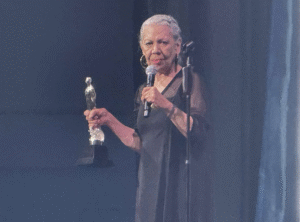
Most powerful in their fervent honesty was Best Actress winner Luisa Huertas for No Nos Moverán. Huertas spoke in memory of those who have been “disappeared” by fascist regimes and how we must stand on the right side of history. The very fiery Best Actor winner from La cocina, Raul Briones, let the expletives fly against ICE, Trump, and Israel’s government. Their statements were bold, and unlike at the Emmys, where some winners did speak out on these issues, they were not discouraged.
As for the awards themselves, the voters of the Ariels spread the wealth around to four films in particular. Winning the most statues on the night was Pedro Páramo, a surreal time-shifting drama directed by four-time Oscar nominee (as a cinematographer) Rodrigo Prieto. Pedro Páramo took home eight awards, including cinematography for Prieto and Nicholas Aguilar.
Taking home five Ariel Awards (including Best Actor for Raul Briones and Best Adapted Screenplay for writer/director Alonso Ruizpalacios) was La cocina, the NYC immigrant drama starring Briones and Rooney Mara, as two lovers working at a diner under an unforgiving and disreputable restaurant owner. One critic called La cocina “The Bear on steroids,”—an apt description of the film. Last year, I served as a judge for the Heartland Film Festival in Indianapolis for the Best Narrative Feature category. We on the panel chose La cocina for the honor. (Read my review here.)
Director Pierre Saint-Martin’s extraordinary No Nos Moveran won four prizes on the night, including Best Actress (Huertas) and Best Original Screenplay (Saint-Martin and Iker Compean). I first discovered No Nos Moveran at the 2024 Virginia Film Festival, where the film won the Programmer’s Award for Best Narrative Feature. No Nos Moveran (in English We Shall Not Be Moved) is a striking black & white film about an aging lawyer (Huertas) who discovers the man who may have murdered her brother more than fifty years prior in the true-life 1968 Tlatelolco massacre of student protestors in Mexico City. No Nos Moveran is, on one hand, a revenge drama, but also a deep family story about the cost of obsession, with no small amount of dark humor. Shortlisted by Mexico for 2026 Oscar consideration for Best International film, you can read my review here.
Finally, Sujo, a coming-of-age crime drama set in the world of the Mexican cartels, was awarded with three victories, but among that triptych was the most prestigious prize of the night: Best Picture. Also taking home the award for Best Director (Astrid Rondero and Fernanda Valadez), Sujo was one of the best-reviewed films of the year and served as Mexico’s 2024 submission for Best International Feature.
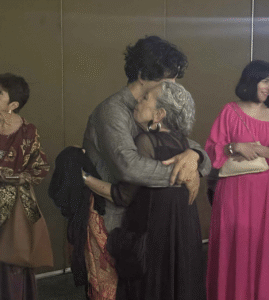
I would be remiss if I didn’t take a moment to thank the No Nos Moveran crew for ensuring that my wife and I could attend. As I mentioned before, I first saw their great film at the Virginia Film Festival last year. Festival organizers asked me to hold a post-screening Q&A with Producer Victor Leycegui. We had a great discussion with the audience and then left together for the festival wrap party. We stayed in touch over the last year, and during that time, I was introduced to Director Pierre Saint-Martin and Actress Agustina Quinci. I had terrific conversations with both of them, and ended up interviewing Pierre for the film. It was my great honor to be there with them (and to meet in person the great Luisa Huertas and the fabulous Jose Alberto Patino, winner of the Breakthrough Performance Ariel). As a journalist, you are supposed to be neutral (or at least pretend to be) at these sorts of events. I say with no small amount of pride that I failed miserably last night. My new friends made a great film, and my chest rose and fell with every win and loss.
It was a wonderful night for my wife, me, and for cinema.
See below the full results (winners and nominees) of last night’s Ariel Awards, followed by a personal photo dump.
- Winner, Best Picture: Sujo
- Bad Actor
- La cocina
- Pedro Páramo
- No Nos Moveran
- Winner, Best Director: Astrid Rondero, Fernanda Valadez — Sujo
- Urzula Barba Hopfner — Corina
- Rodrigo Prieto — Pedro Páramo
- Alonso Ruizpalacios — La cocina
- Pierre Saint Martin — No Nos Moveran
- Winner, Best Actor: Raúl Briones — La cocina
- Alfonso Dosal — Bad Actor
- Manuel García Rulfo — Pedro Páramo
- Juan Ramón López — Shame
- Juan Jesús Varela — Sujo
- Winner, Best Actress: Luisa Huertas — No Nos Moveran
- Naian González Norvind — Corina
- Rooney Mara — La cocina
- Fiona Palomo — Bad Actor
- Adriana Paz — Dead Man’s Switch
- Winner, Best Supporting Actress: Yadira Pérez Esteban — Sujo
- Mayra Batalla — Pedro Páramo
- Laura de Ita — Corina
- Carolina Politi — Corina
- Agustina Quinci — No Nos Moveran
- Giovana Zacarías — Pedro Páramo
- Winner, Best Supporting Actor: Héctor Kotsifakis — Pedro Páramo
- Juan Carlos Colombo — No Nos Moveran
- Noé Hernández — Dead Man’s Switch
- Eduardo Olmos — La cocina
- Alexis Varela — Sujo
- Winner, Best Breakthrough Performance: José Alberto Patiño — No Nos Moveran
- Ale Cosío — The Muleteer
- Jairo Hernández — Sujo
- Sofía Quezada — Sharp Wounds
- Andrés Revo — Fine Young Men
- Miguel Valverde — Down the Rabbit Hole
- Winner, Best Cinematography: Rodrigo Prieto, Nicolás Aguilar — Pedro Páramo
- Ximena Amann — Sujo
- César Gutiérrez Miranda — No Nos Moveran
- Juan Pablo Ramírez — La cocina
- María Sarasvati Herrera — The Muleteer
- Winner, Best Original Screenplay: Pierre Saint Martin, Iker Compean Leroux — No Nos Moveran
- Alejandro Andrade Pease, Armando López Muñoz — Fine Young Men
- Jorge Cuchí — Bad Actor
- Astrid Rondero and Fernanda Valadez — Sujo
- Samuel Sosa Derat, Urzula Barba Hopfner — Corina
- Winner, Best Adapted Screenplay: Alonso Ruizpalacios — La cocina
- Nicolás Giacobone — Down the Rabbit Hole
- Mateo Gil — Pedro Páramo
- Edgar San Juan, Juan Curi, Hipatia Argüero — Quite Like Paradise
- Javier Van de Couter, Camila Sosa Villanda, and Laura Huberman — Thesis on a Domestication
- Winner, Best Original Score: Tomás Barreiro — La cocina
- Alejandro Otaola — No Nos Moveran
- Gustavo Reyes, Andrés Sánchez — Corina
- Astrid Rondero — Sujo
- Gustavo Santaolalla — Pedro Páramo
- Winner, Best First Work: No Nos Moveran (Award given to Pierre Saint-Martin)
- Corina
- Pedro Páramo
- Shame
- The Thickness of Dust
- Winner, Best Sound: Javier Umpierrez, Isabel Muñoz Cota, Michelle Couttolenc, Jaime Baksht — La cocina
- Omar Juárez Espino, Patricia Balderas Castro, Josué Ramos Cruz, Alejandro Mayorquin — Sujo
- Christian Giraud, Luis Castañeda, Miguel Ángel Molina Gutiérrez. Raymundo Ballesteros Castillo — Jíkuri: Journey to the Land of the Tarahumara
- Daniel Rojo Solís. Alejandro Díaz Sánchez, César Gónzalez Cortés — No Nos Moveran
- Santiago Nuñez, Jaime Baksht, Michelle Couttolenc, Skip Lievsay, Rich Bologna — Pedro Páramo
- Winner, Best Editing: Yibrán Asuad — La cocina
- Roberto Bolado, Raúl Zendejas — No Nos Moveran
- Jorge Cuchí, Victor Gonzáles Fuentes — Bad Actor
- Astrid Rondero, Fernanda Valadez, and Susan Korda — Sujo
- Soledad Salfate — Pedro Páramo
- Liora Spilk, Yibrán Asuad — The Invisible Contract
- Winner, Best Art Direction: Carlos Y. Jacques, Eugenio Caballero — Pedro Páramo
- Alisarine Ducolomb — No Nos Moveran
- Belén Estrada — Sujo
- Lou Pérez Sandi — Corina
- Sandra Cabriada — La cocina
- Winner, Best Makeup: Lucy Betancourt — Pedro Páramo
- Alfredo “El Tigre” Mora — Let’s Play in the Woods
- Dalia Rosales — No Nos Moveran
- Fernanda Juárez, Ana Ximena Serrano Sierra — A History of Love and War
- Itzel Peña García — La cocina
- Roberto Ortiz, Ana Flores — Párvulos: Children of the Apocalypse
- Winner, Best Custume Design: Anna Terrazas — Pedro Páramo
- Adela Cortázar — La cocina
- Anna Barroso Bou — Corina
- Dalia Rosales — No Nos Moveran
- Lupita Peckinpah — The Muleteer
- Mariestela Fernández — Technoboys
- Winner, Best Special Effects: Alejandro Vázquez — Pedro Páramo
- Yoshiro Hernández — Párvulos: Children of the Apocalypse
- José Martínez — Sujo
- Alejandro Vázquez — Let’s Play in the Woods
- Gregorio Vega — La cocina
- Winner, Best Visual Effects: Marco Maldonado — Pedro Páramo
- Enrique Cantú Garza Villareal, Fernando Campos Mendoza, Raul Campos Mendoza, Zack Rodríguez Moreno — Night Shift
- Leo Carrillo — Párvulos: Children of the Apocalypse
- Raúl Luna — La cocina
- Luis Montemayor — Jíkuri: Journey to the Land of the Tarahumara
- Winner, Best Documentary Feature: The Invisible Contract
- Concerto for Other Hands
- Cracked
- The Guardian of the Monarchs
- State of Silence
- The Woman of Stars and Mountains
- Winner, Best Animated Film: Uma & Haggen
- Winner, Best Short Film: La cascada
- El límite del cuerpo
- Passarinho
- Spiritum
- Viaje de negocios
- Winner, Best Animated Short Film: Fulgores
- Aferrado
- Dolores
- La carretera de los perros
- Ser semilla
- Winner, Best Documentary Short Film: Anónima inmensidad
- Buscando un burro
- Hasta encontrarlos
- Pequeños zorros
- Vientre de luna
- Winner, Best Ibero-American Film: Kill the Jockey (Argentina)
- The 47 (Spain)
- The Dog Thief (Bolivia)
- In Her Place (Chile)
- Rita (Guatemala)



![Tuc Watkins: Star Of New Queer Indie ‘Exit Interviews’ [VIDEO]](https://thecontending.com/wp-content/uploads/2025/09/Donny-on-Couch-2-75x75.jpg)



![James Cusati-Moyer On the World Premiere of ‘Sacred Creatures’ at Edinburgh International Film Festival [VIDEO]](https://thecontending.com/wp-content/uploads/2026/08/SC_MicRay_10_Courtesy-Nicolas-Villegas-H-120x86.jpg)