
When it comes to taboo subject matter, pedophilia ranks pretty high. When a film dares to delve into such content, its focus is usually on the victim.
Elliot Tuttle’s bold, provocative and tantalizing feature debut, Blue Film, ballsily shifts that focus to the pedophile, or to be technically correct, hebephile (someone sexually attracted to post-pubescent children, ages 11-14)—a former teacher who forces an encounter with a student he lusted after, years earlier, and may still be in love with. In doing so, Tuttle has crafted a hypnotic, disturbing, yet strangely moving two-hander—one sure to spark controversy and, God help us, conversation.
The film just world-premiered at the Edinburgh International Film Festival, after being turned down by many major queer fests. That is a shame, because this is an intelligent, thought-provoking, beguiling work that boasts two captivating performances by Reed Birney and newcomer Kieron Moore, who sears the screen. Kudos to EIFF for not capitulating to fear.
The very first shot in Blue Film shows Aaron Eagle (Moore) a boastful, Dom camboy, turning on, as he bellows, “What’s up, faggots?” Aaron sees himself as a kind of hairy, hyper-masculine savior to gay men with submissive fantasies who like to be mistreated and/or humiliated.
Later that night, Aaron arrives at the rented Air B&B of an older man who has paid a pretty penny to spend one night with him. Little does Aaron know the initially ski-masked guy is his former middle school English teacher, Hank Grant (Birney), who once crushed on the boy, when he was twelve. Mr. Grant, Aaron recalls, was fired for the attempted assault of another 12-year-old.
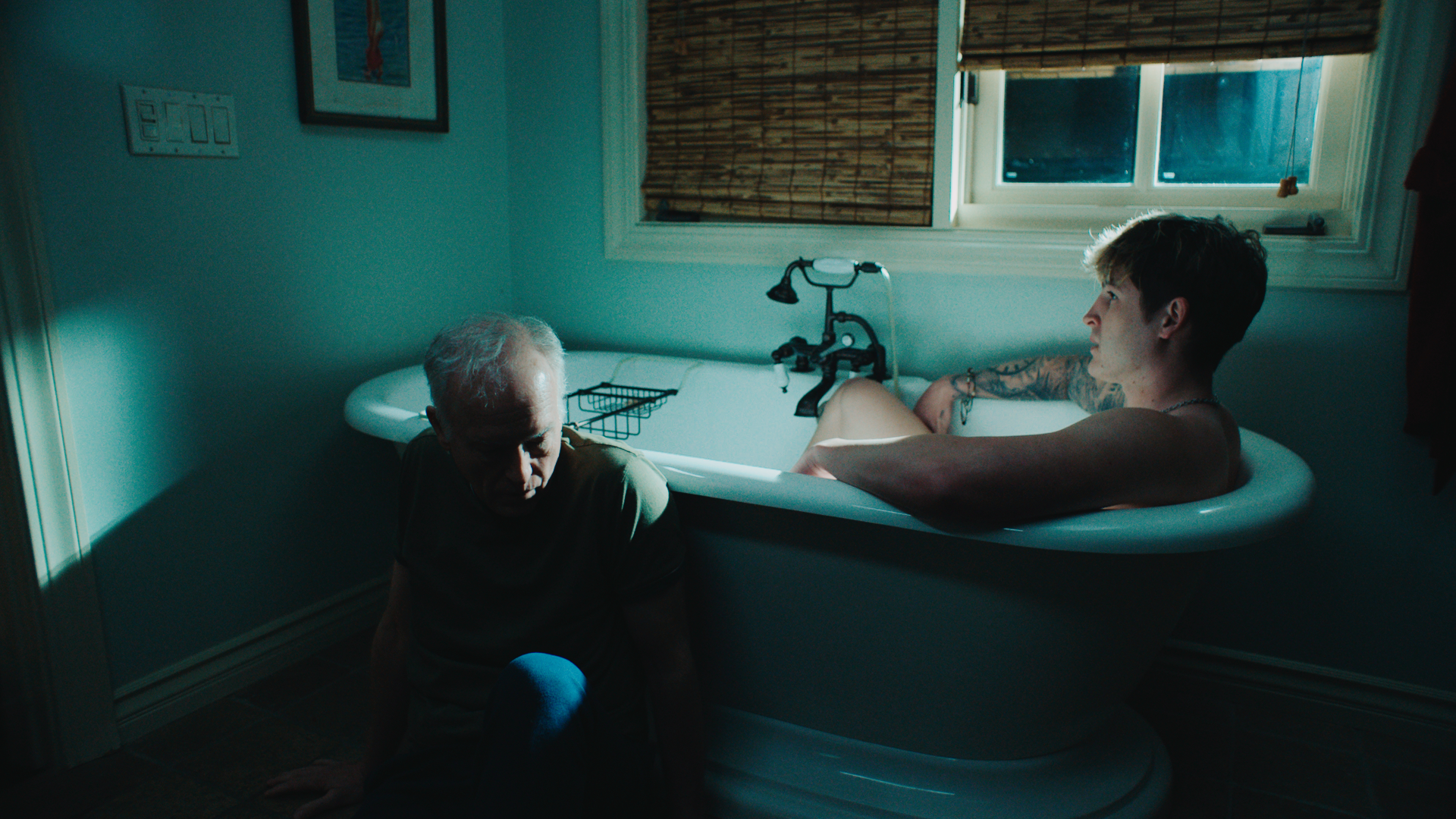
What follows is a night filled with frank (and not-so-frank) discussions, sexual tension and a few startling revelations from two very damaged individuals.
Hank is a self-aware man who doesn’t try and deny his attraction to young boys, but he isn’t proud of it either– quite the contrary. He’s arranged the meeting in hopes that he’s still attracted to the now-grown man, desperately trying to prove something to himself.
Aaron, whose real name is Alex McConnell, struts about like a sexual peacock. A former tweaker, he now sees himself as “California sober,” meaning he drinks and smokes weed—nothing else. And he is quite proud of his physique, shedding his clothes with ease and pride. “If you looked like me, you’d want to be naked too,” he boasts. But as the evening progresses, Aaron/Alex begins to metamorphose. The tough, seemingly dangerous dude’s layers slowly begin to strip. And he stops performing.
“Were you attracted to me?” he almost sheepishly asks Mr. Grant. They both surprise one another with the raw and penetrating responses to questions as they apprehensively, often resentfully, revisit their respective pasts. Grant’s youth backstory is particularly grim and horrific, but also revelatory. Both are naturally curious and sometimes pretentiously philosophical. The dialogue can be a bit too self-reflexive at times, but then Grant is a former English teacher.
The idea for Blue Film came from the filmmaker musing on his memories of his own sexual awakening. “I remember how badly I wanted my history teacher to want to have sex with me,” Tuttle explains in the press notes. “And then I began to extrapolate who the character that I was fantasizing about might have actually been.”
The writer-director dares to present both his characters, warts and all, and not judge them. Most any other American filmmaker would have felt the need to take things to some condemnatory extreme, but here, complexities and nuances are explored instead.
The sex scenes, for the most part, feel authentic, although there are a few moments that are way too ‘intimacy coordinated,’ and sometimes too careful to only show so much.
But the actors sell it.
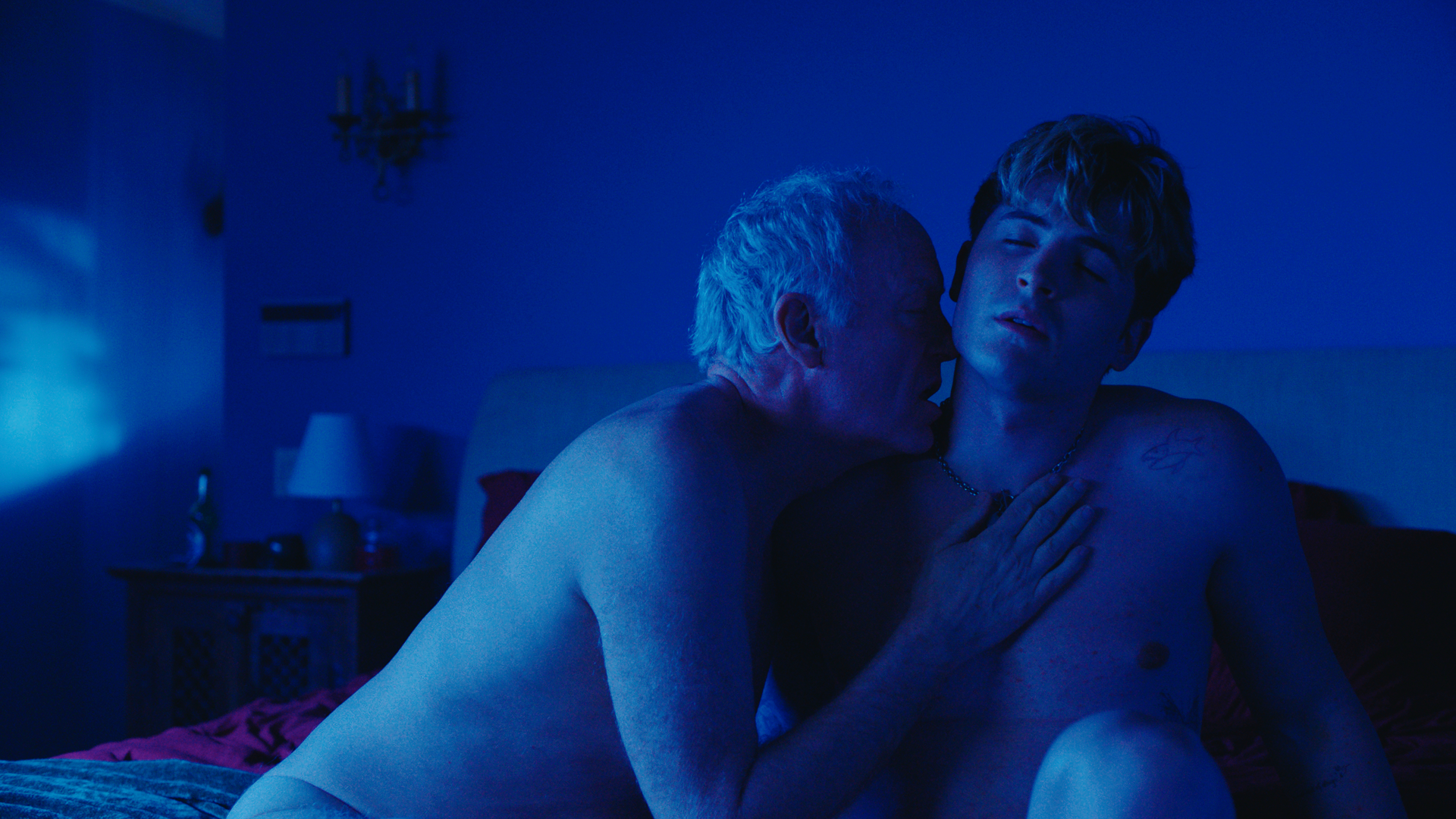
Birney balances his character’s shame and self-disgust with a real desire to survive and better himself. Grant’s endless fascination with Alex is palpable and Birney imbues Grant with a refreshing humor and grace.
The magnetic and mesmerizing Moore achieves something sublime. Alex’s journey is quite an extraordinary one. He comes in cocksure and slowly becomes an innocent little boy again. Moore makes it appear seamless–it’s a heartbreaking turn, radiating with confusion and curiosity; the kind of performance that, with a decent release, would and should be in the awards conversation. Plus, Tuttle and his extraordinary DP, Ryan Jackson-Healy, know exactly how to capture Moore, using startlingly effective extreme close-ups that manage to penetrate his armor and give us a glimpse of a lost but not yet destroyed soul.
And the final scene is absolutely transcendent.
Blue Film is not an easy sit–it pushes boundaries by daring an audience to sympathize with a cocky, overly sexual manboy and, most unsettling, a pederast. Tuttle is breaking with today’s truly frightening culture of carefulness and capitulation to the mundane and inoffensive.
“Why were you in love with me?” Alex queries his former teacher. The answer doesn’t matter as much as the significance of the character asking the question.
Blue Film has additional Edinburgh International Film Festival screenings Sunday, August 17 at 9:45PM and Monday, August 18 at 1:45PM. The film is currently seeking distribution.