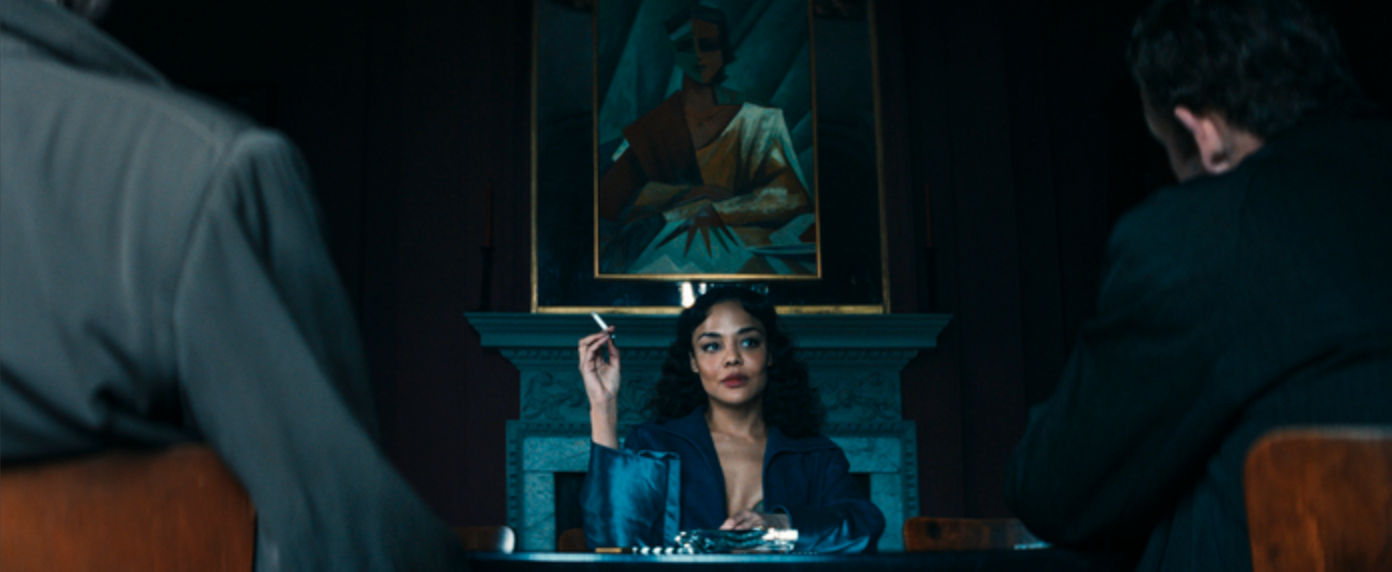
Writer-director Nią DaCosta’s Hedda immediately engages the viewer with a deceptively simple scene. We’re immediately introduced to Hedda Gabler (Tessa Thompson) as she’s being interrogated for a mysterious crime. Yet, what immediately catches our eye is the gorgeous painting centered above Hedda’s head. It’s a portrait of the character established in tauntingly blue hues. The color blue replicates itself in multiple ways throughout this scene and in other aspects of the Hedda production design.
It’s a captivating way to kick off the film. Clearly DaCosta agreed as it was not originally how the film was to begin. Yet, she fell in love with Hedda’s portrait as imagined by production designer Cara Brower, and the rest is cinematic history.
“I didn’t know that Nia was going to do that shot with the painting. She just loved that painting so much. It’s really fulfilling when you do something and, and the director really loves it so much that she just features it in the film,” Brower revealed.
The portrait stems from an enormous amount of research Brower undertook to understand the period. When first imagining the project, she immediately assumed it would take on a Remains of the Day look and feel — a beautiful, classic and very traditional period piece. But that’s not what DaCosta had in mind. She wanted the Hedda production design to render as boldly as its main character.
So, as with The Marvels and Candyman before it, Hedda provided Brower the opportunity to world build, something that excited the designer immensely. This is, after all, an artist who cut her teeth as art director on the great David Lynch’s Twin Peaks: The Return. World building is what she lives and breathes.
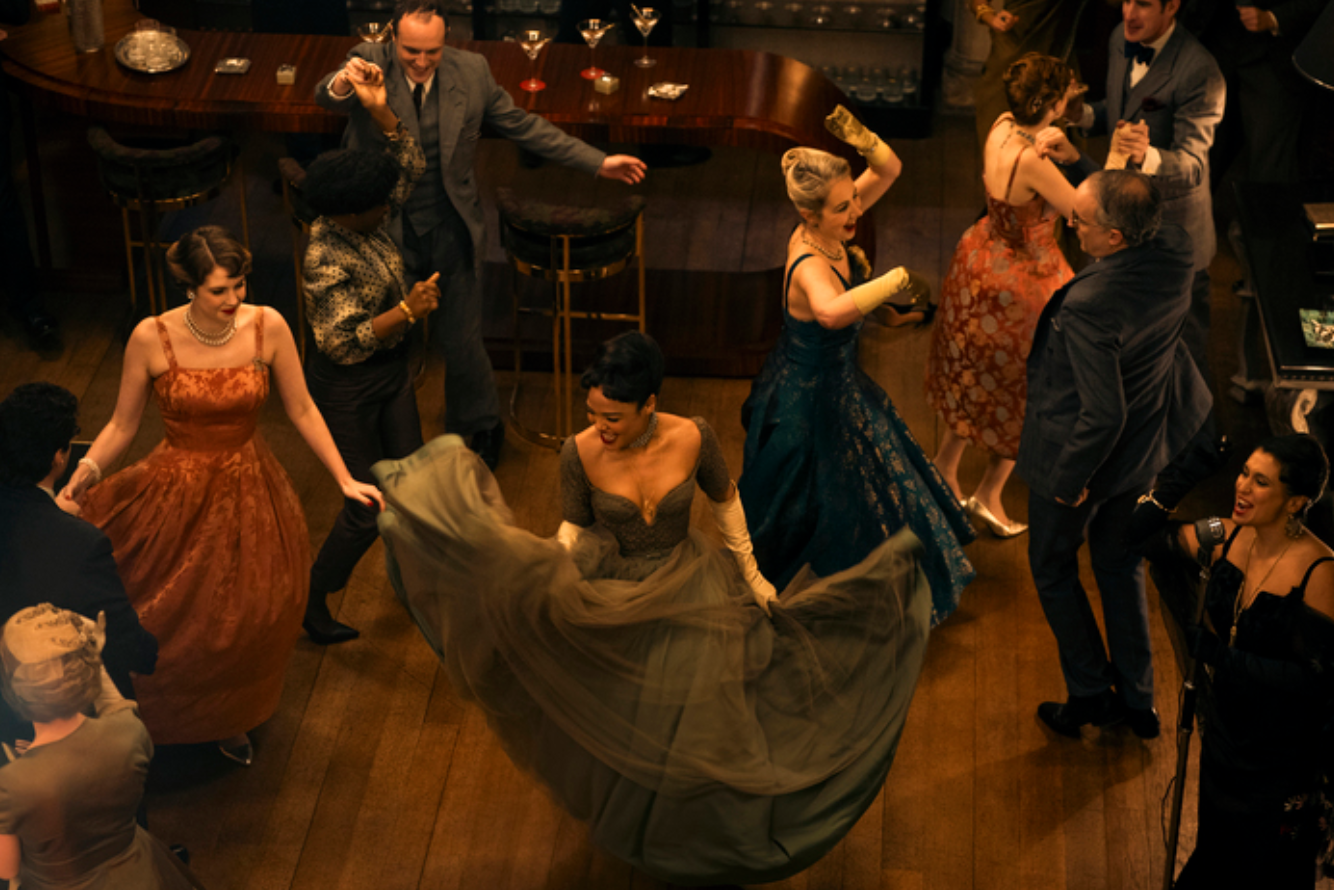
“It’s also a little bit scary because it could be anything when somebody says, ‘I don’t want it to look like anything that’s done before.’ Where do I begin?,” Brower explained. “I initially started with trying to find the right house and then simultaneously trying to figure out who this person was and what is the justification for the production design and building the world around her based on her character. I started reading about all these socialites from that time. And then that’s when it clicked because I was reading about people like Gloria Vanderbilt, Oonagh Guinness, and Lee Radziwill that came from these aristocratic families where tradition was really prioritized and how these women bucked the norms and the trends and really wanted to live in the modern world. So, they created their own world around them.”
Further exploration of Guinness, in particular, led Brower to Guinness’s wildly decorated Irish castle, Ashford Castle. The estate inspired the Hedda production design thanks to its shocking satin purple and hot pink drapes and its rose or green carpets and multi-patterned wallpaper. Like Hedda, Oonagh Guinness hosted wild, week-long parties, so naturally the historic figure seemed a perfect fit for a unique take on Henrik Ibsen’s character.
The portrait that begins the film then stemmed from a similar portrait in Guinness’s bedroom. DaCosta saw it and immediately wanted something similar for her film. Brower then fashioned a version of the portrait on her iPad that illustrated Thompson’s Hedda in sharp angles and hard edges. Something incredibly moody yet incredibly beautiful. When a painter translated that into an actual piece of art, the opening of the film changed, orienting the audience within the world and personality of Thompson’s Hedda.
The biggest challenge presented through the Hedda production design was to find the house that would represent Hedda’s lavish estate. Throughout the film, she hosts a wild party that echoes similar events hosted by Guinness. Yet, about halfway through the film, a Bertie, a housemaid played by Kathryn Hunter, reveals that Hedda and her husband George (Tom Bateman) definitely live above their means. They’ve poured everything they have into decorating this house to realize a lifestyle they logically cannot afford.
This character trait absolutely influenced Brower’s production design.
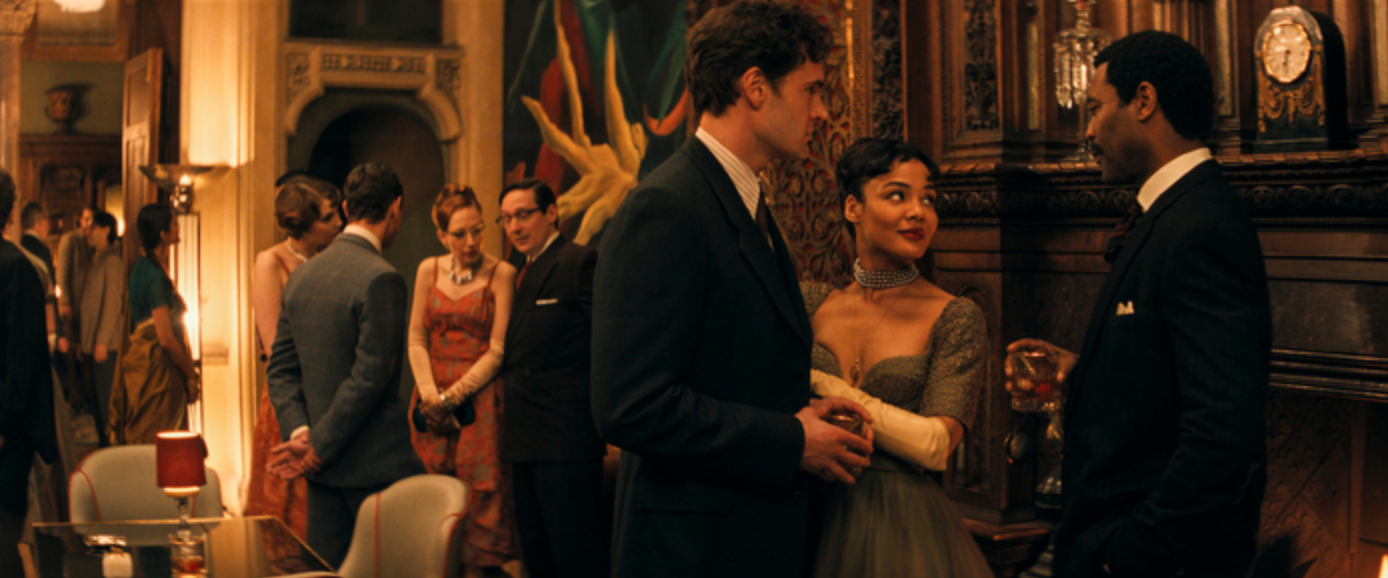
“The whole time I was trying to find the right balance. A country state by nature is very sort of ostentatious, and you need money to live in that sort of house. In my search I was always remembering that this should be something that you would look at and you would desire, but then it shouldn’t be so large that it feels completely not within their means whatsoever,” Brower explained. “I vetted around 200 houses with anchor points from the film that Nia wanted. The house needed to have a lake in the background. She wanted a grand staircase. She wanted a great room with, ideally, a balcony around it. She wanted a period kitchen. She wanted to be able to shoot on the roof. She wanted to be able to drop a chandelier in the house. I picked a few of those — the grand staircase, the great room, the lake — as anchors.”
When Brower finally settled upon a house several hours outside of London, she was able to transform much of it into the vision DaCosta had for the film. She created an overlay in the kitchen to restore it to period trappings. She created a period bathroom from an incomplete room on upper floors of the house. She was able to maintain the slightly crumbling plaster work original to the house to subtly hint at Hedda’s financial troubles.
While the audience may be transported by the wild events of the film, Brower takes great pleasure in knowing that her production design supports not only the narrative but also the character design of Hedda Gabbler. Even though something as simple as color choices for the stunning portrait that kicks off the film.
“I had picked out this color palette based on 40s and 50s trends that were very moody and sort of jewel toned. They’re beautiful jewel tone colors, but they’re moody and almost putrid,” Brower laughed. “I can’t even find another word for it. I thought this is right for the period, and this is right for Hedda because she is a romantic and stunning person. Yet, there’s also something that’s quite unappealing about her. I just thought this feels right.”
Hedda is now streaming on Amazon Prime.



![James Cusati-Moyer On the World Premiere of ‘Sacred Creatures’ at Edinburgh International Film Festival [VIDEO]](https://thecontending.com/wp-content/uploads/2026/08/SC_MicRay_10_Courtesy-Nicolas-Villegas-H-120x86.jpg)