AppleTV’s Chief of War production designer Jean-François Campeau performed extensive research to authentically recreate 18th Century Hawaii.
AppleTV’s Chief of War creates an exciting and engrossing world authentically based in the late 18th century Hawaiian islands. The series visually stands apart from the sea of European-set historical dramas. As such, Chief of War production designer Jean-François Campeau had the opportunity to envision a unique, yet culturally authentic, landscape.
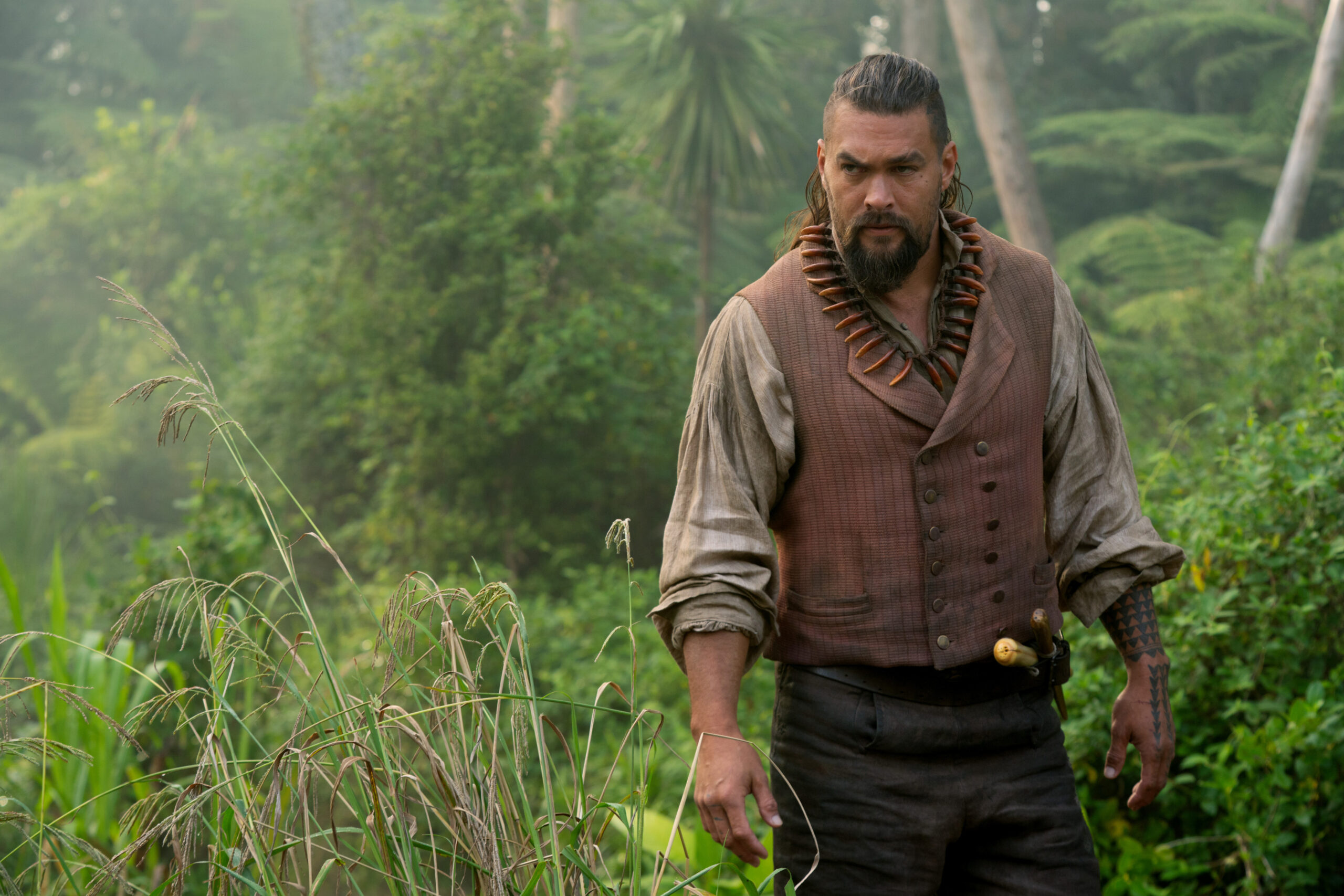
Co-created by and starring Jason Momoa (Game of Thrones), Chief of War orients the viewer in a war raging between the four major kingdoms of the Hawaiian Islands. Momoa’s Ka’iana, the warrior chief of Kaua’i, eventually rebels against the unification of Hawaii under Kamehameha. The series excited critics and viewers alike with its culturally authentic look at a previously unexplored world.
As such, Chief of War production designer Jean-François Campeau needed to imbed himself in extensive research. He needed to accurately portray not only the Hawaiian huts of the period but also find period-authentic representation of port cities. Campeau also needed to make accommodations in his Hawaiian-based structures that would align with the natural lighting concept of the cinematography. He also needed to construct buildings that would eventually burn down based on story requirements.
Here, in an interview with The Contending, Chief of War production designer Jean-François Campeau reveals how he accomplished all of this and much more for AppleTV.
The Contending: This period of Hawaiian history isn’t as frequently realized as more European-centric locales. What kind of research did you undertake to authentically recreate this world?
Jean-François Campeau: Yeah, exactly. As you see, we had the feeling that we were doing something that hadn’t been done before. Usually, you get to do a Victorian era, for example, and at some point you try to always take apart what we’re used to seeing about a certain era. To strip it down. This time was totally different. We felt like it was the first time we could actually represent Hawaiian culture in a big, universal, spectacular way. It was special.
With the research, there are fewer visual archives, obviously. Most of them are from the European engravings, so we wanted to go from the inside. There are good resources like the Bishop Museum in Honolulu, of course, and we had a lot of cultural advisors on the production, but it was a totally different process. The research was a bit more challenging, but also more exciting than just grabbing pre-existing stuff.
The Contending: Absolutely. That sense of discovery, that sense of engaging in something new, and it’s visually unlike anything else that’s out there right now. So that must have been incredibly rewarding for you.
Jean-François Campeau: It was great. Also, it’s not a documentary at the same time, so we wanted to keep it universal, entertaining. W also wanted to be culturally as authentic as we can. In this case, what really inspired me was that I had to deep-dive, obviously, in Hawaiian culture, which I wasn’t that familiar with.
What really struck me was the real contrast between the mana and the kapu. The mana is kind of the godly energy that’s within everything, which is really typical of a polytheist religion. That was the Hawaiian one. The kapu is the rules that the men would implement on society, so it’s basically the man-made structures. So it became a really nice motivation to visualize the contrast between the poetic relationship to nature and how God’s in everything.
There’s something very almost esoteric in that culture that’s very relevant today. So that counterpoint, we always tried to express it visually as much as we can, such as shooting in nature and building those structures.
The Contending: Now that you mention that, much of the series does take place in the natural world. Tell me about the location scouting process.
Jean-François Campeau: Yeah, that was a huge part of it. Scouting is also more like research concept than scouting. In this case, when I got to Hawaii, we weren’t sure. We thought we could maybe do the whole thing in Hawaii. But then we understood that we also had to film in New Zealand, which made a lot of sense just even culturally being in a Polynesian triangle.
So, the scouting was even more crucial than usual. It was a big, big part of the process because we wanted to approach it in a very naturalistic way, which meant relying on VFX as less as possible and building sets on location. That made the whole location scouting process a bit more complex than usual.
The Contending: There are multiple kingdoms represented in the series. How does the architecture represent each kingdom?
Jean-François Campeau: The challenge was to create identities for the islands, as you just said. I think the choice was made to make one big set that would kind of become the geopolitical landmark of that island. For example, when King Kahekili invades O’ahu, it’s the bone temple he ends up building. We have Kahu in Hawaii, the big island, which is the geopolitical center of the whole islands when the king dies. The spectator hut we don’t see much, but at the beginning, when you first meet Kahekili, which is the really first very powerful person, we camped him in the spectator hut. Honestly, historically, that was just basically a hut they would use to watch his warriors train. For us, it became a landmark of how powerful he was. How big a civilization this was. We basically used physical sets in each of the kingdoms and of course landscapes.
The Contending: As you look at the series and navigate inside these authentic buildings, we realize that the cinematography is based in a lot of natural lighting. Did that impact your designs?
Jean-François Campeau: Yeah, for sure. Honestly, that was the part that was the most, I would say, familiar to me because it’s almost like doing any period show that’s pre-Victorian. You film where the windows are to achieve natural light. I think it’s the best approach. We really played with also the shape of the roofs. Huts could, visually, get boring. When you look at the hut, it’s just basically nothing attaching. So, making it structurally interesting was one of our best ways to give it style and bring light into the interiors. Then, you also get shadow from the structure and the openings. Lighting was a whole discussion for sure.
The Contending: The series also features a city that is more European in its construction. Talk to me about building the city of Zamboanga.
Jean-François Campeau: So that’s the Philippines basically. As Ka’iana’s going on his two or three year tour, this one, story-wise, was really a counterpoint to Hawaii. He sees what’s coming to them. We practically addressed it exactly like that, a counterpoint. All of our Hawaiian sets were built as much as possible in natural context, one, for example, 20 feet off the cliffs right by the Pacific Ocean.
Zamboanga was more like a backlot, a combination of backlot build and stage sets. We wanted to create a really claustrophobic feeling exactly the opposite of the Hawaiian sets. We had a lot of stagnant water, for example, there. That contrasts with the Hawaiian sets which were close to the waves and the blue ocean.
The Contending: So you have to also design the set to be burned because, at the end of episode four, Jason Momoa’s character goes to the slave pens and burns them down just to help the other character escape. Tell me about burning your set down.
Jean-François Campeau: There’s two ways to do it. In Zamboanga, you basically make the set non-flammable with materials that look like wood. The actual fire was very controlled so we could basically turn it on and off at will. The inside warehouse where we put the fire was actually on stage. So that was a really quick beat and then the effects took over.
The food hut you see burning in episode five, that was totally different approach. I basically built the two ends of it. Those were touching naturally the way it should be done. For the center, we just build a more generic wood frame that didn’t have all the care it needed, but then we actually set the thing on fire basically at night. They enhanced it a little bit, but that’s why it looks really good and realistic. We just actually set it on fire and then put it out. Of course, the aftermath’s a whole other thing because you just burn something down, and it doesn’t always look like you want it to the next day.
The Contending: Last question for you: what was the most challenging aspect of the series to design?
Jean-François Campeau: I think the temple was the biggest challenge being on that cliff, more for a technical reason. I’d say, conceptually, the biggest challenge was to realize how big Hawaiian civilization was while staying in a very naturalistic approach. Not using too much VFX. Practically, I think that set on the cliff was because we were really close to the edge. When you looked at it from the sea, it looked like it could be a landslide any day. So everyone’s like, oh, this is crazy, but we had geological engineers really spec the land. They told us, yes, it looks bad, but once you go down four feet, you hit a rock. It’s stable. So we had to put six foot stakes, maybe around 145, down and then we could build our platform there and everyone felt safe.
But it was so close to the cliff we didn’t even finish the ocean side of it. We finished all the stone work around, but this one we left to VFX because they had drone shots. Just for the safety of the crews, we relied on VFX because you don’t want people working 20 feet off the cliff, obviously. So yeah, I would say this set was maybe one of the biggest challenges and most exciting ones for sure.
Chief of War concludes its first season tomorrow on AppleTV+.


![James Cusati-Moyer On the World Premiere of ‘Sacred Creatures’ at Edinburgh International Film Festival [VIDEO]](https://thecontending.com/wp-content/uploads/2026/08/SC_MicRay_10_Courtesy-Nicolas-Villegas-H-120x86.jpg)